Most advertisers treat prospecting and retargeting as separate budget buckets. Prospecting “finds” new customers. Retargeting “closes” them. The split often becomes a fixed ratio — 70/30, 60/40, or whatever someone once recommended.
In practice, budget allocation between prospecting and retargeting is not about ratios. It is about signal flow, audience saturation, and conversion velocity. If you misread those mechanics, you either starve growth or overspend on recycled demand.
Let’s break down how the system actually works and how to allocate budget with structural logic.
The Functional Difference Between Prospecting and Retargeting
Prospecting campaigns operate at the top of the acquisition engine. They introduce your offer to cold audiences and generate new qualified traffic. Their primary role is signal generation.
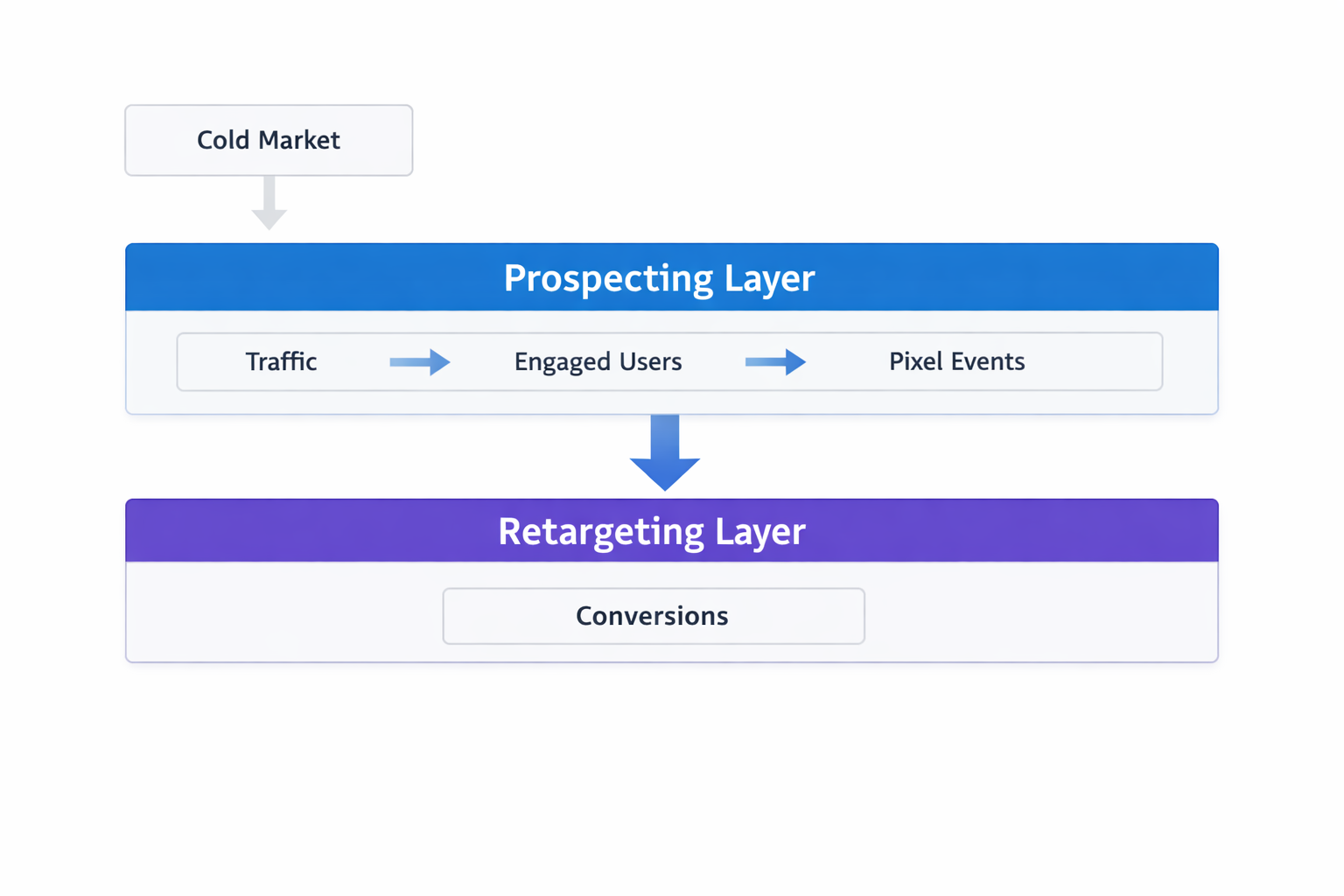
Retargeting campaigns operate downstream. They re-engage users who already interacted with your brand — website visitors, video viewers, engaged users, add-to-cart events, CRM uploads, and other Custom Audience pools.
If you need a structured breakdown of how warm, cold, and custom audiences interact inside a funnel, review The Complete Guide to Warm, Cold, and Custom Audiences in Meta Ads.
The distinction matters because:
-
Prospecting determines how much new demand enters the system.
-
Retargeting determines how efficiently existing demand converts.
-
Prospecting performance compounds through learning stability and broader modeling.
-
Retargeting performance is constrained by pool size and frequency tolerance.
Understanding how these audiences are built — especially Custom Audiences from engagement, website activity, and CRM data — is foundational. If you need a deeper technical breakdown, see Facebook Custom Audiences Guide: Everything You Need to Know.
Why Fixed Budget Ratios Often Fail
You will often hear rules such as:
-
70% prospecting, 30% retargeting.
-
80/20 for scaling.
-
50/50 for aggressive conversion capture.
These ratios ignore audience size dynamics and event volume capacity.
Retargeting audiences are finite. If your website generates 10,000 visitors per month, there is a maximum amount of spend that pool can absorb before frequency spikes and performance deteriorates.
When advertisers force a fixed percentage split, two structural problems appear:
-
Retargeting saturation.
If budget exceeds audience capacity, frequency rises rapidly. CPM increases. CPA inflates. Incremental conversions flatten because you are repeatedly reaching the same users. -
Prospecting underinvestment.
If you shift budget into retargeting because it shows a lower CPA in the short term, you reduce demand inflow. Traffic declines gradually, and conversion volume eventually plateaus.
Budget strategy must adapt to audience capacity and demand flow — not arbitrary ratios.
The Core Mechanism: Audience Size × Conversion Window × Frequency
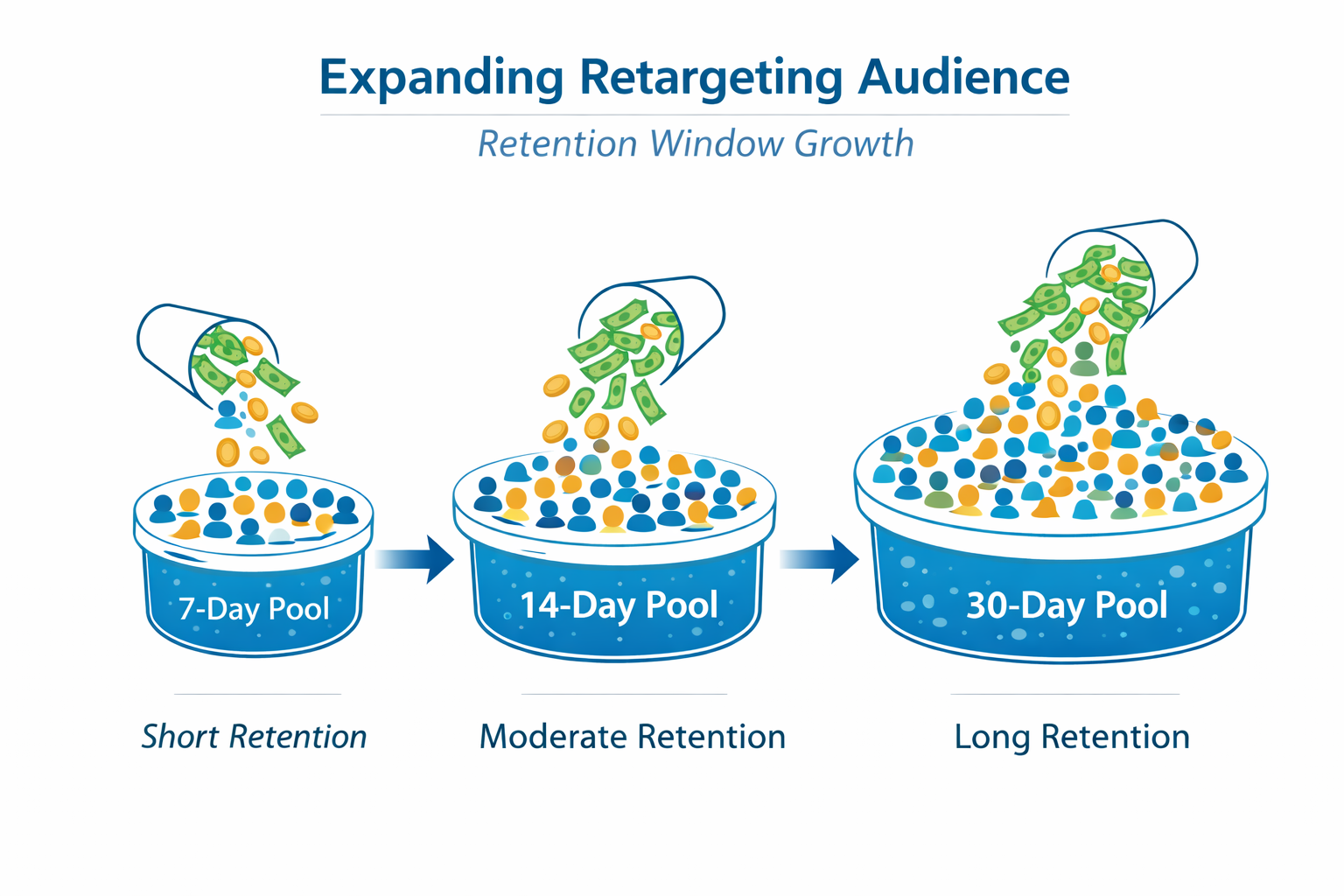
Retargeting capacity is formed by three structural variables.
-
Audience size — How many users enter the pool daily or weekly.
-
Retention window — Whether you include them for 7, 14, or 30 days.
-
Frequency tolerance — How often they can see ads before diminishing returns begin.
For example, if you generate 500 add-to-cart events per week and use a 14-day window, your pool may contain roughly 1,000–1,500 users at any given time. That audience cannot absorb unlimited budget without performance decay.
As spend increases beyond structural capacity:
-
Frequency climbs above 3–5.
-
CPA increases without proportional conversion growth.
-
Delivery becomes unstable.
To build stronger retargeting pools and improve downstream performance, advanced audience construction matters. Techniques such as segmentation by engagement depth or buyer profile can materially change results. See Targeting Niche Buyer Profiles with Custom Facebook Audiences for deeper implementation examples.
Prospecting Feeds Retargeting — Not the Other Way Around
Retargeting depends entirely on prospecting inflow. If you reduce prospecting to protect short-term ROAS, your retargeting pool will shrink over time.
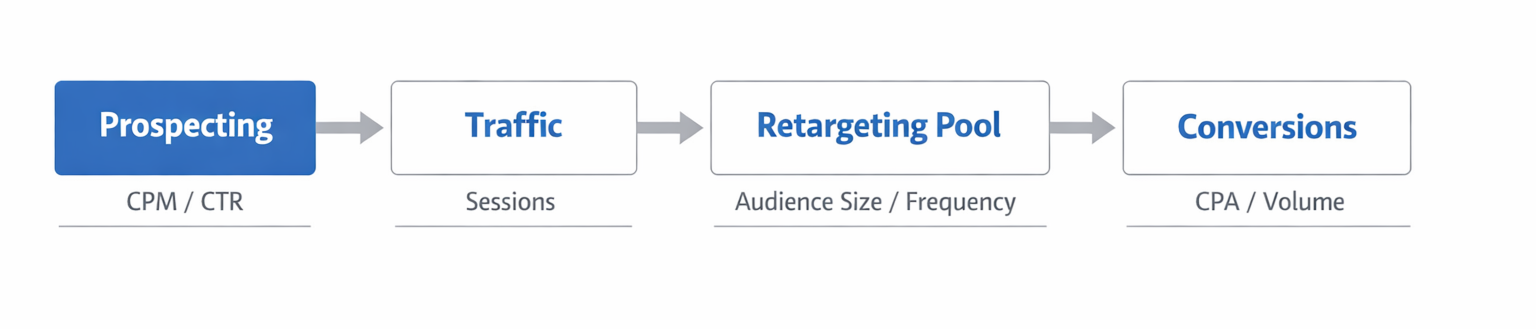
This creates a common performance illusion:
-
You increase retargeting budget.
-
Short-term CPA improves.
-
Prospecting traffic declines.
-
Retargeting audience shrinks.
-
Total conversions drop weeks later.
The structural role of prospecting is expansion. That expansion is often powered by Lookalike Audiences and broad targeting strategies. If you're scaling beyond small pools, revisit How to Build Lookalike Audiences that Actually Convert.
Prospecting should continuously introduce new qualified users into the system. Retargeting then improves yield per visitor.
When Prospecting Should Dominate Budget
Prospecting deserves the majority of budget when:
-
Retargeting frequency consistently exceeds 3 and conversion growth stalls.
-
Retargeting CPA rises while audience size remains stable.
-
Website traffic growth has slowed.
-
You are expanding into new markets or offers.
In these scenarios, the constraint is demand generation, not conversion efficiency.
For most scaling accounts, prospecting often represents 70–85% of total spend — not because of a rule, but because it is structurally scalable.
When Retargeting Deserves More Budget
Retargeting expansion makes sense when:
-
Prospecting traffic is strong but on-site conversion rate is weak.
-
Add-to-cart volume is high but purchase rate is low.
-
You are running short promotional cycles.
-
You observe high cart abandonment.
In these cases, the constraint is yield, not inflow.
Retargeting allows you to:
-
Reinforce value propositions.
-
Address objections.
-
Introduce urgency.
-
Increase conversion probability per visitor.
However, segmentation must be disciplined. Over-fragmenting small retargeting pools reduces signal density and increases CPM. For structural segmentation principles, see Maximizing ROI through Facebook Audience Segmentation.
The Strategic Shift: Think in Flow, Not Buckets
Prospecting controls inflow.
Retargeting controls yield.
Budget allocation should reflect:
-
Audience saturation.
-
Conversion bottlenecks.
-
Signal stability.
-
Long-term demand flow.
Instead of asking, “What percentage should I allocate?” ask:
“Where is the structural constraint in my acquisition system right now?”
That shift moves budget allocation from convention to mechanics — and that is where sustainable scaling begins.