Scaling ad spend sounds straightforward. If a campaign is profitable at $1,000 per day, increasing it to $5,000 should multiply results.
In practice, that assumption frequently fails. You raise the budget, CPA increases, performance becomes volatile, and efficiency declines. If you manage performance accounts regularly, you’ve likely seen this pattern repeat.
The issue is not that higher budgets are harmful. The issue is how budget expansion interacts with auction mechanics, audience saturation, signal density, and structural readiness. If those variables are not aligned, scaling exposes weaknesses quickly.
Before you increase spend, it helps to understand how your audience architecture is built. If you need a structural refresher, review The Ultimate Guide to Facebook Audience Targeting and Why Custom Audiences Should Be the Core of Your Ad Strategy. Scaling only works when the foundation is strong.
Let’s examine why budget increases often hurt performance and how to approach scaling more intelligently.
The Auction Expands Before It Improves
When you increase budget, the system must find additional inventory to spend it.
At lower budgets, delivery concentrates on higher-probability segments within your target audience. The algorithm can afford to be selective. Once budget rises, it must:
-
Enter more auctions, including those with lower predicted conversion probability. These impressions were previously deprioritized because the system could hit your budget without them.
-
Compete for broader inventory pools, where user intent may be weaker and bid pressure more volatile.
-
Allocate impressions into marginal audience segments that historically produced fewer conversion signals.
This expansion reduces average conversion likelihood. As a result, CPA increases even though targeting and creative remain unchanged.
If performance declines immediately after a large budget increase, it is usually not a creative issue. The auction mix has shifted.
Operational guidance: Increase budget in controlled increments. Smaller adjustments allow the algorithm to expand selectively and recalibrate bidding behavior instead of forcing abrupt distribution into weaker inventory.
Audience Saturation Accelerates Under Higher Spend
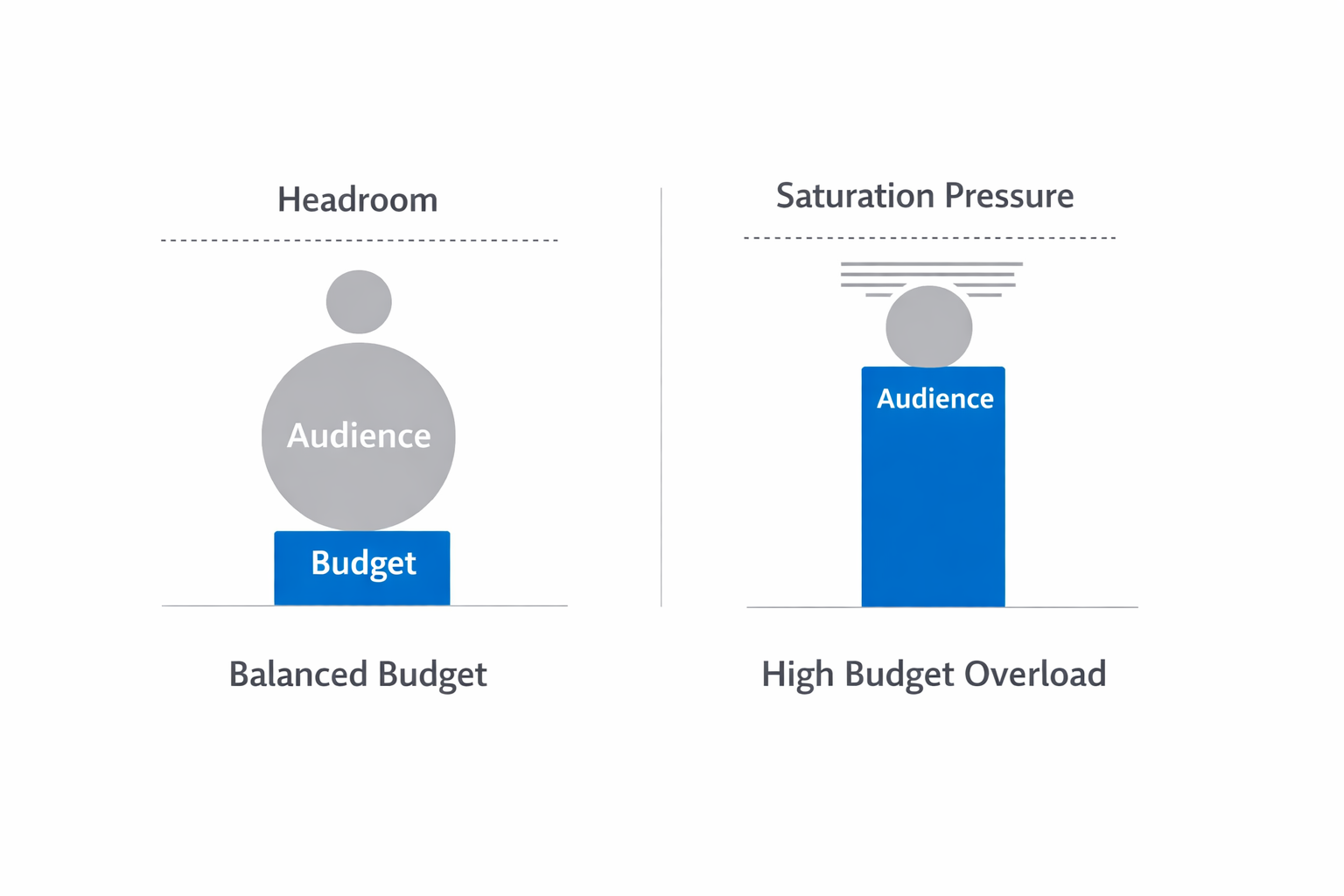
Budget increases drive frequency upward. If your audience size remains constant, higher spend means more impressions per user.
That leads to predictable degradation:
-
CTR declines as exposure increases and novelty fades. The same users see the same ads repeatedly, reducing engagement probability.
-
CPM rises because lower engagement reduces perceived ad quality in the auction.
-
Conversion rates weaken as marginal impressions reach less responsive users within the audience pool.
This pattern is especially common in retargeting and narrow prospecting segments built from engagement or CRM data. If you are heavily relying on website visitors or small email uploads, revisit your strategy in Facebook Custom Audiences Guide: Everything You Need to Know.
You may assume creative fatigue is the primary issue. Often, the audience simply absorbed too much exposure too quickly.
Diagnostic checkpoints:
-
Monitor frequency trends over a 7–14 day window after scaling, rather than reacting to single-day spikes.
-
Compare CTR movement relative to frequency increases to confirm saturation rather than creative failure.
-
Evaluate audience size against daily spend capacity to determine whether headroom actually exists.
As a practical rule, aggressive spending into audiences under 200,000 users increases saturation risk substantially. Budget growth without audience expansion creates compression.
If you want to scale sustainably, reach must scale alongside spend. That often means incorporating lookalikes or broader seed strategies, as explained in Lookalike Audiences: How to Seed, Train, and Scale.
Learning Instability Increases Performance Volatility
Meta’s optimization system depends on stable event density.
When you raise budget significantly, you often trigger:
-
Re-entry into learning due to pacing and bid changes that alter delivery patterns.
-
Redistribution across audience clusters, which temporarily disrupts historical performance baselines.
-
Higher short-term variance in CPA and ROAS while the system recalibrates.
Even if the campaign exits learning quickly, volatility tends to persist while the algorithm searches for a new equilibrium.
This is especially visible when scaling conversion campaigns tied to narrow custom segments. If your structure relies on tightly layered targeting, review whether that layering is limiting flexibility in How to Layer Detailed Targeting for Hyper-Specific Facebook Audiences.
Safer scaling pattern:
-
Increase budget by 15–30 percent at a time, rather than doubling overnight, to preserve delivery stability.
-
Allow 48–72 hours for performance to normalize before making additional changes.
-
Evaluate both CPA and conversion volume, focusing on trend direction rather than reacting to isolated performance dips.
Stability compounds efficiency. Sudden expansion disrupts it.
Marginal Costs Rise as Spend Increases
Cost curves in ad auctions are not linear.
The system captures the highest-probability conversions first. As budget increases, you move into progressively more expensive marginal conversions. A typical progression may look like this:
-
At $1,000 per day, CPA averages $40 because delivery concentrates on high-intent users.
-
At $3,000 per day, CPA increases to $47 as the auction pool expands into lower-probability segments.
-
At $6,000 per day, CPA rises to $58 due to diminishing marginal conversion likelihood.
This does not indicate campaign failure. It reflects competitive auction mechanics.
The strategic question is not whether CPA increases. It is whether incremental CPA remains profitable relative to contribution margin.
If you do not evaluate incremental profitability at higher spend levels, you risk scaling into negative unit economics. Segmentation and audience prioritization, discussed in Maximizing ROI through Facebook Audience Segmentation, become critical at this stage.
Budget Scaling Exposes Structural Weaknesses
Lower budgets can conceal inefficiencies. Higher budgets amplify them.
Several structural issues commonly surface during scale.
1. Fragmented Ad Set Architecture
When campaigns contain too many small ad sets, higher budget distributes unevenly. Some ad sets absorb additional spend without sufficient conversion volume, weakening signal density and optimization quality.
Consolidating ad sets concentrates events, strengthens modeling, and improves delivery stability. If you are unsure whether custom or lookalike structures should dominate at scale, review Custom vs Lookalike Audiences: What Works Best for Facebook Campaigns?.
2. Insufficient Creative Depth
Scaling increases impression volume significantly. If you rely on only one or two strong creatives:
-
Frequency accelerates fatigue and shortens performance lifespan.
-
CTR declines faster under higher delivery pressure.
-
CPA rises disproportionately as engagement weakens.
A structured testing pipeline and broader audience seeding, such as CRM uploads covered in How to Turn CRM and Email Lists into High-Quality Facebook Audiences, can provide more stable scale inputs.
3. Narrow Audience Strategy
If prospecting relies heavily on tight interest stacks or small engagement pools, scaling forces the system into low-quality expansions. Broader, signal-driven targeting structures typically scale more predictably.
For more advanced expansion strategies, see How to Build Lookalike Audiences that Actually Convert and Smarter Audience Building: Beyond Meta’s Built-In Targeting Tools.
Budget does not repair structural flaws. It magnifies them.
Retargeting Cannot Scale Independently
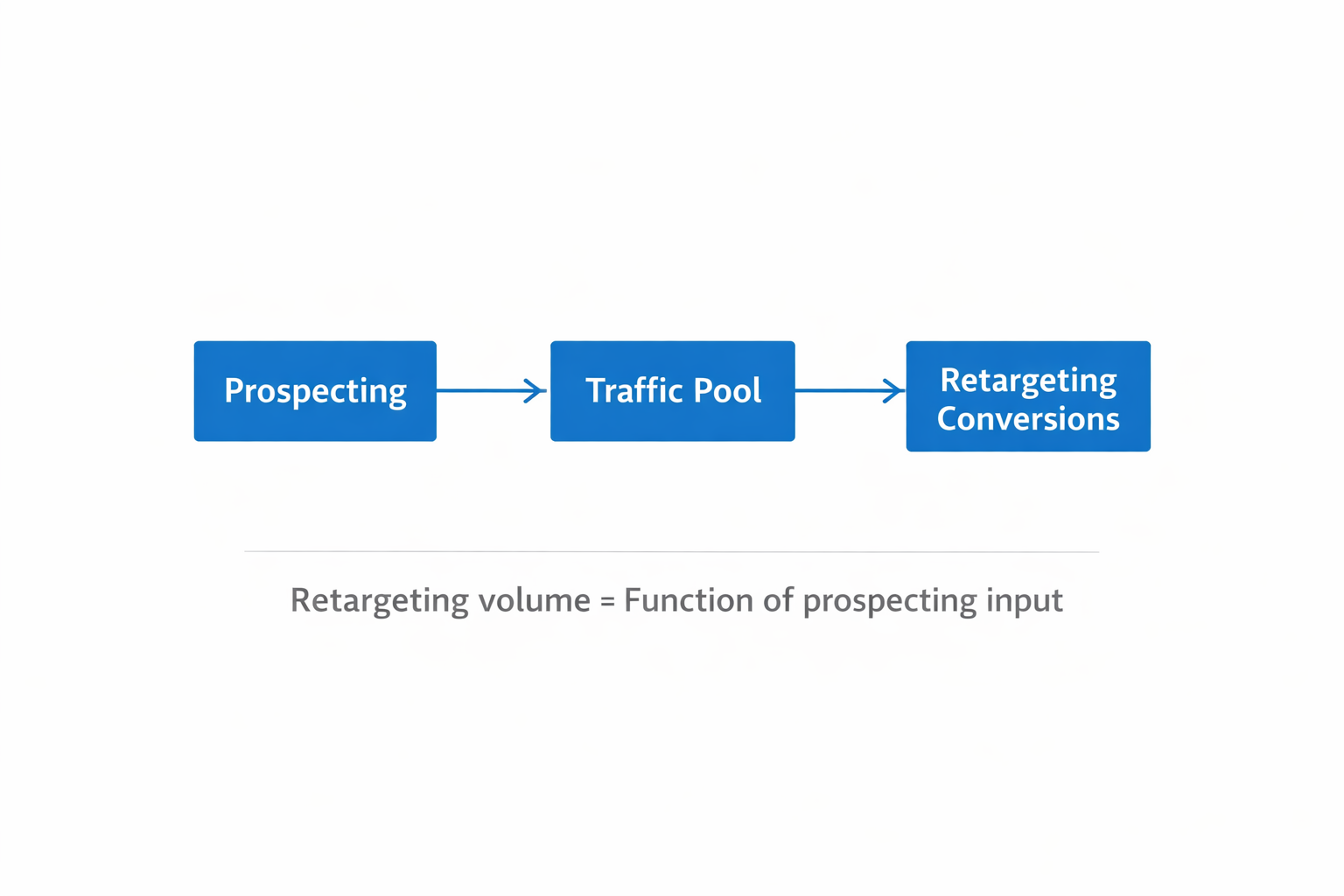
One of the most common scaling mistakes is increasing retargeting budget without increasing prospecting input. Retargeting conversion volume is constrained by upstream traffic and engagement.
If you push more budget into a fixed retargeting pool:
-
Frequency increases sharply because the same users are served more impressions.
-
Conversion volume plateaus since audience size remains unchanged.
-
CPA rises due to audience exhaustion and declining marginal returns.
Retargeting is downstream infrastructure. Its capacity is determined by prospecting flow.
If you want more retargeting conversions, you must first increase qualified top-of-funnel traffic. Structuring warm, cold, and custom layers correctly is explained in The Complete Guide to Warm, Cold, and Custom Audiences in Meta Ads.
A Controlled Framework for Budget Increases
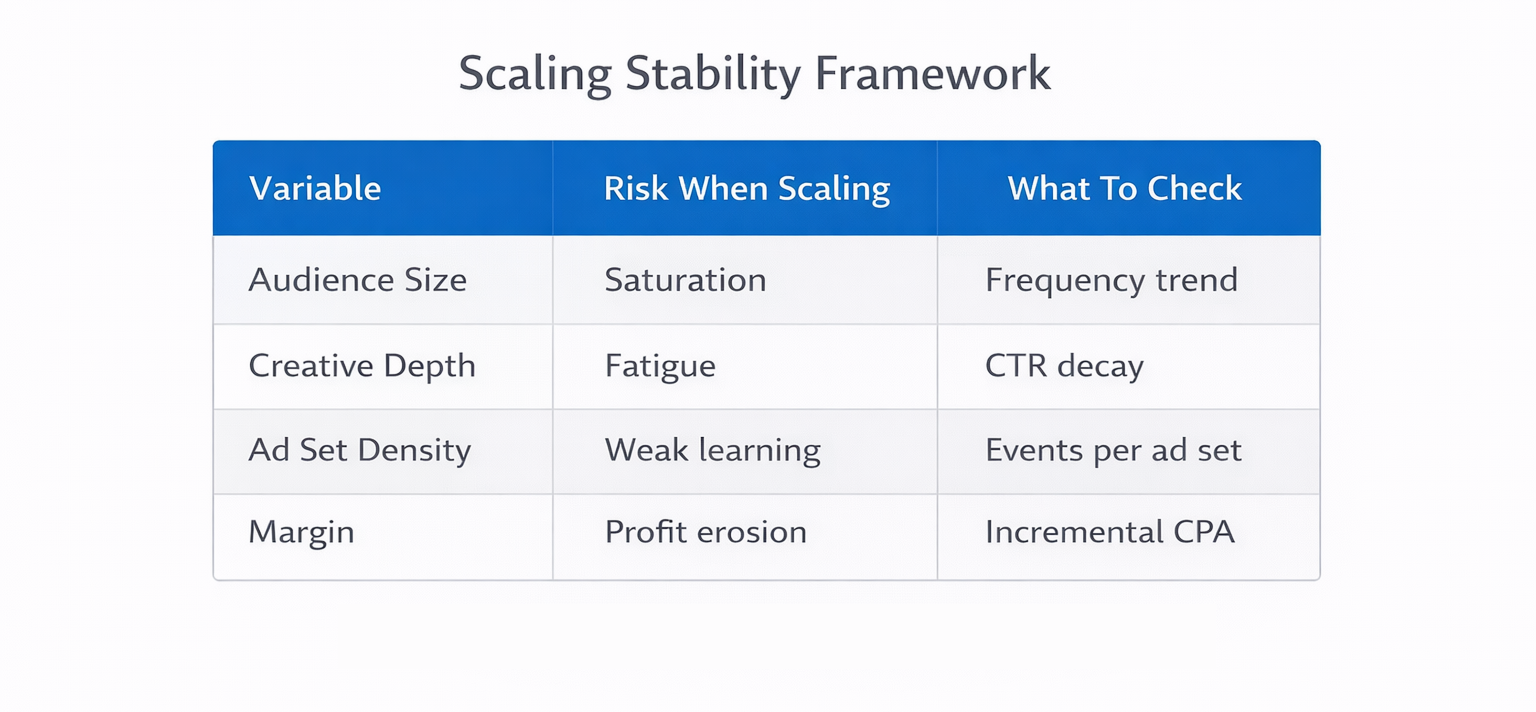
Before scaling, assess structural readiness.
-
Does audience size provide sufficient headroom relative to daily spend?
-
Is creative rotation strong enough to support higher frequency without rapid fatigue?
-
Are ad sets consolidated enough to maintain conversion density per optimization unit?
-
Does incremental CPA remain within acceptable margin thresholds?
When scaling, follow a deliberate sequence:
-
Expand audience breadth where structurally justified, ensuring additional reach exists before increasing spend.
-
Strengthen creative diversity to reduce fatigue risk under higher impression volume.
-
Consolidate fragmented ad sets to increase conversion density and signal clarity.
-
Increase budget gradually, monitoring stability rather than reacting to short-term variance.
-
Evaluate incremental efficiency instead of relying solely on blended account averages.
Each step protects performance integrity while allowing growth.
Final Perspective
Increasing Facebook ad budget does not inherently damage performance. It changes auction exposure, marginal cost structure, audience pressure, and signal distribution.
If budget is treated as a blunt growth lever, performance deteriorates. If it is treated as a controlled variable within a structured system — audience capacity, creative depth, signal concentration, and margin thresholds — scaling becomes predictable.
The practical shift is simple. Do not ask how much more you can spend. Ask how much your audience system can absorb without compromising efficiency.