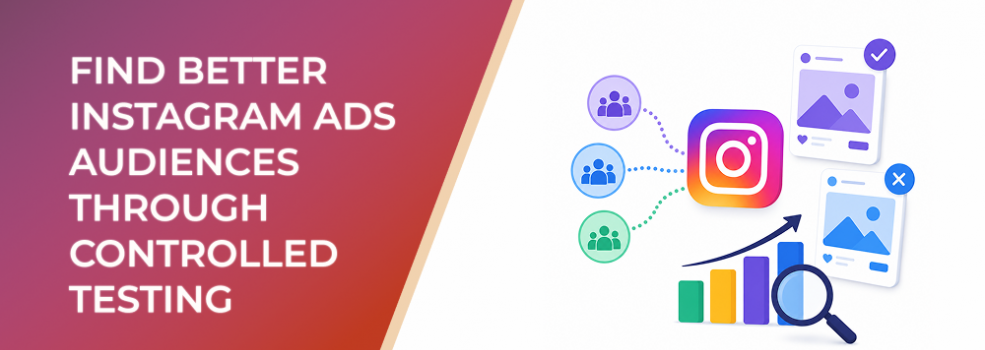
Finding better Instagram ads audiences is one of the hardest parts of paid social growth.
The problem is not a lack of targeting options. The problem is knowing which audience signals actually lead to better customers, lower CAC, stronger ROAS, higher lead quality, and more stable scaling.
Many advertisers try to solve this by changing interests, expanding age ranges, narrowing demographics, testing lookalikes, or letting the platform optimize with broader inputs.
Some of those moves can help. But without controlled testing, audience discovery becomes guesswork.
Better audiences are found through structured comparison, not random changes.
The Problem
The problem is that advertisers often search for better Instagram audiences without a controlled testing process.
They test one audience this week, another audience next week, change the creative, adjust the CTA, revise the offer, switch the objective, and then compare results as if the audience was the only difference.
That makes the learning unreliable.
A campaign may improve, but the team cannot explain why. A campaign may weaken, but the team may blame the wrong variable.
The advertiser keeps spending, but the account does not build a clearer picture of which audience sources produce qualified buyers, leads, subscribers, appointments, or revenue.
Why This Problem Hurts Performance
Uncontrolled audience discovery hurts performance because it turns budget into noise.
Every campaign spend should produce either a result or a lesson. Ideally, it produces both.
When audience testing is uncontrolled, the lesson is weak. The team may keep testing new audiences without understanding what made the last test work or fail.
This affects CPA, CAC, ROAS, conversion rate, and lead quality. It also makes scaling risky. If the advertiser does not know which audience source created the strongest customer quality, increasing spend may simply expand delivery into weaker users.
For agencies, uncontrolled testing weakens client communication. “We are testing audiences” is not enough. Clients need to know what each test is proving.
For SMBs and startups, uncontrolled testing can drain limited budget before a repeatable acquisition path is found.
Common Scenarios Where This Happens
A startup tests broad Instagram interests, creator followers, lookalikes, and retargeting audiences across different weeks, but each test uses different creatives and offers. The team cannot isolate audience quality.
An ecommerce brand assumes competitor followers will perform better, but tests them with a discount-heavy ad while the broad audience gets a product-education ad. The comparison is unfair.
A B2B team tests job-title-like interest signals against professional communities, but does not track sales-qualified lead rate. The campaign with cheaper leads looks better until sales reviews the pipeline.
An agency launches several audience ideas for a client but lacks a naming convention. A month later, nobody remembers which audience was built from which source.
An affiliate marketer keeps switching audiences based on CPC, then realizes the lowest-click-cost audience produces the weakest revenue.
Why the Problem Happens
This problem happens because audience discovery is often treated as a targeting task instead of a learning system.
Advertisers open Ads Manager, choose available targeting options, launch, and react to the numbers. That process may produce performance movement, but it does not necessarily produce durable learning.
Another cause is overvaluing early engagement. Instagram can generate likes, views, and clicks from people who enjoy content but are not buyers.
The third cause is not separating source signals. Broad interests, competitor followers, niche communities, warm engagers, professional data, and customer lists all represent different hypotheses. If they are blended together, the advertiser cannot identify which source is responsible for results.
The fourth cause is weak downstream feedback. Without CRM, sales, ecommerce, or booking-quality data, the advertiser may mistake cheap actions for valuable customers.
The Solution
The solution is to build a controlled audience discovery workflow.
This workflow helps you find better Instagram audiences by testing one audience hypothesis at a time, measuring the right outcomes, and using each result to decide the next test.
Step 1: Define the ideal customer
Start with customer fit, not targeting options.
Define who you want to reach:
- What problem do they have?
- What stage of awareness are they in?
- What accounts, creators, groups, or communities do they follow?
- What professional roles or industries matter?
- What buying signals suggest stronger intent?
- What users should be excluded?
A better audience starts with a better customer hypothesis.
Step 2: Build an audience source map
Create a list of possible audience sources.
For Instagram campaigns, this may include:
- Broad baseline audience
- Meta interest-based audiences
- Instagram profile followers
- Instagram engagers
- Competitor profile followers
- Niche creator audiences
- Relevant Facebook group members
- Website visitors
- Customer lists
- Lookalikes
- LinkedIn-derived professional segments
- Custom social-profile sources
Each source should map to a specific reason someone may care about the offer.
Step 3: Turn each source into a testable hypothesis
Do not launch audiences because they sound interesting.
Write a hypothesis.
For example:
“Followers of niche creator accounts will produce higher purchase intent than broad category interests.”
“LinkedIn-derived operations professionals will produce better qualified demo requests than general business audiences.”
“Facebook group-based audiences will produce more relevant local inquiries than radius-only targeting.”
A hypothesis turns audience discovery into structured learning.
Step 4: Control the campaign variables
If the test is about audience quality, keep the creative, offer, CTA, objective, destination, and budget structure consistent.
Changing everything at once makes the result hard to interpret.
A controlled test does not need to be complicated. It needs to be readable.
Step 5: Score audiences by business outcome
Create a simple scoring system.
For lead generation, score audiences by:
- CPL
- Qualified lead rate
- Booked call rate
- Sales acceptance
- Pipeline value
- Cost per qualified opportunity
For ecommerce, score by:
- Purchase CPA
- ROAS
- Add-to-cart quality
- AOV
- Repeat purchase potential
- Refund or return quality where relevant
For local services, score by:
- Message quality
- Appointment rate
- Service-area fit
- Quote request quality
- Close rate
The better audience is the one that improves business quality, not just the one that improves ad-platform activity.
Step 6: Use results to choose the next test
Controlled audience discovery should compound.
If competitor followers outperform broad interests, test different competitor categories.
If niche creators produce strong engagement but weak purchases, test a stronger offer or a more product-aware source.
If professional segments produce fewer leads but better sales acceptance, test more specific job-role or industry segments.
Each test should make the next test smarter.
How LeadEnforce Helps
LeadEnforce helps advertisers turn audience discovery into a more controlled process.
Instead of relying only on broad interests or platform-defined categories, advertisers can use LeadEnforce to build audiences from Instagram profile followers, Instagram engagers, Facebook groups, LinkedIn-derived professional data, and custom social-profile inputs. That makes it easier to test specific audience-source hypotheses instead of guessing which broad category might work.
For example, an ecommerce brand can test followers of niche product profiles against broad interest audiences. A B2B team can test professional-fit audiences against general business audiences. An agency can build separate source-based audiences for each client hypothesis and document performance over time.
LeadEnforce is most useful when the advertiser already has a clear ICP and wants better ways to source, label, and compare audience inputs.
It does not guarantee performance. It helps make the audience discovery process more precise and easier to learn from.
Risks and Considerations
Controlled testing does not remove every risk.
Some audiences may be relevant but too small to scale. Some may show strong engagement but weak conversion quality. Some may require segment-specific creative after the first test.
Audience overlap can also distort results. If multiple segments contain many of the same users, the comparison becomes less clear.
Do not ignore other constraints. Weak creative, poor offer-market fit, slow landing pages, unclear CTAs, low-quality conversion signals, or sales follow-up issues can all make a good audience look weak.
Compliance and platform policies should be considered before building or activating any audience strategy.
Prerequisites and Dependencies
You need a defined ICP and a clear campaign objective.
You need source logic. Do not choose Instagram profiles, Facebook groups, or professional segments only because they are large. Choose them because they connect to customer intent.
You need enough budget to test each audience fairly. You need a stable creative and offer. You need reliable tracking or downstream review.
For lead-generation campaigns, coordinate with sales before testing. Decide what counts as a qualified lead and how feedback will be captured.
If LeadEnforce is part of the workflow, prepare source lists before launch and use naming conventions that make each audience easy to identify later.
Practical Recommendations
Start with a small audience discovery roadmap.
Choose one broad baseline and two source-based audience hypotheses. Run the same ad experience across each segment. Review platform metrics and business-quality metrics together.
After the first test, do not simply scale the cheapest audience. Ask what the result proved.
If one source produces better leads, test adjacent sources. If one source produces cheap clicks but weak customers, either change the offer alignment or remove it from the next round.
Keep an audience learning log. Record the source, hypothesis, audience size, creative, offer, budget, result, quality feedback, and next action.
Use LeadEnforce when your current audience discovery process depends too heavily on generic interests, broad assumptions, or hard-to-compare audience groups. It fits naturally at the audience-building stage, before controlled testing begins.
Final Takeaway
Better Instagram ads audiences are discovered through controlled testing.
Define the customer, map audience sources, test one hypothesis at a time, control the campaign variables, and judge results by business quality. That is how audience discovery becomes a repeatable growth process instead of another round of guessing.
To discover and test higher-relevance Instagram audience sources with a cleaner workflow, join the free 7-day LeadEnforce trial period.
Related LeadEnforce Articles
- Find Higher Intent Instagram Ads Audiences — Closely matches the audience discovery process described in this article.
- How to Build Instagram Ad Audiences From Account Followers — Useful for advertisers who want to test audiences built from relevant Instagram profile followers.
- How to Reach Instagram Followers of Competing Brands — Explains how competitor follower audiences can become one source in a controlled testing roadmap.
- How to Select Facebook and Instagram Sources for Targeting with LeadEnforce — Helps advertisers choose better source inputs before building test audiences.
- Build an Instagram Ads Optimization Loop That Shows What Works — Shows how to turn audience test results into repeatable campaign learning.