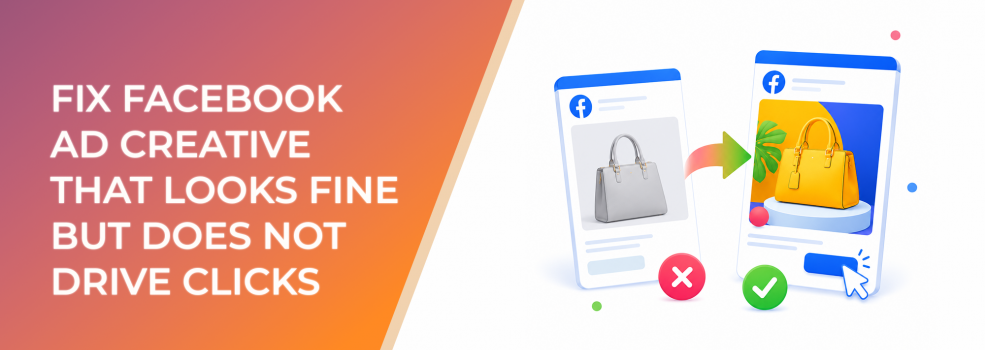
“Looks fine” is not a performance standard.
A Facebook ad can be clean, branded, readable, and technically acceptable but still fail to drive clicks. The design may not be ugly. The copy may not be wrong. The CTA may be visible. Yet the campaign gets impressions without enough click activity to support efficient CPC, CPA, CAC, ROAS, or learning.
This problem is common for SMB owners, agencies, startup marketers, B2B lead-generation teams, ecommerce brands, affiliate marketers, and freelancers. The ad passes internal review, but the market ignores it.
When that happens, the issue is not whether the ad looks fine. The issue is whether it gives the right people a strong enough reason to click.
The Problem
The problem is creative that is acceptable but not compelling.
Many ads are built to avoid mistakes. The logo is present. The product is visible. The headline is safe. The CTA is standard. The brand colors are correct.
But users do not click because the ad does not interrupt their scroll, communicate value fast enough, or create a clear expectation for what happens next.
A fine ad often blends in. It does not create urgency, curiosity, relevance, or confidence. It may be easy to approve, but it is also easy to ignore.
Why This Problem Hurts Performance
Low click performance affects the entire campaign.
If CTR is weak, the campaign needs more impressions to generate traffic. That can make CPC less efficient and slow down testing. If few users click, the landing page, offer, and conversion path receive less signal. It becomes harder to know whether the funnel is underperforming or whether not enough qualified users are reaching it.
For lead-generation campaigns, low clicks mean fewer chances to create qualified conversations. For ecommerce brands, it means fewer product views, add-to-cart opportunities, and purchases. For agencies, it means slower optimization cycles and more pressure to explain why a visually acceptable ad is not moving performance.
Low clicks can also hide audience problems. If the ad is shown to people who do not care about the category, even strong creative may appear weak.
Common Scenarios Where This Happens
A SaaS company runs a clean ad with a product screenshot and headline like “Manage Your Workflow Better.” The message is understandable, but it does not speak to a specific pain or outcome.
An ecommerce brand uses a professional product image but does not show the product in context, explain the benefit, or provide a reason to shop now.
A local business promotes a service with a branded graphic, but the ad does not mention the local problem, service area, offer, or booking incentive clearly enough.
An agency launches client creative that looks polished in a deck but feels generic in the feed. Users scroll past because the ad could belong to almost any competitor.
A B2B lead-generation team targets a broad audience with a technically accurate ad. The people seeing it do not recognize the problem as urgent, so they do not click.
Why the Problem Happens
This problem happens when advertisers mistake visual acceptability for click motivation.
The first cause is a weak hook. The ad does not immediately tell the user why they should stop.
The second cause is unclear value. The user sees what the company offers but not what they gain by clicking.
The third cause is passive visual hierarchy. The eye does not know where to go first. The key message, proof point, product, or CTA may be present but not prioritized.
The fourth cause is generic copy. Safe language like “solutions for your business” or “quality products at great prices” rarely creates enough click intent.
The fifth cause is audience mismatch. Even a strong hook can fail if the ad reaches people who do not have the problem, context, budget, or interest.
The Solution
The solution is to rebuild the ad around click intent.
Start with the hook. The first visible message should connect to a real user problem, desired outcome, question, comparison, or offer. A strong hook makes the user think, “This might be for me.”
Then sharpen the value proposition. Do not ask people to click just to understand the offer. Tell them what they will get, learn, save, solve, compare, or access.
Next, improve visual hierarchy. Make the most important element obvious. That may be the product, the outcome, the offer, the pain point, the proof, or the CTA. If everything has equal weight, nothing leads the eye.
Then clarify the CTA. The CTA should match the click reason. If the ad offers education, the CTA should lead to a guide, checklist, video, or article. If the ad offers product value, the CTA should lead to shopping, pricing, comparison, or product details. If the ad offers service help, the CTA should lead to a quote, consultation, call, or message.
Finally, check audience relevance. If the audience is too broad or poorly matched, the ad may get impressions from users who were never likely to click. In that case, rewriting the creative alone may not solve the problem.
How LeadEnforce Helps
LeadEnforce helps advertisers address the audience side of low-click performance.
When an ad gets impressions but few clicks, marketers often assume the creative is the only problem. Sometimes it is. But sometimes the ad is being shown to people who do not recognize the offer as relevant.
LeadEnforce allows advertisers to build audiences from Facebook groups, Instagram profiles, Instagram followers, Instagram engagers, LinkedIn professional data, and custom social-profile data. These audience sources can give advertisers stronger context before writing the hook and CTA.
For example, a local business can test a more relevant community-based audience. An ecommerce brand can build audiences around Instagram profiles or engagers connected to its category. A B2B team can use LinkedIn-derived professional data to align the ad with role, industry, or business context. An agency can build sharper audience hypotheses before rewriting client creative.
LeadEnforce does not make weak creative strong by itself. The ad still needs a clear hook, compelling value proposition, strong CTA, and aligned destination. But it helps reduce the risk of judging creative based on low-relevance impressions.
Risks and Considerations
Do not overcorrect by making the ad clickbait.
A better hook should be clearer and more relevant, not misleading. If the ad earns clicks with exaggerated promises, conversion quality will suffer.
Also avoid narrowing the audience too far. High relevance is useful, but the campaign still needs enough audience size to deliver and learn.
Do not judge CTR in isolation. A higher CTR is valuable only if the clicks have business potential. If the campaign attracts cheap but low-quality traffic, CPC may improve while CPA or CAC gets worse.
Watch the destination as well. Users may stop clicking future ads if previous clicks led to a poor landing page, confusing offer, or mismatched experience.
Compliance remains important. Audience-specific messaging should focus on problems and outcomes without implying sensitive personal attributes or private knowledge.
Prerequisites and Dependencies
Before fixing click performance, define the audience, offer, campaign objective, and click destination.
You need to know who the ad is meant to reach and what would make that person care. You also need a clear reason for the click. Is the user clicking to compare, learn, shop, book, apply, download, message, or start a trial?
The landing page or destination must match the click promise. If the ad says “compare options,” the page should support comparison. If the ad says “get pricing,” pricing should be easy to find. If the ad says “book a quote,” the booking path should be obvious.
If LeadEnforce is part of the workflow, you need relevant source groups, profiles, engagers, professional data, or custom social-profile inputs that reflect real market context.
You also need enough budget and time to compare creative and audience changes fairly.
Practical Recommendations
Audit the ad in three seconds. If the value is not obvious quickly, rewrite the hook or redesign the hierarchy.
Replace generic headlines with audience-specific outcomes. “Improve Marketing Results” is weaker than a specific pain, promise, or use case.
Make the CTA visible and logical. Users should know what happens after the click before they click.
Test one major click driver at a time. Start with hook, then visual hierarchy, then CTA, then audience. Changing everything at once makes the result harder to interpret.
Use LeadEnforce when the ad may be reaching low-relevance users. Build a more intentional audience pool, then test whether the same offer earns stronger click behavior from people who better match the market.
Evaluate clicks by quality. Review conversion rate, qualified lead rate, purchase behavior, and sales feedback before deciding that higher CTR automatically means better performance.
Final Takeaway
Facebook ad creative that “looks fine” often fails because it does not create enough reason to click.
The fix is to move beyond safe creative and build for attention, relevance, value, CTA clarity, and audience fit. The best ad is not the one that survives internal review. It is the one the right users understand and want to act on.
To test your click-driving creative with more relevant audience inputs, join the free 7-day LeadEnforce trial period.
Related LeadEnforce Articles
- Meta Ads Getting Impressions but No Clicks? Here’s Why — Directly related to diagnosing low-click Meta ad campaigns.
- Headline Formulas That Boost Facebook Ad Clicks — Helps improve the first message users notice.
- Why Your Visual Hierarchy Determines Facebook Ad Click-Through Rates — Explains how layout affects whether users notice and act.
- Facebook Ad Copywriting: How to Match Tone With Buyer Intent — Useful for matching copy style to awareness and intent.
- How to Build Your Target Audience from a Facebook Group — Shows how stronger audience relevance can support better click performance.