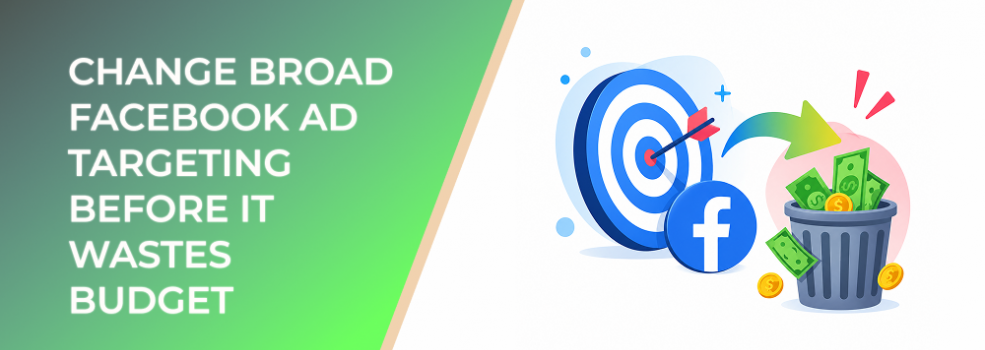
Broad Facebook ad targeting can look attractive at first. The audience size is large, setup feels simple, and Meta has more room to optimize. That is exactly why many advertisers launch too quickly.
The problem starts when “broad” becomes “undefined.” Your campaign reaches people who technically fit the audience settings but have little reason to click, inquire, buy, or book a call. By the time the issue becomes obvious, the campaign has already spent budget collecting weak signals.
This matters most for marketers creating ads quickly from a Facebook Page, agencies launching client tests, SMB owners with limited budget, and lead-generation teams that cannot afford cheap but unqualified traffic.
The Problem
Broad Facebook ad targeting becomes dangerous when the audience is large but strategically vague.
A broad audience is not automatically bad. Meta can perform well with room to optimize when the campaign has strong conversion signals, clear creative, enough budget, and a well-defined outcome. But when advertisers launch with a generic audience such as “business owners,” “fitness,” “real estate,” “parents,” “entrepreneurs,” or “people interested in marketing,” the campaign may reach a mixed pool of people with very different needs, budgets, urgency levels, and purchase intent.
The issue is not only reach. It is relevance.
If the audience includes too many people who are unlikely to convert, Meta has to spend money learning who matters. That early learning cost can become expensive, especially when the offer is niche, B2B, local, high-ticket, or lead-quality sensitive.
Why This Problem Hurts Performance
Broad targeting hurts performance because it weakens the relationship between audience, message, and conversion intent.
You may see high impressions but low CTR. You may get clicks that never become leads. You may get leads that sales rejects. You may also see a deceptively low CPC while CPA and CAC move in the wrong direction.
This creates several business problems:
- Budget goes toward people outside your real ICP.
- Creative feedback becomes unreliable because the wrong people are reacting to the ads.
- Meta learns from low-quality clicks or shallow engagement.
- Retargeting pools become polluted with weak visitors.
- Scaling becomes harder because you are expanding from poor audience signals.
A campaign can look active while quietly teaching the platform to chase the wrong users.
Common Scenarios Where This Happens
This often happens when a local business boosts or promotes a Page post and chooses a large geographic radius without narrowing by real buyer intent.
It happens when a startup launches a lead magnet to “all founders” instead of separating bootstrapped founders, funded SaaS founders, ecommerce founders, and agency owners.
It happens when an ecommerce brand targets a broad interest like “skincare” or “fitness” without separating casual content consumers from active buyers.
It happens when a B2B advertiser tries to use Facebook for lead generation but does not define job role, company context, industry pain point, or professional buying trigger.
It also happens inside agencies when the team is under pressure to launch quickly and uses a generic starter audience because it feels safer than making sharper audience decisions.
Why the Problem Happens
Broad targeting usually happens for five reasons.
First, advertisers confuse audience size with opportunity. A large audience feels promising, but large does not mean qualified.
Second, marketers rely on interests that are too vague. Someone can be interested in “marketing” without needing a CRM, agency, analytics tool, course, or consulting offer.
Third, the campaign objective is unclear. If the real goal is qualified leads, but the setup optimizes for traffic or engagement, Meta may find people who click but never convert.
Fourth, the advertiser has not translated the ICP into targeting inputs. Knowing “we sell to operations managers at growing logistics companies” is useful, but only if that insight becomes audience criteria.
Fifth, the team launches without exclusions. Existing customers, low-quality leads, irrelevant geographies, job seekers, students, and casual content consumers may all remain in the pool.
The Solution
The solution is not to make every audience tiny. The solution is to make broad targeting guided, intentional, and testable.
Start by defining the audience in business terms before touching the ad setup. Ask who has the budget, urgency, authority, and problem fit to take the action you want. That gives you a sharper starting point than interests alone.
Next, separate audience intent levels. Cold prospecting audiences should introduce the problem and attract relevant users. Warm audiences should receive proof, comparison, or offer-led messaging. High-intent audiences should receive a direct conversion path.
Then refine the starter audience before launch. Use one or more of these inputs:
- Customer traits from your best buyers.
- Competitor or adjacent-brand communities.
- Facebook groups related to the problem.
- Instagram profiles, followers, or engagers connected to the niche.
- LinkedIn-derived professional attributes for B2B campaigns.
- CRM or customer list data.
- Website visitors and meaningful engagement audiences.
- Exclusion lists for customers, low-quality leads, or irrelevant segments.
Finally, test broad versus guided audiences with clear success metrics. Do not judge only by CPC or CTR. Measure CPA, lead quality, qualification rate, sales acceptance, ROAS, CAC, and conversion rate.
How LeadEnforce Helps
LeadEnforce is useful when broad targeting feels too vague and the advertiser needs stronger audience inputs before launch.
Instead of relying only on Meta’s broad interest categories, advertisers can use LeadEnforce to build audiences from Facebook group members, Instagram profile followers, LinkedIn-derived professional data, and custom social-profile links.
For example, a B2B marketer can build a more relevant audience from professionals associated with specific industries, job titles, or company types. An ecommerce advertiser can source audiences from Instagram profiles and competitor followers that already signal category interest. A local business can focus on community-based audiences instead of targeting everyone in a broad radius.
LeadEnforce does not replace good creative, conversion tracking, or offer strategy. Its role is to reduce targeting guesswork so the campaign starts with people who are more likely to care about the message.
Risks and Considerations
Sharper targeting can improve relevance, but it can also create new risks.
An audience that is too small may struggle to deliver. A niche community may look relevant but lack buying power. A competitor audience may respond poorly if your offer is not clearly differentiated. A professional audience may still need educational creative before it converts.
You should also avoid assuming that better targeting fixes every campaign issue. Weak landing pages, unclear offers, poor lead forms, bad conversion signals, and misaligned creative can still hurt performance.
When using any audience-building workflow, stay aligned with platform policies, data-use permissions, and your own privacy obligations.
Prerequisites and Dependencies
Before fixing broad targeting, you need a clear ICP. That means knowing who buys, why they buy, what problem they are solving, and what disqualifies a prospect.
You also need a campaign objective that matches the business goal. A campaign optimized for engagement will not behave like a campaign optimized for qualified leads or purchases.
Strong creative is another dependency. If the ad speaks generically, even a refined audience may not respond. The message should reflect the audience source, pain point, and stage of the funnel.
You also need enough budget to test cleanly. A small budget can still work, but it must be focused. Running too many ad sets with too little spend creates weak learning.
If LeadEnforce is part of the workflow, you need relevant source groups, profiles, LinkedIn criteria, or social-profile data that truly match your market.
Practical Recommendations
Start with one clear conversion goal. Do not ask the same campaign to generate awareness, traffic, leads, and sales at once.
Build a narrow definition of your best-fit audience, then decide how much room Meta should have to expand. Use broad targeting deliberately, not as a substitute for strategy.
Create at least two audience tests: one guided audience based on high-intent signals and one broader audience with strong creative qualifiers. Compare them on downstream results, not only click cost.
Use exclusions where appropriate. Remove existing customers from acquisition campaigns, suppress known low-quality leads, and separate warm users from cold prospecting.
Use LeadEnforce when the biggest weakness is audience discovery. It fits best before launch, when you need to find relevant groups, profiles, followers, engagers, professional segments, or social-profile audiences that better reflect your real buyer.
Final Takeaway
Broad Facebook targeting wastes budget when it is undefined, not when it is simply large. The fix is to give Meta better audience direction, better conversion signals, and better creative alignment before the campaign starts spending.
A strong audience does not need to reach everyone. It needs to reach enough of the right people to produce reliable performance data.
Join the free 7-day LeadEnforce trial period to build more relevant audience inputs before your next Facebook ad campaign starts spending.
Related LeadEnforce Articles
- Why Your Target Audience Might Be Too Broad — Even If It Looks Right — Explains why large audiences often hide weak intent and wasted spend.
- Facebook Ad Targeting 101: How to Reach the Right Audience — Covers core Facebook targeting options and how to use them strategically.
- LeadEnforce Audiences vs. Interest Targeting: Which Drives Better Results? — Useful for comparing source-based audiences with standard interest targeting.
- Optimizing Marketing Spend: Reduce Waste with Precision Targeting — Connects audience precision directly to budget efficiency.
- 10 Ways To Improve Your Ad Targeting — Offers broader targeting improvement ideas for paid campaign planning.