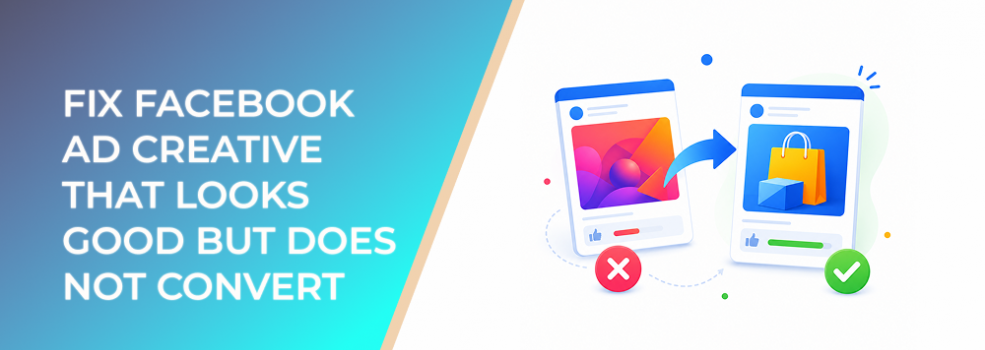
A Facebook ad can look impressive and still fail.
The image is polished. The copy sounds professional. The CTA is visible. The brand feels credible. But once the campaign starts spending, the results do not match the quality of the creative. Clicks do not become leads. Leads do not become opportunities. Product visits do not become purchases. CPA climbs, ROAS weakens, and the team starts debating whether the ad “just needs more budget.”
This problem affects agencies, SMB owners, ecommerce brands, B2B lead-generation teams, startups, affiliate marketers, and freelancers. It is especially frustrating because the ad does not look obviously broken.
The mistake is assuming that good-looking creative is the same as conversion-focused creative.
The Problem
The problem is creative that creates surface interest but not enough purchase, lead, or decision intent.
Many advertisers judge creative quality by how it looks in the feed. They ask whether the design is attractive, whether the headline is clean, whether the image looks branded, and whether the ad feels professional. Those things matter, but they do not prove that the ad is built to convert.
A conversion-focused ad has a different job. It must connect the right audience, the right problem, the right offer, the right proof, and the right next step.
When any of those pieces are weak, the ad may still get attention. It may even generate clicks. But the campaign will struggle to produce meaningful business outcomes.
Why This Problem Hurts Performance
Good-looking ads that do not convert waste budget quietly.
They often generate enough activity to avoid immediate concern. CTR may look acceptable. CPC may not seem alarming. Engagement may create the impression that the message is resonating. But if conversion rate stays low, the real acquisition cost rises.
For lead-generation teams, this can mean more form fills but fewer qualified leads. For ecommerce brands, it can mean product page traffic with weak add-to-cart or purchase behavior. For agencies, it can mean difficult client conversations because the ad looks strong but the pipeline does not move.
The larger issue is misleading learning. If the campaign keeps spending on users who click but do not convert, the platform may continue finding more people who behave the same way. That can make the campaign more efficient at generating low-value activity.
Common Scenarios Where This Happens
A B2B SaaS company promotes a well-designed demo ad, but the copy speaks broadly to “teams” instead of a specific buyer, role, or pain point. The ad gets clicks, but sales rejects most leads because they are not decision-makers.
An ecommerce brand uses beautiful product photography, but the ad does not explain why the product is different, who it is for, or why someone should buy now. Traffic arrives, but the product page does the heavy lifting alone.
A local service business promotes a seasonal offer with a clean graphic, but the audience includes people outside the real service area or outside the buying window. The ad looks good, but the clicks are not commercially useful.
An agency launches polished creative for a client but uses a broad audience because the deadline is tight. The creative attracts curiosity, not qualified demand.
An affiliate marketer uses a professional-looking ad but sends users to an offer that feels disconnected from the promise in the ad. Clicks happen, but downstream conversion quality stays weak.
Why the Problem Happens
This problem usually happens because advertisers separate creative quality from conversion context.
The first cause is weak audience fit. A good ad shown to the wrong audience is still a weak campaign. If the people seeing the ad do not have the problem, budget, urgency, or category interest, the creative has very little chance of producing profitable action.
The second cause is vague value. Many ads describe the product but do not make the payoff obvious. Users should understand what changes for them if they click, sign up, book, download, or buy.
The third cause is poor message match. The ad promise and the destination experience must feel connected. If the ad promises a specific benefit but the landing page opens with generic brand copy, momentum drops.
The fourth cause is CTA mismatch. A cold audience may not be ready for “Buy Now” or “Book a Demo.” A high-intent retargeting audience may not need another educational CTA. The next step must match the user’s awareness level.
The fifth cause is overvaluing visual polish. A polished ad can still be too passive, too generic, or too disconnected from the buying decision.
The Solution
The solution is to audit the ad as a conversion path, not as a design asset.
Start with the audience. Ask who the ad is truly for, what problem they already recognize, and what would make them believe the offer is worth acting on now. If the audience is broad, split it into clearer intent groups before rewriting the creative.
Then check the promise. The ad should answer one practical question fast: “Why should this person care enough to take the next step?” Avoid relying only on product features or brand statements. Translate the offer into a clear business or personal outcome.
Next, check the proof. Conversion-focused creative often needs reassurance. That proof may be a specific use case, social proof, a recognizable pain point, a demo angle, a guarantee, a comparison, or a reason the offer is relevant now. The proof should support the action you are asking for.
Then check the CTA. Match the CTA to the audience’s stage. Cold users may need a softer action such as viewing a guide, seeing examples, or comparing options. Warm users may be ready for a quote, trial, consultation, or purchase. Retargeting users may need urgency, reassurance, or a specific incentive.
Finally, review the destination. The landing page, instant form, message flow, product page, or booking path should continue the same promise. If the ad sells one idea and the page opens with another, conversion rate will suffer.
How LeadEnforce Helps
LeadEnforce helps when the conversion problem is partly caused by weak audience relevance.
Instead of testing polished creative only against broad interests or generic audiences, advertisers can use LeadEnforce to build more intentional audience pools from Facebook groups, Instagram profiles, Instagram followers, Instagram engagers, LinkedIn professional data, and custom social-profile data.
That matters because conversion-focused creative is easier to write when the audience context is clear.
A B2B team can build audiences around professional signals that better match its ICP. An ecommerce brand can test audiences connected to relevant Instagram profiles or competitor communities. A local business can test audiences connected to specific communities or interests that reflect real demand. An agency can create separate audience pools for each client instead of recycling one broad targeting template.
LeadEnforce does not write the ad, fix the offer, repair the landing page, or guarantee conversions. Its role is to reduce targeting guesswork so the creative is tested against people who are more likely to understand and care about the offer.
Risks and Considerations
Do not assume that better targeting alone will fix a weak ad.
A more relevant audience still needs a clear offer, persuasive creative, strong CTA, and aligned destination. If the landing page is slow, confusing, or inconsistent with the ad promise, conversion rate may remain weak.
Audience size also matters. Very small audiences can limit delivery, raise frequency, and make tests harder to interpret. High-intent audiences are useful, but they still need enough scale to generate signal.
Compliance should stay central. Creative can reflect audience needs and market context, but it should not imply sensitive personal knowledge or make users feel individually targeted.
Also avoid judging performance only by CTR. A higher CTR with weak conversion quality is not a win. The goal is not just more clicks. The goal is more valuable action.
Prerequisites and Dependencies
Before fixing the creative, define the campaign’s business outcome.
You need a clear ICP, a specific offer, a campaign objective, a measurable success metric, and a destination that supports the ad promise. For lead generation, define what qualifies a lead before launch. For ecommerce, know the target CPA, ROAS, AOV, and margin assumptions. For agencies, align with the client on whether success means qualified leads, booked calls, purchases, pipeline, or retargeting growth.
If LeadEnforce is part of the workflow, you also need relevant source communities, profiles, followers, engagers, professional segments, or custom social-profile data that match the offer. The stronger the source relevance, the more useful the audience test.
Reliable reporting is also important. You do not need a complicated technical setup to diagnose the issue, but you do need enough conversion and sales feedback to tell whether the campaign is attracting the right people.
Practical Recommendations
Start by separating creative problems from audience problems.
Test the same offer and similar creative against a more relevant audience before assuming the design is the issue. If conversion improves, audience fit was likely a major constraint. If conversion remains weak, review the offer, CTA, proof, and destination.
Rewrite the ad around one conversion promise. Do not try to communicate every feature, benefit, and use case in one ad. Pick the strongest reason for that audience to act.
Use the landing page headline as a message-match checkpoint. If the ad and destination do not feel like part of the same conversation, fix that before scaling.
Review conversion quality, not just platform activity. A campaign that produces fewer clicks but better qualified leads may be more valuable than a campaign with cheap traffic and poor downstream results.
Use LeadEnforce when you need a cleaner audience test. Build audience pools from communities, profiles, engagers, or professional data that reflect real intent, then compare results against broader targeting with the same offer logic.
Final Takeaway
Good-looking Facebook ad creative does not automatically convert.
The fix is to stop judging the ad only by its appearance and start judging the full conversion path: audience, promise, proof, CTA, and destination. When those pieces work together, creative stops being decoration and starts becoming a performance asset.
To test your next Facebook ad against more relevant audience sources, join the free 7-day LeadEnforce trial period.
Related LeadEnforce Articles
- How to Structure a High-Converting Facebook Ad: Hook, Body, CTA — Useful for rebuilding creative around a clear conversion flow.
- The Attention-Recall Gap: Why Clicks Don’t Equal Conversions — Explains why click activity does not always translate into business outcomes.
- Post-Click Optimization: Beyond the Ad — Helps diagnose what happens after the click when conversion rate is weak.
- When Facebook Page Ads Reach the Wrong Audience — Connects poor audience fit to wasted spend and weak lead quality.
- Why Meta Ad Quality Problems Make Facebook Ads More Expensive — Shows how relevance and quality issues can raise campaign costs.