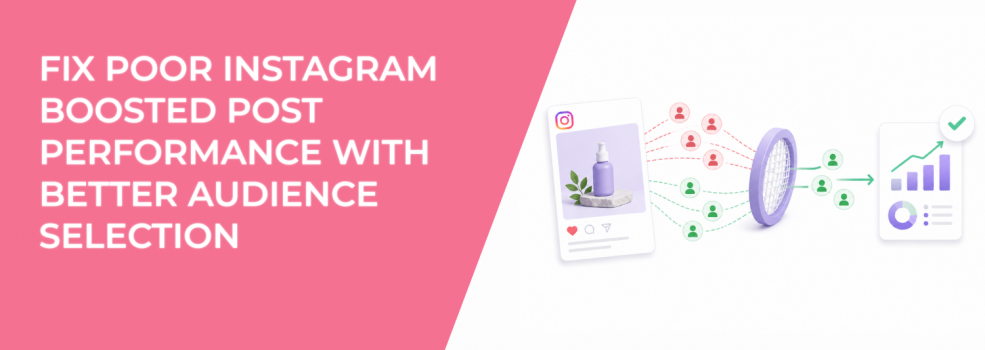
Poor boosted post performance is often treated like a creative problem.
The advertiser changes the caption, swaps the CTA, or boosts a different post. Sometimes that helps. But if the audience is weak, better copy only makes the wrong users click faster.
Audience selection should be the first fix when a boosted Instagram post gets cheap engagement, weak leads, poor sales, or unstable CPA.
Better audiences start with stronger intent signals
A broad Instagram audience can work when the brand has strong data, strong creative, and a product with wide appeal. Many SMBs, agencies, and B2B teams do not have that advantage.
They need more precise source signals.
Intent signals come from behavior that shows the user is closer to the problem. Following a niche account, engaging with competitor content, joining a relevant community, visiting a product page, or interacting with industry-specific posts all say more than a broad interest category.
This is the difference between targeting “marketing” and targeting users who follow several paid media educators, engage with Meta ads content, and belong to growth-focused communities.
To improve audience quality, start by learning how to find high-intent audiences using public social data. The strongest boosted posts usually work because the audience already has a reason to care.
Select the audience based on the buying stage
Not every audience should receive the same boosted post. A person who just discovered your brand needs different content than a person who follows your competitors or has visited your pricing page.
Audience selection becomes easier when you match the boost to buying stage:
- Cold but relevant users need problem-aware content. Use educational posts, pain-point explainers, and category comparisons.
- Warm Instagram engagers need proof. Show testimonials, use cases, before-and-after process examples, or service breakdowns.
- High-intent users need a direct next step. Send them consultation offers, product pages, quote forms, or demos.
- Existing customers need exclusion or upsell logic. Do not keep paying to reach users who already converted unless there is a clear retention goal.
This structure prevents one boosted post from trying to do every job. It also makes reporting cleaner because each audience has a specific expected behavior.
Use Instagram followers and engagers carefully
Instagram followers are not automatically high-intent. Some followed for education, entertainment, giveaways, or curiosity. Others may be strong prospects.
Split them by behavior when possible. A user who saved a product comparison post is usually more valuable than a user who liked a meme. A user who watched most of a demo Reel has a different signal than someone who tapped like on a lifestyle image.
The same applies to engagers. Treat post type as part of the audience signal. Engagement with a pricing post, customer story, or technical explainer usually carries more commercial meaning than engagement with a general awareness post.
That is why better boosted post performance often comes from fewer but cleaner audience pools. The goal is not to reach everyone who knows you. The goal is to reach the people whose behavior matches the next offer.
Do not make the audience so narrow that delivery breaks
Precision does not mean tiny. If the audience is too small, the boost may struggle to deliver, repeat impressions too quickly, or produce unstable costs.
A better approach is to build several focused audience pools and test them separately. One pool might come from Instagram engagers. Another might come from competitor followers. Another might come from relevant Facebook groups or website visitors.
Keep the budget small at first. Watch the quality of engagement, not just the cost. If one audience produces fewer clicks but better lead behavior, it may be the better scaling candidate.
This is where high-intent audiences convert better than broad ones. The winning audience is not always the cheapest audience. It is the one that creates the strongest path from impression to revenue.
Fix the audience before increasing spend
Increasing budget on a weak boosted post usually makes the problem bigger. It gives Meta more money to reach users who already showed poor fit.
Before raising spend, check whether the audience matches the offer, the post matches the buying stage, and the CTA matches the user’s intent level. If those three pieces do not line up, performance will stay unstable.
A strong boosted post needs more than good content. It needs a selected audience with a real reason to care.
The practical shift is simple: stop boosting posts to “people who might like this.” Start boosting to users whose behavior suggests they may need the offer. That is how audience selection turns a weak boosted post into a useful performance test.