Launching new creatives is supposed to unlock performance. In practice, many campaigns see the opposite pattern: new ads struggle to spend, CPL rises, and the system keeps favoring older ads.
This behavior often overlaps with issues described in Why Your Creative Testing Strategy Isn’t Working (And How To Fix It) and Why Testing Too Many Ads at Once Hurts Your Campaign Results — but the root cause is usually deeper than just “bad creative.”
It reflects how Meta’s delivery system evaluates risk, allocates spend, and prioritizes proven signals over potential upside.
If you understand what the system is actually reacting to, this pattern becomes predictable — and fixable.
The First Signal: Spend Stays Locked on Old Ads
You launch new creatives into an ad set, but nothing really shifts.
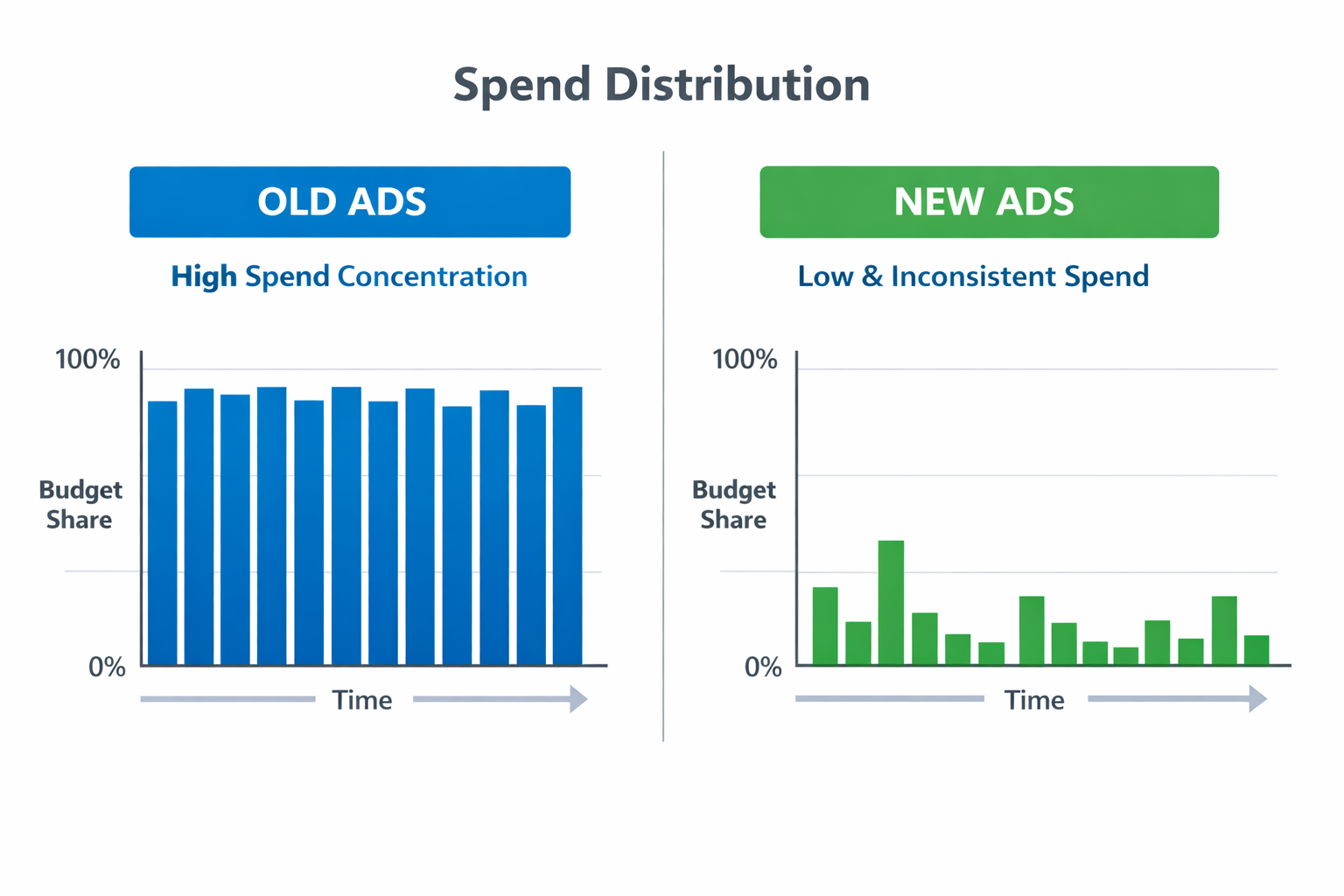
The older ads continue to take most of the spend, while the new ones barely enter auctions. Even after a few days, impressions remain low and performance looks weak simply because the system never gave them a real chance.
Inside Ads Manager, this usually shows up as:
-
Spend concentration, where one or two legacy ads receive 70–90% of the budget, while new ads remain under-delivered. This is not a budget issue — it’s a confidence issue tied to expected outcomes.
-
Low impression volume on new ads, often below the threshold needed to generate meaningful signals. Without ~1,000–3,000 impressions, most ads don’t even get reliable CTR or CVR signals.
-
Stable performance on old ads, which reinforces the system’s bias. A steady 2–3 conversions per day is enough to keep an ad dominant.
At this stage, the system is not comparing creatives equally. It is protecting existing performance.
Why the System Prefers Old Creatives
Meta’s delivery system does not optimize for “newness.” It optimizes for predictability inside the auction.
An older ad with conversion history carries a structural advantage. The system already understands who converts, when they convert, and how aggressively it should bid.
New creatives enter with no behavioral mapping.
What the algorithm actually compares
When deciding where to allocate spend, the system evaluates:
-
Expected conversion probability, built from real historical data. Old ads have it; new ones rely on weak engagement proxies.
-
Auction win rate, where proven ads are more likely to enter and win competitive auctions.
-
Cost of error, meaning how expensive it is if the ad fails to convert after impression delivery.
This is closely tied to how the auction system works, as explained in How Meta Ads Decide Where to Spend Budget.
Because of this, even a stronger creative can lose early simply because it is unknown.
Early Performance Bias Locks In Quickly
A small difference in early results can permanently shape delivery.
If a new creative gets initial impressions but fails to convert, the system immediately reduces its priority. From that point, it participates in fewer auctions, which limits recovery.
This creates a feedback loop:
-
Low initial conversions reduce predicted performance.
-
Lower prediction reduces auction participation.
-
Fewer auctions lead to fewer impressions.
-
Fewer impressions prevent the ad from generating recovery signals.
Meanwhile, the old ad keeps compounding its advantage.
Creative Changes Reset Learned Context
Even small edits break continuity.
If you duplicate an ad and adjust the creative, the system treats it as a new entity. The original ad’s performance history does not carry over.
What gets reset
When a creative changes, the system loses:
-
User-response mapping, meaning it no longer knows which behavioral clusters respond.
-
Engagement signals, such as historical CTR patterns tied to specific segments.
-
Conversion clustering, where past conversions helped define high-probability users.
From the system’s perspective, you didn’t improve an ad. You replaced it with an unknown version.
Auction Pressure Amplifies the Gap
In competitive environments, this bias becomes stronger.
If CPM increases or more advertisers enter the same audience auctions, the system becomes more selective. It leans even harder toward ads with predictable outcomes.
Under these conditions:
-
Old creatives maintain delivery because they are “safe.”
-
New creatives struggle to enter auctions at all.
-
Testing slows down, even with stable budgets.
This is why creative refreshes often fail during peak periods. The system penalizes uncertainty when auction costs rise.
Why “Better” Creatives Still Lose
A creative can objectively be stronger and still underperform.
The issue is not quality — it’s signal timing.
A better creative only wins if:
-
It gets enough impressions early.
-
It generates conversions within the first delivery window.
-
The system updates its prediction before deprioritizing it.
If any of these fail, the creative never reaches its potential.
This explains why some ads perform well when isolated but fail inside a mixed ad set.
How to Diagnose This in a Live Campaign
You can confirm this pattern directly in Ads Manager.
Look for:
-
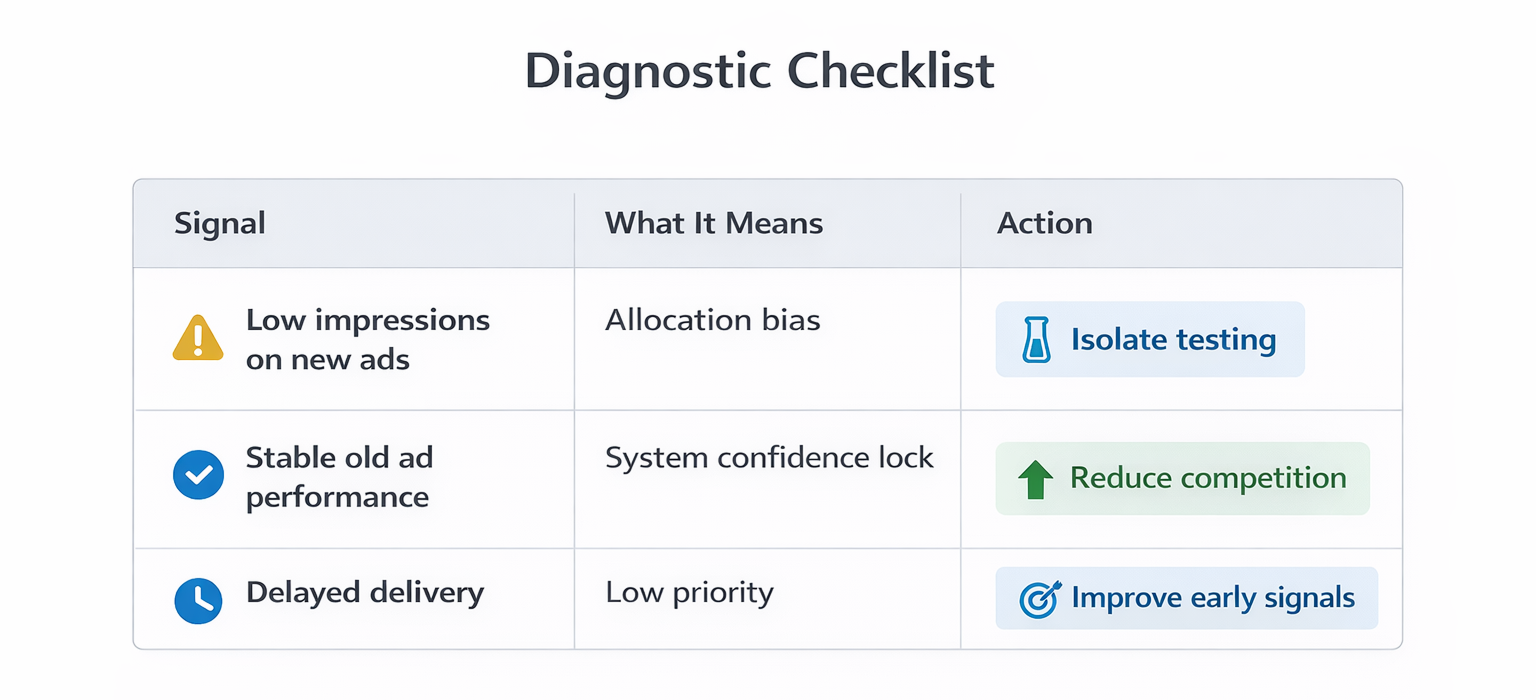
Impression imbalance, where new creatives receive minimal delivery despite sufficient budget.
-
Flat conversion count, even when spend exists at the ad set level.
-
Stable CPM and CTR on old ads, indicating no pressure to reallocate budget.
-
Delayed delivery patterns, where new ads only get impressions late in the day or in small bursts.
If these signals appear together, the issue is allocation logic — not just creative performance.
What Actually Helps New Creatives Compete
Fixing this requires changing how the system evaluates new ads.
Separate testing from optimization
Running new creatives inside a mature ad set limits exposure.
Instead:
-
Launch new creatives in a dedicated test ad set with controlled budget.
-
Keep targeting identical to isolate creative impact.
-
Evaluate based on early conversions, not surface metrics like CTR.
Control early signal quality
The first conversions carry disproportionate weight.
To improve early signals:
-
Start with higher-intent segments instead of broad audiences.
-
Limit the number of new creatives per ad set to avoid dilution.
-
Ensure landing page consistency. A drop in post-click conversion rate immediately penalizes delivery.
Reduce internal competition
Too many creatives slow down learning.
A more stable structure:
-
Keep 3–5 active creatives per ad set.
-
Pause low-delivery ads early instead of letting them idle.
-
Introduce new creatives in controlled batches, not continuously.
The Structural Shift to Keep in Mind
The system does not reward creative freshness. It rewards predictable conversion outcomes under uncertainty.
Old creatives outperform because they carry accumulated trust.
New creatives underperform because they start with zero context.
Once you recognize this, your role changes. You are no longer just creating better ads — you are managing how the system learns which ads deserve delivery.
That shift is what separates random creative testing from controlled, scalable performance.