You launch multiple ad sets. Some spend quickly. Others barely deliver. It doesn’t seem fair or logical. That’s because Meta doesn’t split budget evenly. It spends based on prediction, not observation.
To improve performance, you need to understand how the system thinks, not just how it reports.
Meta’s Budget System Is Built Around Prediction, Not Waiting
Meta doesn’t test your ads and then decide where to spend. It predicts which ones will perform, based on early signals and historical patterns. That prediction influences budget flow almost immediately.
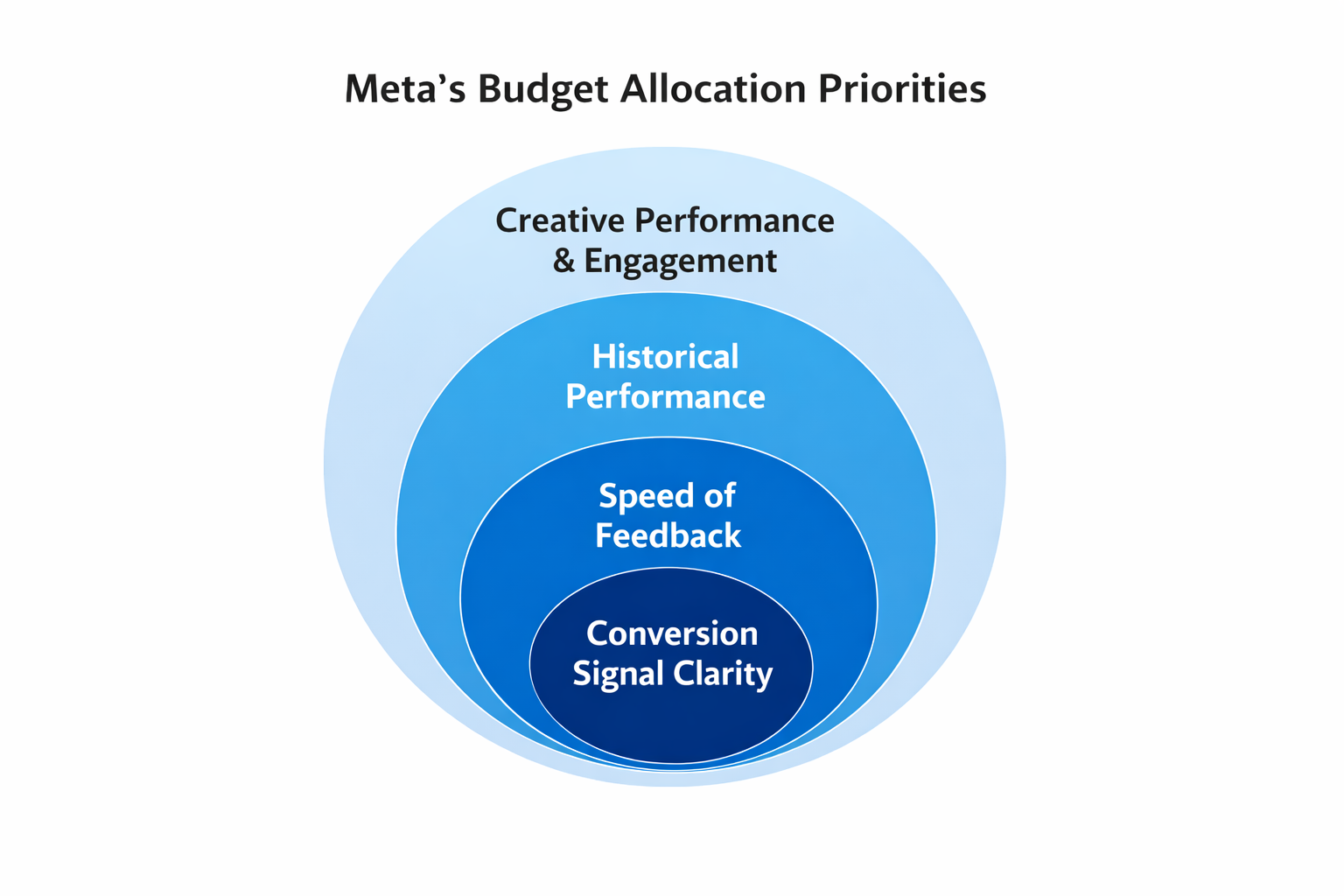
What the Budget Engine Actually Considers
Meta weighs multiple factors at once, including:
-
Past conversion trends, especially from similar ads, formats, or accounts;
-
Speed and clarity of user feedback, like early clicks or conversions;
-
Signal strength, including how easily Meta can track what happens after the click.
This predictive logic explains why ads sometimes receive spend before results are fully visible. It also explains why delivery can stall even when surface metrics look acceptable.
Most Advertisers Miss These Deeper Budget Signals
Many advertisers focus too much on surface-level stats. What matters more is how your ads interact with Meta’s system. Below are three overlooked levers that influence budget flow behind the scenes.
1. Signal Strength Beats Creative Quality
Meta doesn’t prioritize your best-looking ad. It prioritizes the ad that produces clear, trackable, timely outcomes.
For example, if your ad drives clicks to a slow page with no conversion signal, Meta may downrank it. Another ad with less engagement but a faster funnel and a clean “purchase” event will likely receive more spend.
This is closely tied to how Meta exits and evaluates the learning phase, which is covered in more detail in How to Finish the Facebook Learning Phase Quickly.
2. Audience Fatigue Restricts Delivery
Budget can slow down when your audience is too small, too specific, or already saturated. Meta sees diminishing returns and re-routes spend elsewhere.
Watch for signs like:
-
Frequency rising above 3.5 in the first few days;
-
Falling impressions with unspent budget;
-
Click-through rates and engagement tapering off while CPM remains flat.
In these cases, Meta isn’t cutting the campaign. It’s throttling delivery based on expected efficiency.
3. Early Data Shapes Long-Term Behavior
Meta’s model puts weight on early signals. If those signals are weak, the system may deprioritize the campaign, even if you improve things later.
Examples of what can go wrong:
-
Pixel events delayed too long after the click;
-
Combining new creatives with unfamiliar audiences inside the same test;
-
Launching too many variables in one campaign, making data hard to read.
Give the system a clean read by simplifying variables and sending immediate post-click signals.
Advantage+ Campaign Budget: What It Does and Why It Matters
Meta offers an automated way to manage spend across ad sets using Advantage+ campaign budget (also referred to as campaign budget optimization).
Instead of assigning separate budgets for each ad set, you set a single campaign-level budget. Meta then shifts that budget dynamically across ad sets based on real-time performance.
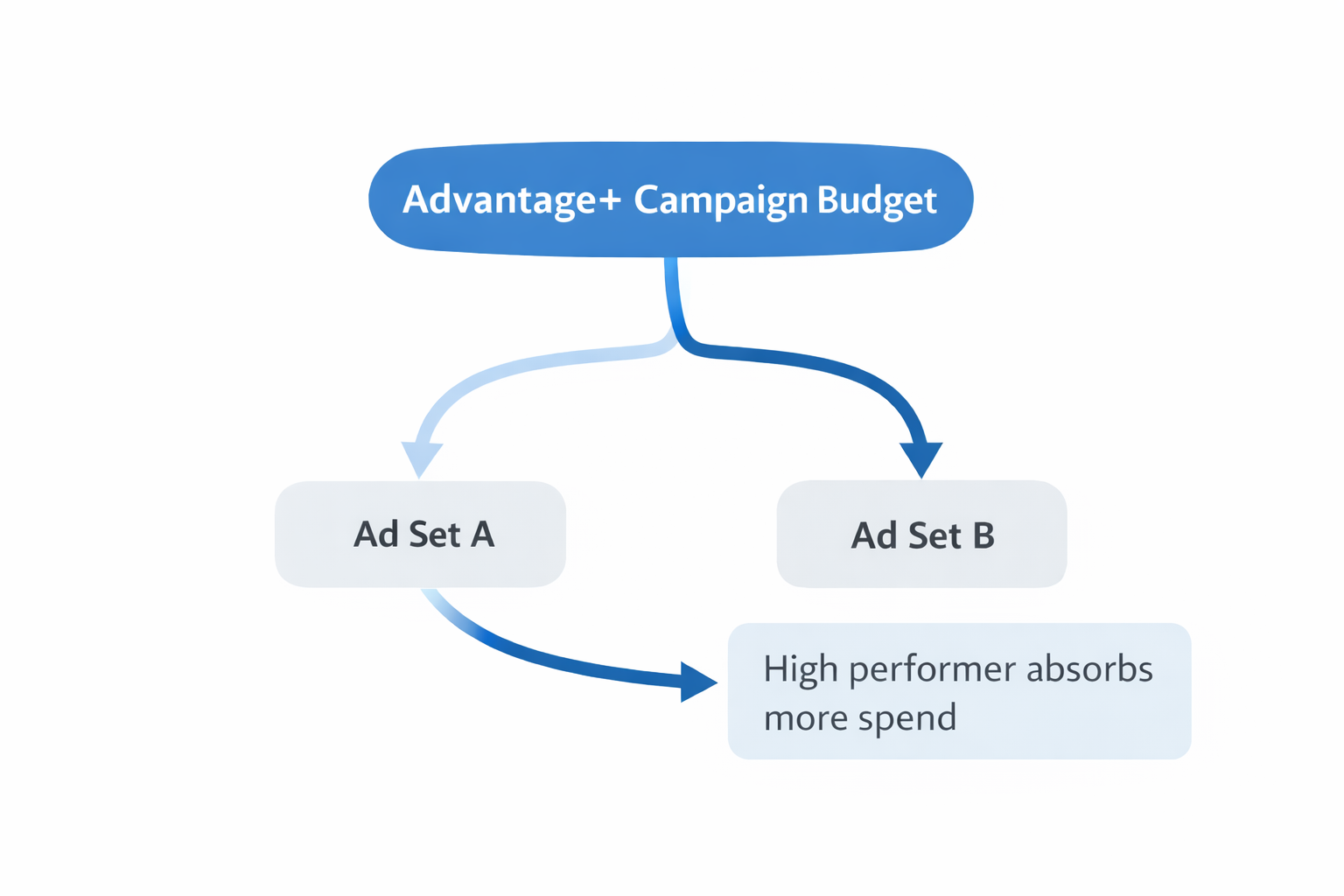
This approach offers three key advantages:
-
Flexibility: Budget flows toward high-performing ad sets automatically, even if one ad set outperforms all others.
-
Efficiency: Meta optimizes for the most results at the lowest cost, not for balance between ad sets.
-
Simplification: You manage fewer budgets, making setup and monitoring less time-consuming.
For advertisers scaling beyond basic tests, a deeper breakdown of setup and trade-offs is covered in How to Optimize Advantage Campaign Budget for Scalable Facebook Ads.
Important Considerations
-
Don’t expect equal delivery across ad sets. Meta will often spend the majority of your budget on one ad set if that improves total campaign results.
-
Review performance at the campaign level, not the ad set level. Budget allocation is based on collective return, not fairness.
-
Use Ad Set Budget Optimization (ABO) when testing concepts that need guaranteed delivery or early-stage exploration.
If you’re eligible, you may also see Opportunity Score suggestions in your account. These are real-time performance hints based on Meta’s internal experiments. They do not guarantee results, but they can highlight structural inefficiencies.
Meta Spends Based on Relative Opportunity
Meta doesn’t only ask whether an ad will work. It asks whether that budget could generate better results elsewhere in your account.
This opportunity-based logic affects:
-
Campaign prioritization within your account;
-
Ad set delivery inside campaigns;
-
Placement selection, such as Feed vs. Stories or Reels.
This internal competition is closely tied to how Meta’s ad auction works. If you want a deeper explanation of why some ad sets struggle to deliver at all, see Facebook Ad Auction: Do Ad Sets Compete Against Each Other?
Use Minimum Spend Caps Strategically
To prevent Meta from ignoring ad sets or ideas you want to test, apply minimum spend limits. These caps force the system to allocate a baseline amount, which is useful when:
-
Exploring new audience segments;
-
Testing creative angles with unknown performance;
-
Ensuring small-budget concepts aren’t skipped entirely.
How to Influence Budget Behavior
While you can’t fully control Meta’s allocation, you can design your campaigns to guide it.
Structure for Visibility and Clarity
Start with Ad Set Budget Optimization when testing, then switch to Advantage+ campaign budget when you’re ready to scale.
-
Separate cold and warm audiences to reduce internal competition.
-
Group similar creative formats within the same campaign.
-
Avoid testing multiple variables (audience, format, offer) in one campaign.
The clearer your structure, the easier it is for Meta to make accurate performance predictions.
Optimize the Funnel, Not Just the Creative
Meta’s delivery system rewards campaigns that send clean data.
Improve signal strength by:
-
Reducing landing page load times to under 3 seconds;
-
Using single-goal landing pages with clear outcomes;
-
Tracking meaningful actions with Meta’s Conversion API or pixel.
Even average creatives can scale when the system clearly understands what success looks like.
Final Thoughts
Meta doesn’t watch and wait. It models outcomes using early data and past behavior, and spends based on predicted return.
If your campaigns aren’t scaling, don’t just tweak creative. Look at what Meta is learning from your setup, and whether you are giving it the right signals to learn from.