Generic B2B campaigns tend to plateau for a simple reason: the buying process behaves differently across industries, but the targeting and messaging often stay the same. When the campaign structure ignores how decisions actually happen in a given sector, performance drops — usually visible as rising CPL, longer conversion windows, and unstable lead quality.
This article breaks down how to align ad strategy with industry-specific buying behavior, so your campaigns produce stronger signals and more predictable pipeline outcomes.
Why Industry Context Changes Campaign Performance
Two campaigns can target the same job title and company size yet produce completely different results depending on the industry. The underlying reason is not audience — it’s decision mechanics.
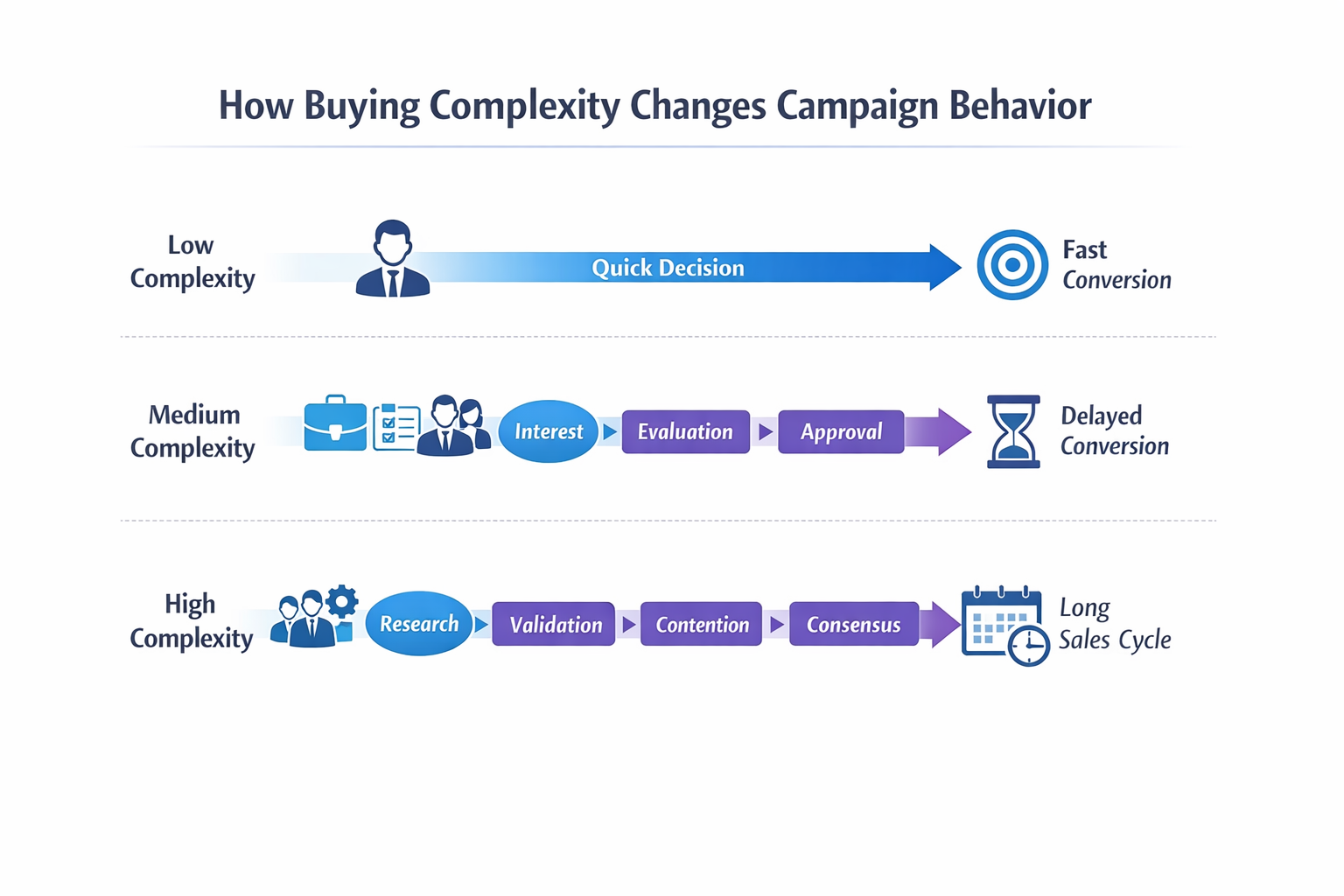
In SaaS, a mid-level manager might start a trial on their own. In manufacturing, that same role usually can’t move forward without procurement and technical validation. If your campaign optimizes for the same conversion event in both cases, the algorithm ends up learning from mixed signals.
That inconsistency shows up in a few ways:
-
Conversion delays, where the time between click and action stretches unpredictably. This makes optimization unstable and harder to scale.
-
Lower event density, especially when decisions require multiple stakeholders before any tracked action happens.
-
Misleading lead signals, where early interest looks similar to high intent but rarely turns into real opportunities.
If you’ve seen campaigns generating leads that never convert into pipeline, the issue often sits here — not in targeting, but in how signals are interpreted.
Mapping Campaign Structure to Buying Complexity
Before adjusting creatives or audiences, it helps to classify the industry by how decisions actually get made. This determines how aggressive your campaign can be and which signals you can trust.
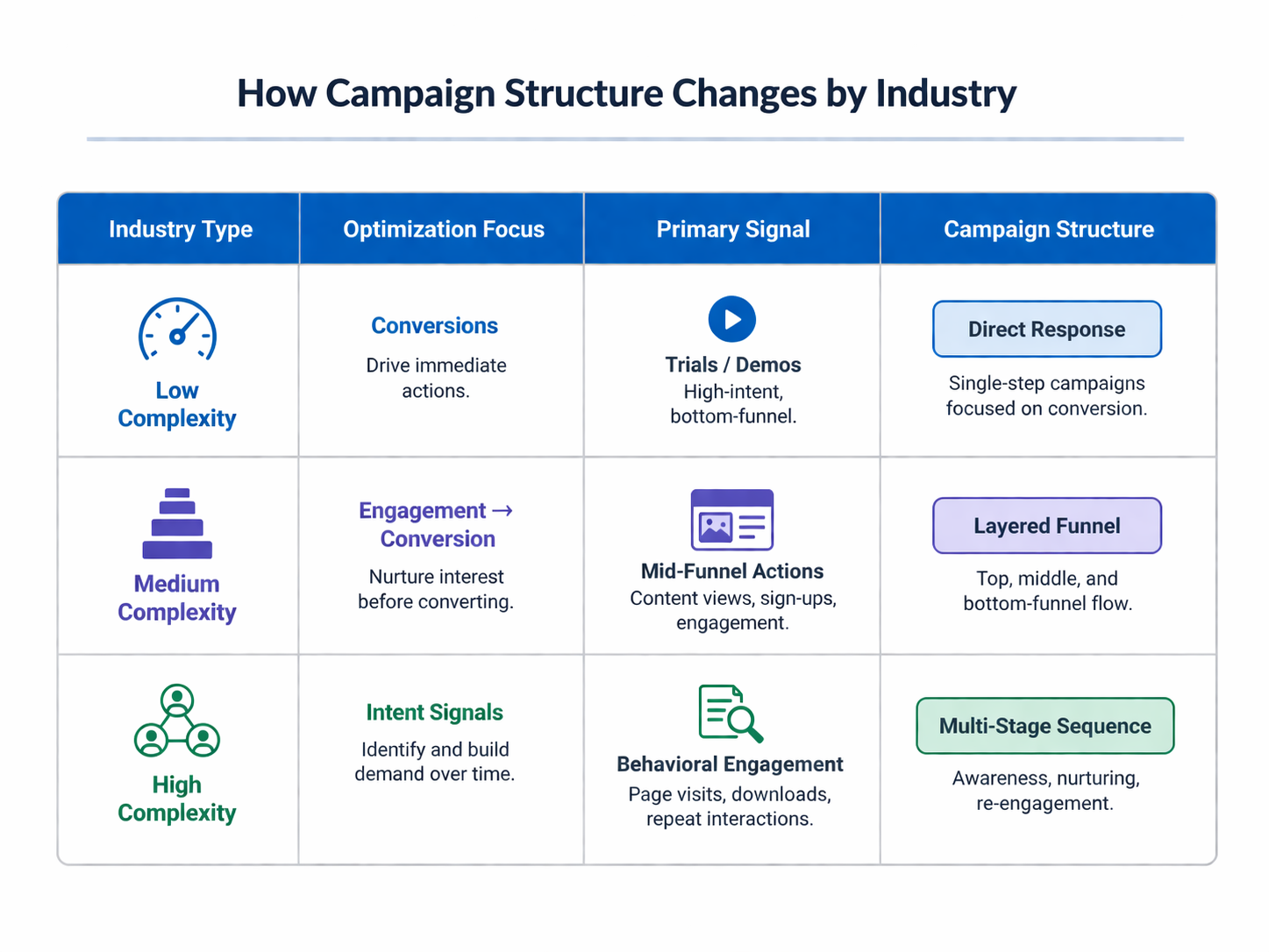
1. Low-Complexity B2B (Fast Decisions)
Think smaller SaaS tools, marketing services, or subscription-based platforms.
In these cases, campaigns can push directly toward conversion because:
-
A single stakeholder usually controls the decision, so there’s less internal friction.
-
Trial or demo actions closely match real buying intent, making them reliable signals.
-
Feedback loops are short, which lets the algorithm adjust quickly based on recent conversions.
From an execution standpoint, you can:
-
Optimize for bottom-of-funnel events early, like trial starts or booked demos.
-
Use shorter attribution windows without losing signal clarity.
-
Scale faster, since the system gets consistent feedback within a few days.
You’ll often see stable CPM and predictable CPA once the campaign exits the learning phase.
2. Medium-Complexity B2B (Layered Evaluation)
This includes HR software, fintech tools, or mid-market SaaS solutions.
Here, decisions tend to unfold in stages:
-
Initial interest from a functional stakeholder.
-
Internal validation, like team discussions or budget checks.
-
A delayed conversion, sometimes days or weeks after the first interaction.
If you push too hard for final conversions too early, the algorithm struggles because signals are too sparse.
A more stable approach:
-
Start with mid-funnel events, like content engagement or deeper page views. These happen more often and help stabilize delivery.
-
Introduce conversion-focused campaigns once users show repeated engagement.
-
Segment retargeting based on behavior intensity, not just recency.
This aligns closely with how structured funnels behave in practice — especially if you’re applying a framework like Facebook Ads Funnel Strategy: From Audience Identification to Conversion.
A common signal here is uneven spend pacing. Campaigns may underdeliver early in the day and accelerate later once enough engagement data accumulates.
3. High-Complexity B2B (Multi-Stakeholder Decisions)
Industries like manufacturing, enterprise IT, and logistics fall into this category.
Conversions are rare and delayed because:
-
Multiple departments need to approve the decision.
-
Technical validation often comes before any commercial discussion.
-
Sales cycles extend beyond typical attribution windows.
If you optimize directly for leads or demos, the system simply doesn’t get enough feedback to learn effectively.
A better structure:
-
Focus on early intent signals, like repeat visits, document downloads, or long session durations.
-
Build layered retargeting sequences that reflect the real decision journey — awareness, validation, then commercial intent.
-
Separate qualification from acquisition, so low-intent traffic doesn’t dilute your signals.
In longer cycles like this, sequencing becomes critical — similar to the logic behind Retargeting vs. Broad Targeting: Which Strategy Drives Better Results?.
In Ads Manager, this often shows up as high CPM combined with low conversion volume and frequent learning phase resets.
Ad Creative Strategy by Industry Type
Targeting alone won’t fix weak performance if the messaging doesn’t match what buyers are actually trying to figure out.
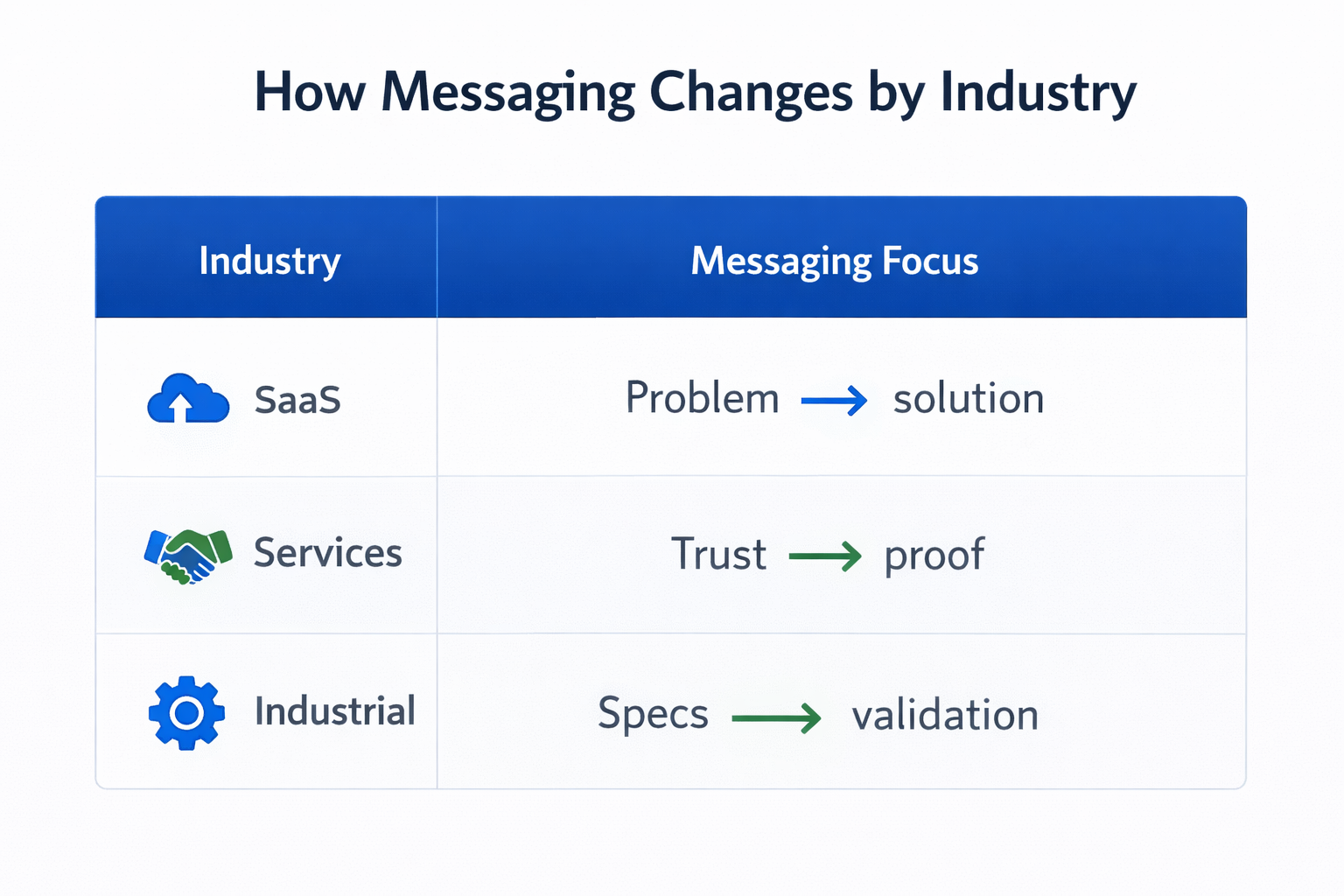
SaaS and Tech (Problem–Solution Clarity)
Buyers usually want to understand:
-
Whether the product solves a specific operational problem.
-
How quickly they can get value from it.
-
Whether it integrates with their current tools.
Strong creatives tend to:
-
Show a clear before-and-after tied to a measurable outcome.
-
Emphasize speed to value, like setup time or onboarding simplicity.
-
Use product-level visuals instead of abstract messaging.
If CTR is high but conversions lag, it usually means the promise and experience are misaligned — a pattern explained in
Facebook Ads Not Converting: How To Fix It.
Professional Services (Trust and Risk Reduction)
In consulting, agencies, or financial services, the main barrier is risk.
Buyers are looking for:
-
Proof of results in similar situations.
-
Evidence of real expertise, not just positioning.
-
Clarity around process, timelines, and outcomes.
Effective creatives:
-
Use specific case outcomes instead of general testimonials.
-
Address common objections directly, like cost structure or implementation effort.
-
Present the service as a clear system, not something vague.
You’ll often see lower CTR but stronger lead quality when this is done well.
Industrial and Manufacturing (Technical Validation)
These buyers are focused on operational fit more than messaging style.
They need:
-
Technical compatibility details.
-
Performance specifications.
-
Proof that the solution works in similar environments.
Creative direction should:
-
Focus on functionality and real use cases.
-
Use diagrams or process visuals instead of branding-heavy designs.
-
Highlight measurable improvements like efficiency or reduced downtime.
Performance usually looks different here — fewer clicks, but longer sessions and deeper engagement.
Targeting Adjustments Based on Industry Signals
Targeting should reflect not just who the buyer is, but how predictable their behavior is.
High-Signal Industries
Where conversions happen frequently and consistently:
-
Use lookalike audiences based on recent converters.
-
Keep targeting broad enough for the algorithm to explore.
-
Scale gradually while watching frequency and CPM trends.
The system performs better because it can identify patterns quickly.
Low-Signal Industries
Where conversions are rare or delayed:
-
Narrow targeting using firmographics like industry, company size, and role.
-
Build audiences from engagement signals, not just conversions.
-
Use CRM-based audiences whenever possible to improve signal quality.
If you rely only on platform signals here, performance will drift — which is why approaches like How to Turn CRM and Email Lists into High-Quality Facebook Audiences become critical for maintaining targeting accuracy.
Campaign Sequencing Instead of Single-Touch Optimization
Running a single campaign optimized for leads rarely works in B2B. You need a sequence that matches how decisions actually unfold.
A practical structure looks like this:
-
Initial engagement campaigns, focused on attracting relevant traffic and identifying early intent signals. These should optimize for events that happen frequently enough to guide delivery.
-
Qualification campaigns, where you introduce more friction through stronger calls to action. This filters out low-intent users before they reach your pipeline.
-
Reactivation campaigns, targeting users who showed interest but didn’t convert. Messaging here should address specific gaps or objections.
Separating these stages keeps signals clean and makes optimization more reliable.
Common Mistake: Treating All Leads as Equal
Many B2B campaigns optimize for “leads” without distinguishing between quality levels. This creates a feedback problem.
When low-intent and high-intent leads are grouped together:
-
The algorithm can’t tell which behaviors actually lead to revenue.
-
Delivery shifts toward users who convert easily but rarely progress.
-
Cost per qualified opportunity rises, even if CPL looks stable.
A better approach is to:
-
Track deeper funnel events, like qualified meetings or sales-accepted leads.
-
Feed CRM outcomes back into the ad platform.
-
Segment campaigns based on lead quality tiers.
This shift alone often stabilizes performance more than any targeting tweak.
Practical Takeaway
Industry-specific strategy isn’t just about changing messaging — it’s about aligning the entire campaign system with how decisions actually happen.
If performance feels inconsistent, start here:
-
Are we optimizing for a signal that actually occurs often enough in this industry?
-
Does our structure reflect the real decision path, or are we forcing a generic funnel?
-
Can the algorithm distinguish between high- and low-quality outcomes based on our data?
When those pieces line up, campaigns become much easier to scale — and far more predictable.