Most advertisers think AI is a scaling tool. In reality, it’s a filtering system.
It decides which brands are worth showing — and which ones never make it into the decision layer at all.
That’s the real shift.
The Real Change: AI Decides What Gets Considered
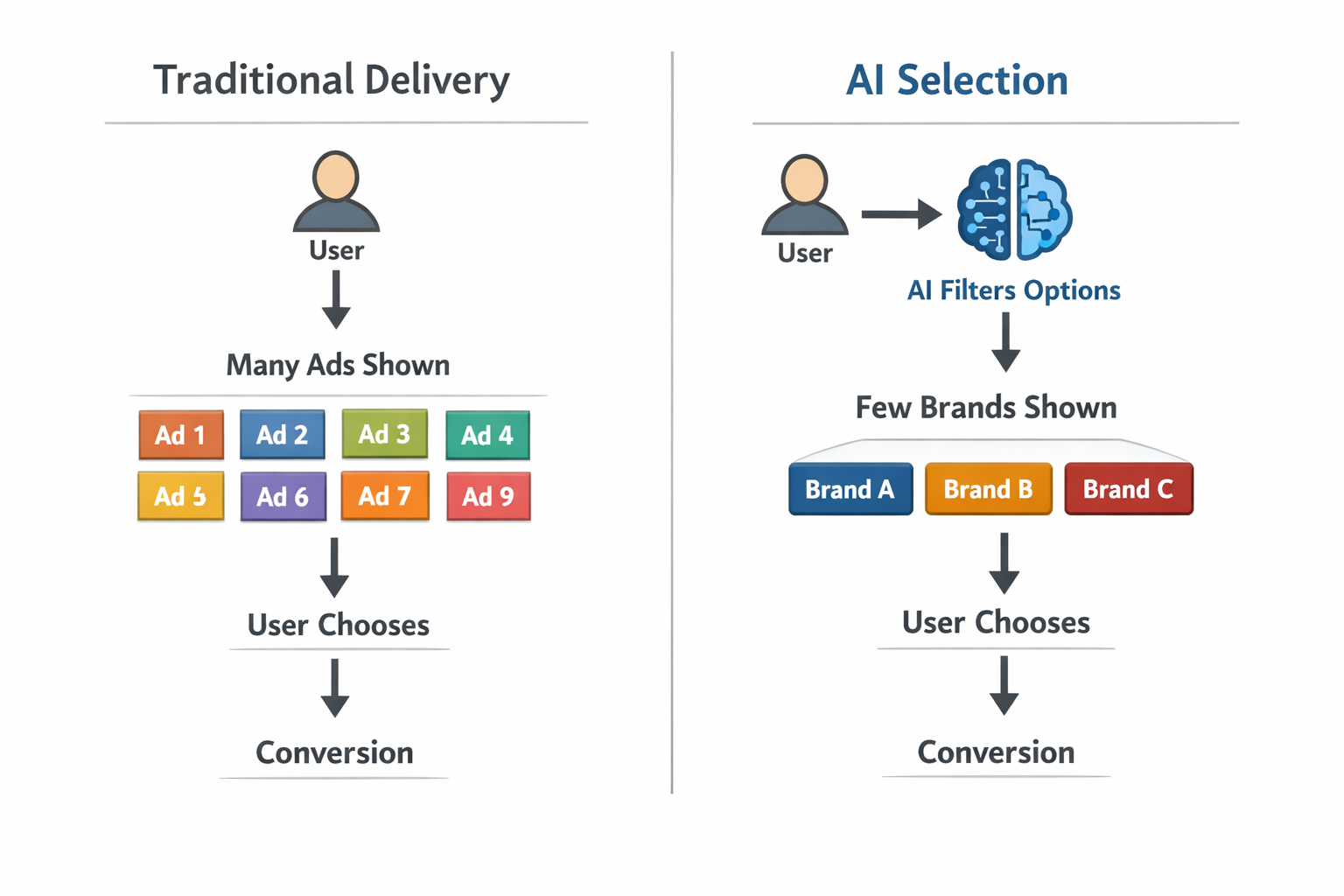
Before, platforms distributed impressions and let performance sort things out. Now, AI systems pre-select options before the user even sees them.
That means your job is no longer just to win auctions — it’s to qualify for recommendation.
In practice, this changes what matters:
-
Not “how do I get clicks?”
-
But “does the system understand when to show me?”
If the answer is unclear, you lose visibility entirely.
Where Most Advertisers Fail (And Don’t Realize It)
When brands don’t show up in AI-driven results, they usually assume it’s a budget or bidding issue.
It’s not. It’s a signal problem.
The most common failure patterns are:
-
Your offer is too generic (“best solution”, “high-quality service”).
-
Your use cases are unclear or buried in long-form copy.
-
Your product data is inconsistent across pages.
-
Your positioning changes depending on the channel.
This is why campaigns can look fine but still underperform — a problem already visible in traditional ads (see Why Your Facebook Ads Look Great But Still Don’t Sell).
AI just makes that failure binary: visible or invisible.
Strategy Shift #1: Turn Your Offer Into Clear Use Cases
AI systems don’t interpret vague value propositions well.
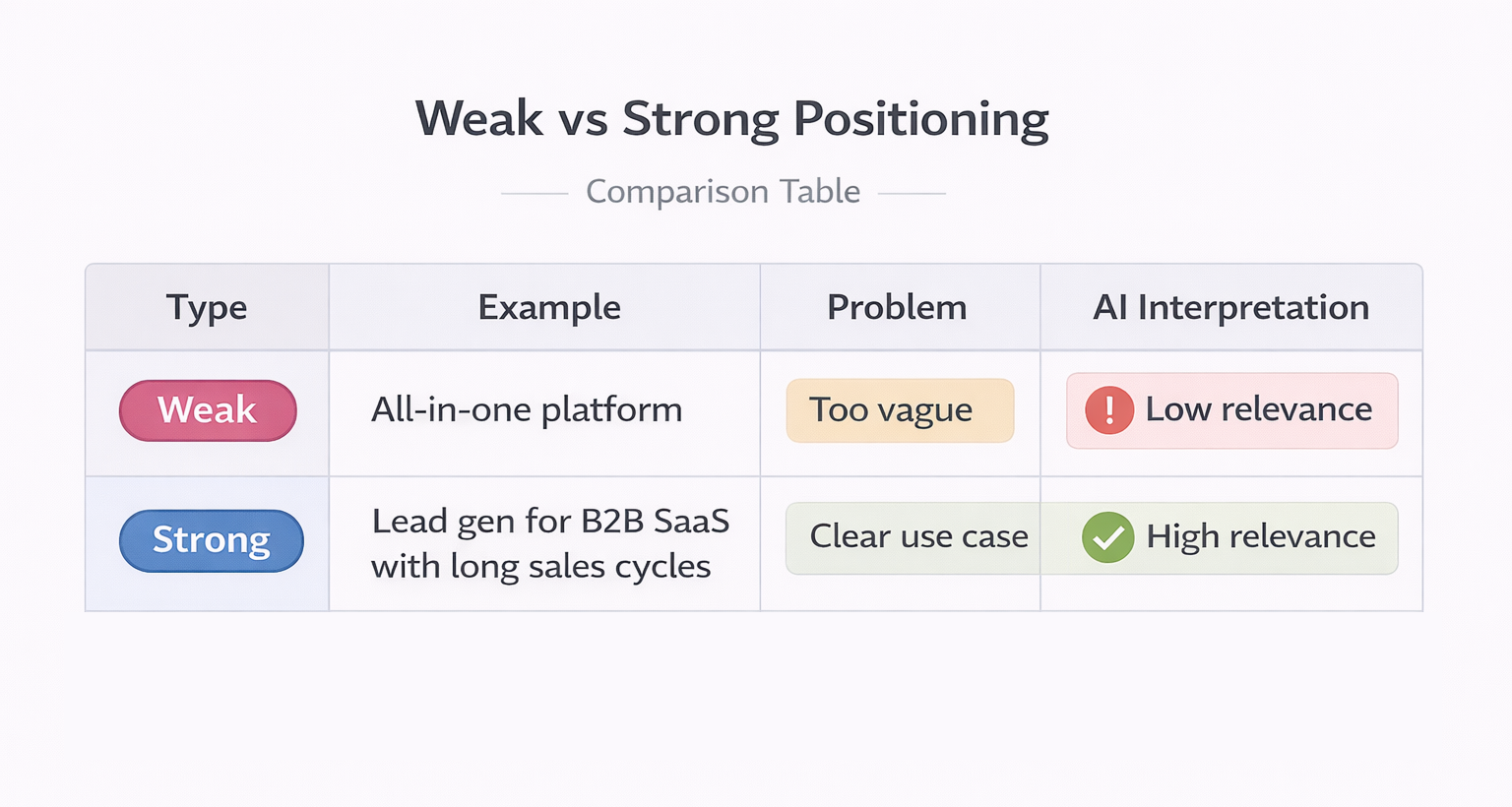
They need clear mappings between:
-
user intent → problem → solution.
Instead of writing:
“All-in-one marketing platform”
You need to structure messaging like:
-
“Lead generation for B2B SaaS companies with long sales cycles.”
-
“Local service ads for HVAC companies targeting homeowners within 20km.”
Actionable rule: every core page and ad should answer:
- Who is this for, in what situation, and why this over alternatives?
If a model can’t extract that in seconds, it won’t use it.
Strategy Shift #2: Fix Data Before You Scale Anything
Most teams try to fix performance by increasing:
-
budget;
-
creative volume;
-
targeting inputs.
In AI environments, that often makes things worse.
Instead, audit your inputs:
-
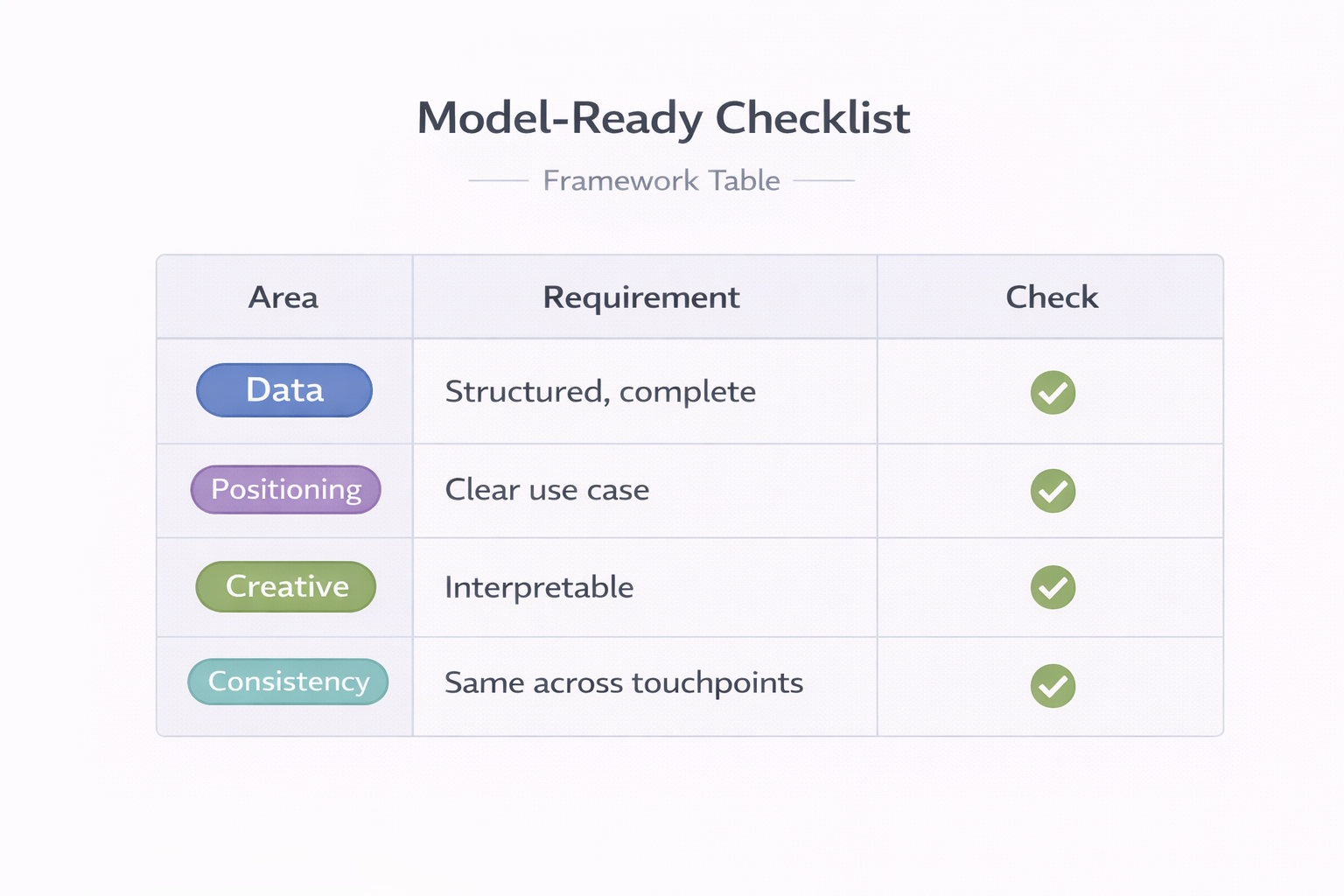
Are product/service attributes complete and structured?
-
Are pricing, positioning, and use cases consistent across pages?
-
Can your offer be compared easily against competitors?
If not, scaling spend just amplifies weak signals.
This is exactly why better inputs outperform smarter targeting (see Why AI Targeting Isn’t Enough Without Better Inputs).
Strategy Shift #3: Stop Producing “Generic” Creative
AI-generated creative is increasing supply — but most of it looks the same.
That creates a new failure mode:
High production quality, low interpretability.
Winning creative now does one thing well:
It makes the use case obvious immediately.
Instead of:
-
polished but abstract branding,
focus on:
-
clear scenario (“Struggling to generate qualified leads?”),
-
defined audience (“For B2B founders…”),
-
concrete outcome (“Reduce CPL by filtering low-intent traffic”).
If your ad can’t be categorized instantly, it won’t scale.
Strategy Shift #4: Treat Trust as a Measurable Input
AI systems are increasingly sensitive to trust signals.
Not just engagement — but consistency and credibility.
That includes:
-
alignment between ad and landing page;
-
presence of proof (reviews, case data, specificity);
-
transparency in messaging.
This matters more than most teams expect.
Because in AI interfaces, recommendations feel like advice — not ads.
If your brand feels unreliable, it won’t be surfaced.
This is why transparency is becoming a performance driver, not just branding (see Why Transparency in Ads Will Be the Next Competitive Advantage).
Strategy Shift #5: Optimize for Selection, Not Reach
Traditional thinking:
More reach = more opportunity.
AI reality:
Only selected options matter.
That means:
-
Being “one of many” is losing value.
-
Being “one of few recommended” is everything.
So instead of expanding reach, focus on:
-
improving relevance for specific intent clusters;
-
tightening positioning around high-value use cases;
-
making your offer easier to compare and select.
This aligns with what we already see in paid social:
Relevance consistently beats reach (see Why Relevance Is More Important Than Reach in Paid Social Campaigns).
The Bottom Line
AI is not just changing how ads are delivered.
It’s changing how brands get considered in the first place.
The gap is already forming:
-
Some brands are easy for AI to interpret, compare, and recommend.
-
Others are too vague, inconsistent, or generic — and get ignored.
That’s what creates winners and losers.
Not who uses AI more. But who builds inputs that AI systems can actually use.