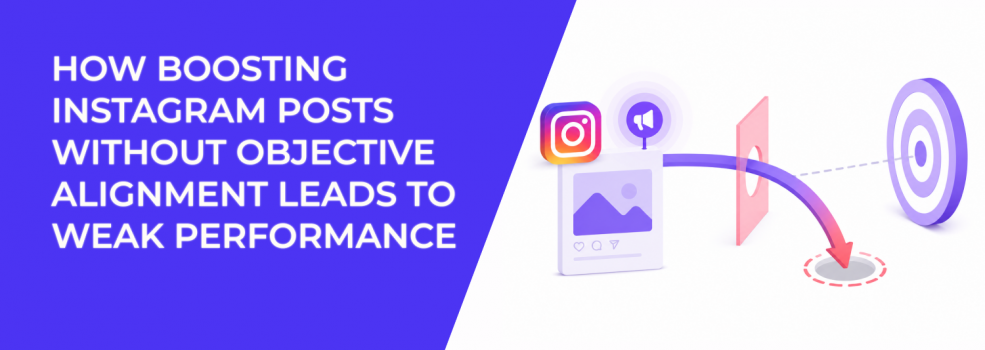
Many Instagram campaigns fail because the boosted post and the campaign objective push Meta toward different user behaviors.
Advertisers often choose a post first because it performed well organically. The content receives strong engagement, so it immediately gets boosted for traffic, leads, or purchases without deeper validation.
The problem is that Meta does not optimize campaigns based on whether the content looks attractive or receives attention. The system optimizes around behavioral patterns connected to the selected objective. When the content naturally attracts passive engagement while the campaign objective expects commercial intent, delivery quality starts weakening quickly.
Why Objective Mismatch Creates Weak Delivery
Different campaign objectives train Meta to prioritize completely different user actions.
Traffic campaigns push delivery toward users likely to click links. Conversion campaigns prioritize users likely to complete purchases or lead events. Engagement campaigns favor users who interact socially with posts through likes, comments, shares, and saves.
The boosted content needs to support the same behavior the objective expects.
A common mistake appears when advertisers boost highly engaging lifestyle or entertainment Reels using a conversions objective. The Reel may generate large amounts of attention organically, but it never creates strong buying intent signals.
Meta receives conflicting feedback from the campaign:
- the objective asks for purchases
- the content attracts passive engagement
- early delivery generates weak conversion feedback
- the algorithm struggles to identify qualified buyers
This often produces unstable CPA and inconsistent ROAS after scaling begins.
That is why experienced advertisers carefully choose the right Meta campaign objective before turning Instagram content into paid delivery.
How To Check Whether an Instagram Post Matches the Objective
Before boosting any Instagram post, advertisers should evaluate what type of behavior the content naturally encourages.
The easiest way to do this is by reviewing how users already interact with the post organically.
For example:
- product demonstrations often align with conversion campaigns because users evaluate the offer directly
- educational carousels frequently support lead generation because users save information for later
- behind-the-scenes Reels usually fit awareness or engagement objectives better
- discussion-driven posts tend to perform strongest inside engagement campaigns
The key question is simple: what action does this content naturally encourage users to take?
That answer usually predicts campaign quality more accurately than engagement totals alone.
Why High Engagement Can Still Damage Conversion Campaigns
Some Instagram posts produce strong metrics while quietly weakening campaign efficiency.
Short entertainment Reels are a common example. They often generate excellent watch-time and low CPC because Meta can distribute them cheaply across large audiences.
But cheap traffic becomes expensive when users never convert.
Inside Ads Manager, this usually appears as:
- strong video completion rates
- healthy CTR
- low outbound click costs
- weak purchase or lead performance
The advertiser may assume the landing page is the problem while the real issue starts earlier in the funnel. Meta simply keeps finding more users who behave like viewers instead of buyers.
This is closely connected to campaigns optimizing for the wrong goal.
How To Align Instagram Posts With Conversion Objectives Before Boosting
Advertisers can improve campaign stability significantly by validating posts before launch.
A practical workflow usually includes several checks:
- Review comment quality carefully.
Comments asking about pricing, shipping, product use, or availability usually indicate stronger commercial intent than generic reactions. - Check whether the content demonstrates an outcome clearly.
Conversion-focused posts typically show the product solving a visible problem or producing a result quickly. - Match the CTA behavior to the objective.
If the campaign objective is purchases, the content should naturally encourage buying consideration instead of passive scrolling behavior. - Separate engagement content from sales content.
Not every strong organic post should become a conversion ad. Some content works better for reach or audience warming.
This process helps prevent weak behavioral signals from shaping delivery too early.
How Objective Alignment Improves Scaling Stability
Campaign scaling becomes easier when the post already supports the intended optimization behavior. Meta receives cleaner feedback from the beginning, which improves:
- conversion prediction accuracy
- audience matching quality
- learning phase stability
- retargeting efficiency
- spend consistency during scaling
Campaigns structured this way usually require fewer emergency optimizations later because the algorithm starts with stronger intent signals immediately.
Advertisers who set up performance-driven Facebook campaign objectives often experience more stable scaling because the content and optimization goal reinforce each other instead of competing.
Final Takeaway
Boosting Instagram posts without objective alignment weakens campaign performance because the content trains Meta toward the wrong user behavior.
A post designed mainly for entertainment or passive engagement rarely performs efficiently inside a purchase-focused campaign. Even strong organic engagement can become misleading when the behavioral signals conflict with the campaign objective.
The safest Instagram campaigns usually start by matching the content format, engagement pattern, and CTA behavior to the exact outcome Meta is expected to optimize for.