A campaign can run across multiple placements and still struggle to scale.
In many cases, the issue is not targeting or creative — it’s how your business assets are connected inside Meta. When Pages, Instagram accounts, WhatsApp accounts, and ad infrastructure are not properly linked, the system cannot use data effectively.
That gap shows up as weaker optimization, inconsistent results, and wasted spend.
What connected business assets actually mean
Connected business assets define how your marketing system operates across Meta platforms.
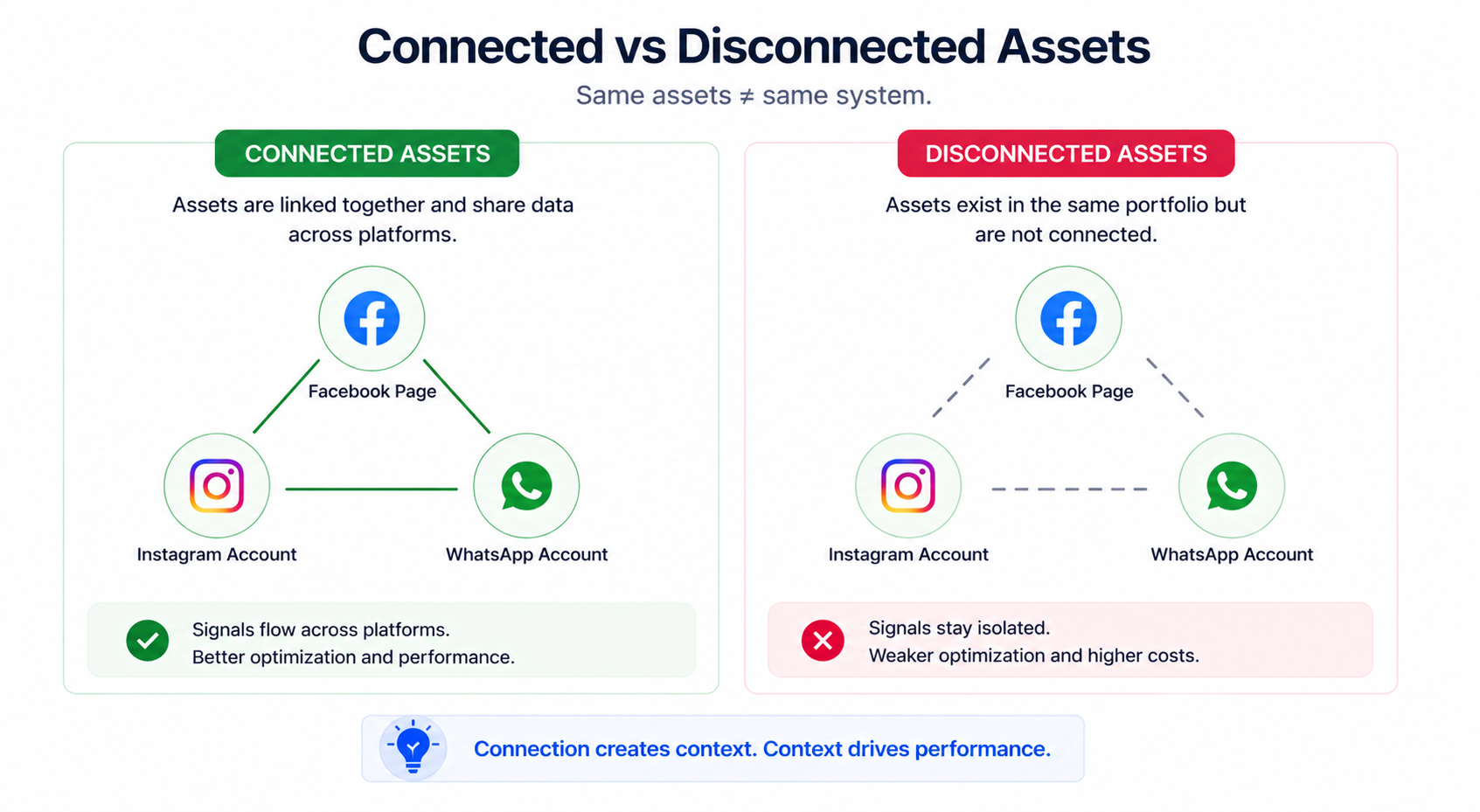
You can connect assets in two ways:
- By adding them to the same business portfolio.
- By connecting them directly to each other.
These two layers serve different purposes.
A shared portfolio gives you centralized control and visibility. Direct connections enable functional features such as crossposting, shared messaging, and unified analytics.
For example:
- A Facebook Page can be connected to an Instagram professional account.
- A Page can also be linked to a WhatsApp Business account.
- These connections allow ads, messages, and engagement signals to work together.
If assets only exist in the same portfolio without direct links, many features remain inactive.
Why this matters for campaign performance
Meta’s delivery system depends on combined signals across platforms.
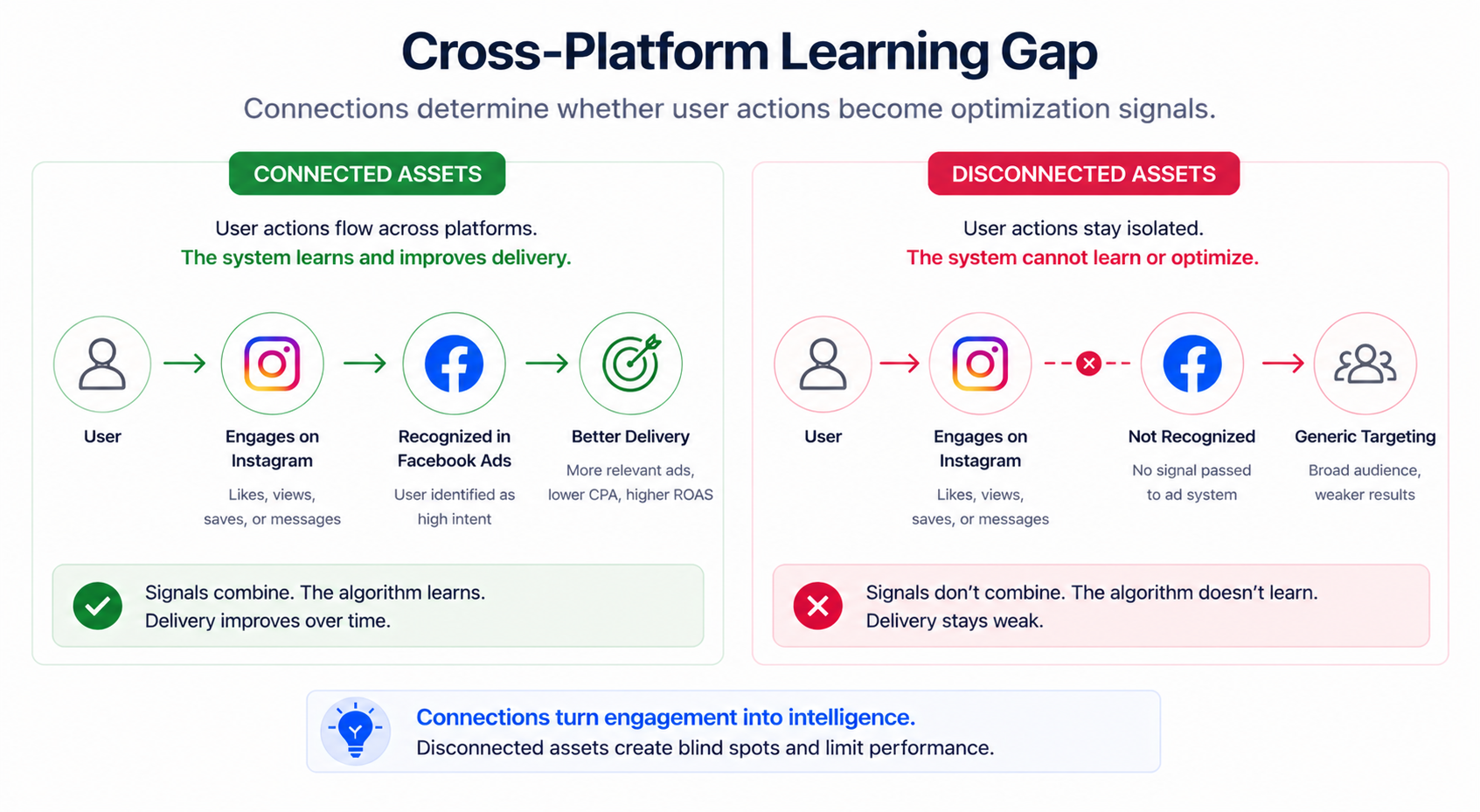
When assets are connected correctly, the system can:
- Deliver ads across Facebook, Instagram, and Threads from a unified setup.
- Combine engagement signals across platforms.
- Use shared data to improve targeting decisions.
When connections are missing, the system sees fragmented behavior.
A user might engage with your Instagram content but never be recognized as a high-intent user in your Facebook campaigns. The algorithm loses context — and that directly affects optimization.
How Meta uses connected data for optimization
Meta shares information across connected assets to improve both delivery and reporting.
This includes:
- Personalizing ads based on user activity across platforms.
- Delivering ads to more relevant audiences using combined signals.
- Consolidating insights across Pages, Instagram accounts, and Threads.
- Managing transactions and payments across commerce features.
From a performance standpoint, this creates a feedback loop:
User interaction → signal captured → delivery adjusted → performance improves.
When assets are not connected, that loop becomes incomplete. The system reacts slower and with less precision.
Business impact on key metrics
Disconnected or partially connected assets rarely break campaigns completely. Instead, they reduce efficiency over time.
You’ll typically see:
- Higher CPC, because the system competes in broader auctions.
- Increased CPA, due to weaker conversion signals.
- Lower ROAS, as budget shifts toward less relevant users.
- Slower learning, especially in new campaigns.
For example, if messaging interactions from Instagram or WhatsApp are not connected to your ad account, those signals are not used for optimization. The system continues targeting users with weaker intent signals.
Common scenarios where this issue appears
These problems often come from operational decisions, not technical mistakes.
1. Assets added but not directly connected
Teams assume being in one portfolio is enough. In reality, features like crossposting and unified analytics stay inactive.
2. Instagram account not properly configured
If it’s not a professional account or not linked correctly, ad delivery and signal sharing are limited.
3. Fragmented communication channels
Facebook, Instagram, and WhatsApp operate separately. Campaigns cannot learn from cross-channel behavior.
4. Scaling across placements without alignment
Advertisers expand into new placements without connecting assets. Performance becomes inconsistent across channels.
This is especially common when teams try scaling without aligning systems — similar to issues described in strategies for running campaigns across Facebook and Instagram.
Risks and considerations
Connecting assets improves capability, but it introduces structural complexity.
- Disconnecting and reconnecting assets can disrupt active campaigns.
- Shared data across assets can distort attribution if poorly structured.
- Over-connecting unrelated assets can mix audience signals.
- Some features remain active after disconnection and require manual disabling.
You should also avoid assuming that connection alone fixes performance. Poor creative or weak offers can still limit results.
Prerequisites for effective asset connections
Connections only work when the foundation is strong.
Before relying on them, make sure you have:
- A clearly defined ICP and targeting logic.
- Consistent conversion tracking across campaigns.
- Active ad accounts aligned with business goals.
- Sufficient budget to generate usable signals.
- Clean campaign structure without overlapping audiences.
If your tracking setup is weak, start by reviewing how to properly set up your Meta pixel.
Practical recommendations for advertisers
Treat asset connections as part of your performance system — not just setup.
Align assets with real user behavior
Your connections should reflect how users move between platforms, not how your internal structure is organized.
Verify functional connections
Check whether features like messaging, analytics, and crossposting are active — not just whether assets exist in one portfolio.
Reduce signal fragmentation
Avoid splitting engagement, messaging, and conversion paths across disconnected assets.
Build stronger audience inputs
Even with perfect connections, weak audiences limit performance. High-intent segments — such as those built from real engagement data — help stabilize campaigns.
Maintain cross-platform consistency
Campaign performance improves when systems are aligned — similar to best practices in synchronizing Facebook and Instagram campaigns.
Final takeaway
Connected business assets define how Meta understands your audience.
When connections are properly configured, the system uses combined signals to optimize delivery and improve results. When they are missing, campaigns operate with incomplete data.
That gap doesn’t always produce errors — but it consistently reduces efficiency.
If you want stable performance, start with structure. Then build targeting and creative on top of it.