Many Instagram campaigns fail because advertisers only measure the click itself.
The ad gets engagement, traffic volume grows, and CTR may even improve. But users still avoid meaningful actions after the click. They leave landing pages quickly, ignore forms, abandon checkout, or stop responding after opening a DM conversation.
This usually signals weak buyer intent hidden underneath strong engagement metrics. Destination testing helps expose that problem early, before CPA starts rising aggressively.
Problem: Weak Instagram Intent Often Looks Like “Good” Performance at First
Instagram users behave differently depending on what happens after the click.
Some users are comfortable opening a DM conversation. Others prefer browsing a profile before trusting the brand. Some are willing to visit a landing page immediately, while others drop off the moment Instagram sends them outside the app.
When every user gets forced into the same destination flow, weak intent becomes harder to diagnose. The campaign may look active, but the traffic does not create enough commercial movement.
This creates misleading patterns inside Ads Manager:
- CTR stays healthy because the creative is still earning taps.
- Outbound clicks increase, but landing page behavior remains shallow.
- CPM may stay stable while conversion rates fluctuate.
- CPA rises later because Meta keeps finding users likely to repeat weak click behavior.
That is why good numbers hide bad performance in many Instagram campaigns.
The issue becomes more expensive during scaling. Meta sees click activity and expands delivery toward users with similar engagement patterns. If the original clicks came from curiosity rather than buying intent, the campaign starts scaling the wrong behavior.
The advertiser often reacts by changing the creative or increasing budget. But the real signal is usually post-click movement. If users do not take the next action after arriving, the campaign does not have enough intent to support growth.
Solution: Test Multiple Destinations to See Where Intent Actually Survives
Destination testing separates passive engagement from real commercial behavior.
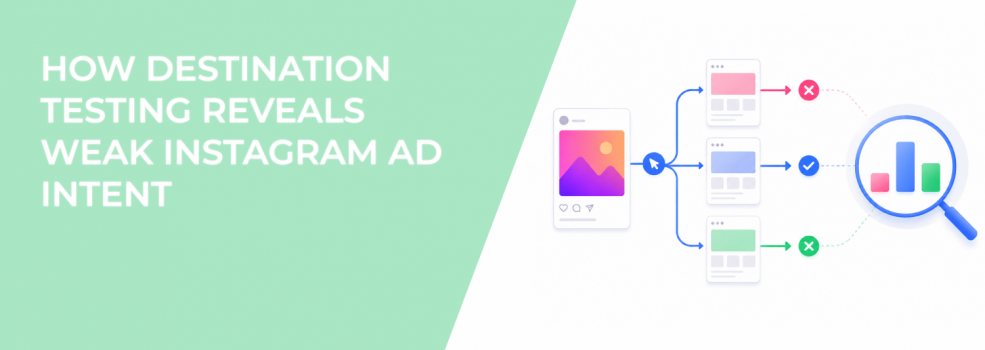
Instead of sending all traffic into one path, advertisers test different destinations using the same creative and audience. This shows where users continue deeper into the funnel and where intent collapses immediately.
The most useful destination tests usually compare:
- Landing pages, where users must leave Instagram and engage with the offer directly.
- Instagram profiles, where users can validate trust through posts, comments, highlights, and social proof.
- DM conversations, where users can ask questions before committing to a form or purchase.
- Instant forms, where friction stays low but lead quality needs close review.
- Product pages, where buying intent is tested through view content, add-to-cart, and checkout behavior.
For example, a cold audience may click aggressively on Reels ads but avoid leaving Instagram entirely. That same audience may respond better to a DM flow because the interaction feels lower friction and more conversational.
A warmer audience may behave differently. Users already familiar with the brand often skip profile exploration and convert directly on-site. In that case, forcing them into a profile-first flow can slow down the buying process.
Destination testing exposes those intent differences quickly.
The key is studying what users do after the click instead of focusing only on CPC or CTR. Strong-intent traffic creates deeper behavioral patterns. Users spend more time on-site, continue product exploration, complete forms more consistently, or maintain conversation quality inside DMs.
Weak-intent traffic usually produces shallow behavior regardless of how cheap the clicks look. This is why advertisers should focus on what metrics really matter when testing new audiences, not only top-level engagement metrics.
Instead of guessing whether the problem is creative, targeting, or funnel design, destination testing shows where the user stops. That makes the next decision more precise: improve the landing page, adjust the CTA, change the offer framing, or rebuild the audience.
Campaigns with real buying intent behave more consistently across the funnel. Campaigns driven by passive curiosity usually break immediately after the first interaction. That is why high buying intent matters more than click volume when judging Instagram ad performance.
Final Takeaway
Instagram clicks alone cannot reveal buyer intent accurately.
Destination testing helps advertisers identify where users continue moving toward conversion and where engagement turns into passive browsing behavior. That insight often matters more than CTR because strong campaigns depend on downstream intent, not just cheap traffic volume.