Meta Business Suite is meant to simplify how you manage your business across Facebook, Instagram, and other Meta platforms. The problem is that it simplifies the view — not the underlying systems.
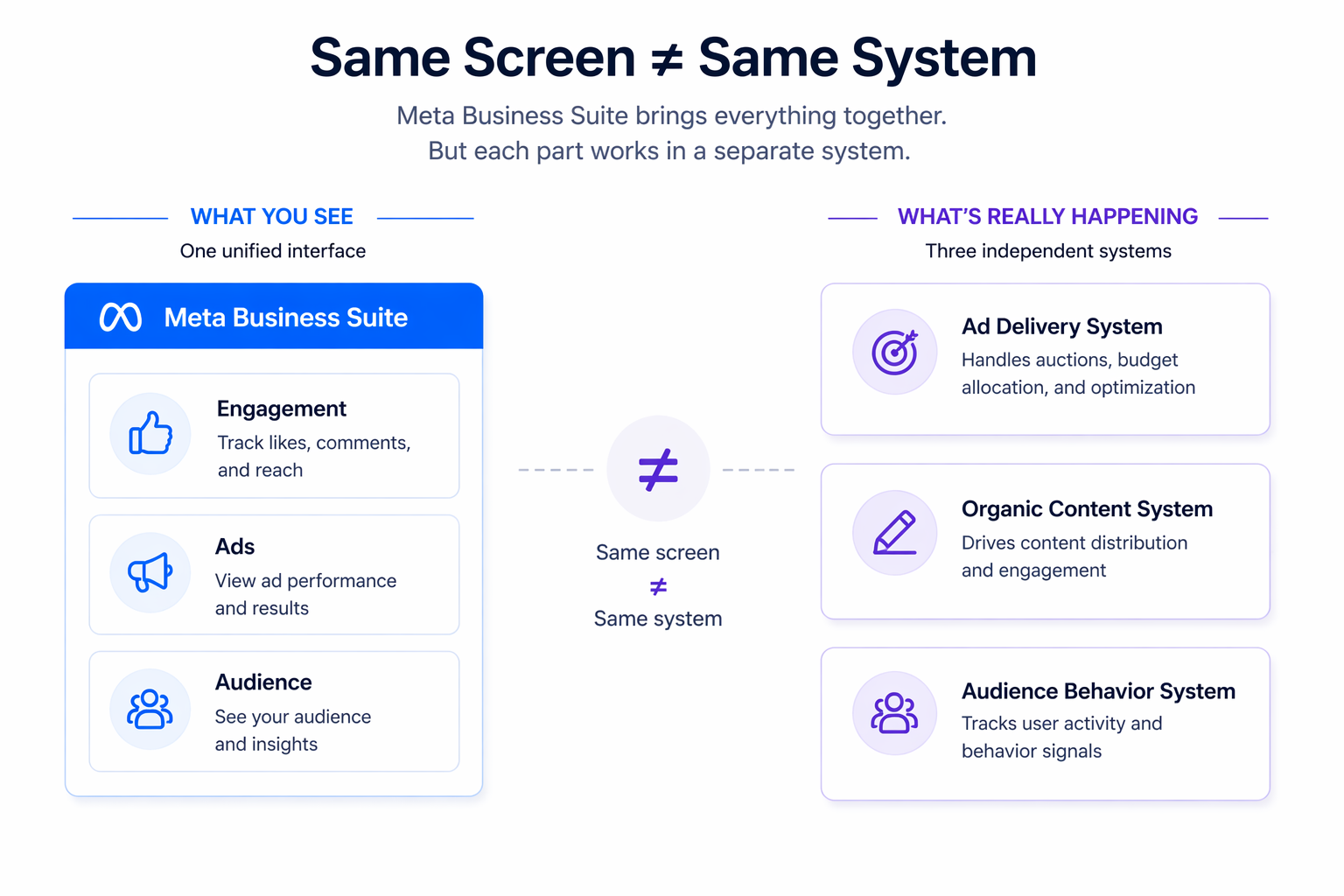
For advertisers, that distinction matters more than it seems. When everything is displayed in one place, it’s easy to assume it all works together. In practice, you’re looking at several independent systems that are only loosely connected.
Most performance issues that “don’t make sense” start right here.
What Meta Business Suite Actually Does
At a functional level, Business Suite gives you centralized access to your business assets through a single interface. You can manage your Pages, ad accounts, content, messages, and permissions without switching tools.
From a workflow perspective, it allows you to:
-
monitor business activity and notifications in one place,
-
plan and publish content across platforms,
-
respond to messages from multiple channels,
-
view high-level performance insights,
-
launch simple ads or boost content quickly.
All of that is useful. The issue is how this structure gets interpreted.
The Key Problem: Everything Looks Connected (But Isn’t)
Because all of these elements sit side by side, it creates a strong illusion of cause and effect.
You see engagement metrics, ad results, and audience activity in one place, so naturally you start linking them. That’s where decisions begin to drift.
A typical situation looks like this:
-
engagement on recent posts drops slightly,
-
at the same time, your CPA increases,
-
both changes appear in Business Suite,
-
you assume one caused the other.
In reality, these signals often come from different systems reacting to different inputs.
For example, your ad performance might be shifting because:
-
your audience is becoming saturated,
-
conversion signals are weakening,
-
or competition in the auction has increased.
The timing overlaps, but the mechanisms don’t.
This is exactly why why performance metrics need context. Without that context, you’re solving the wrong problem.
Why This Directly Affects Campaign Performance
Once signals are misinterpreted, the next step is usually action — and that’s where performance starts to break down.
Instead of isolating the real cause, advertisers tend to adjust whatever is most visible. That usually leads to:
-
changing creatives when the issue is targeting or signal quality,
-
editing campaigns too early, before the system stabilizes,
-
shifting budgets without understanding delivery dynamics.
Each of these actions disrupts Meta’s optimization process.
From the platform’s perspective, consistency is critical. When inputs keep changing, the system has to re-learn where to allocate budget. That leads to unstable performance, even if the original campaign was working.
How This Connects to Targeting and Conversion Signals
At the core of Meta’s ad system is pattern recognition.
The algorithm looks for consistent signals — who clicks, who converts, and what those users have in common. The stronger and more consistent those patterns are, the better your delivery becomes.
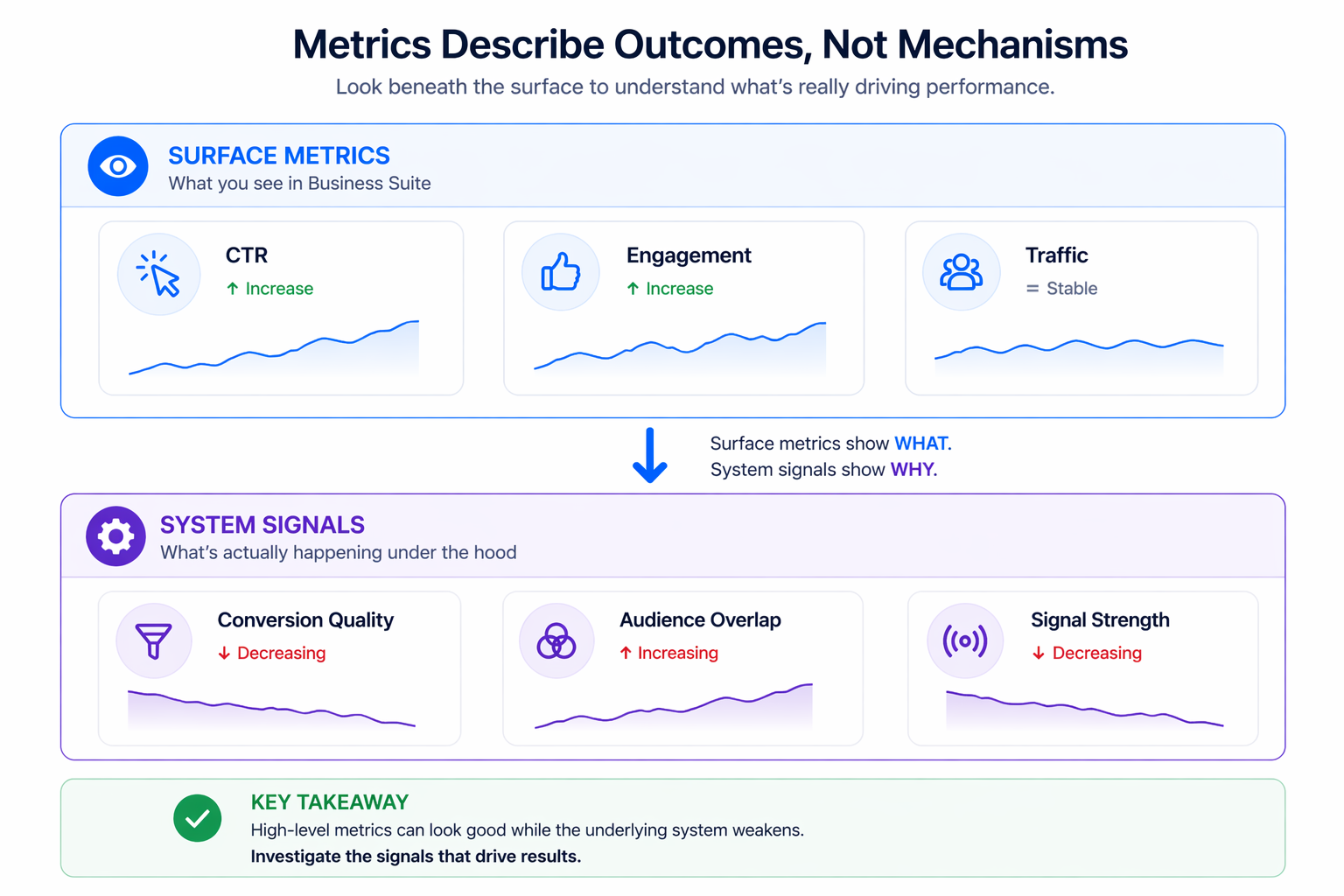
If you rely only on Business Suite summaries, you lose visibility into that layer.
You might see:
-
strong engagement but weak conversions,
-
stable traffic but declining lead quality,
-
or good CTR with rising CPA.
Without deeper analysis, those signals look contradictory.
To understand what’s actually happening, you need to go beyond surface metrics. This is where how to analyze Facebook ad performance beyond surface metrics becomes essential.
Business Impact on Cost and Efficiency
Misreading the system doesn’t just create confusion — it directly affects your numbers.
Over time, you’ll typically see:
-
higher CPC due to inefficient targeting adjustments,
-
rising CPA from interrupted learning phases,
-
inconsistent ROAS caused by unstable budget allocation,
-
lower lead quality when engagement is mistaken for intent,
-
wasted impressions on audiences that don’t convert.
These changes don’t always happen suddenly. More often, performance becomes unpredictable, which makes scaling much harder.
Where This Shows Up in Real Campaigns
This pattern is easy to recognize once you know what to look for.
In B2B lead generation, low conversion volume often leads to overreaction. Small fluctuations get interpreted as problems, and campaigns are edited before enough data accumulates.
In ecommerce, the issue tends to appear during scaling. As campaigns expand, performance temporarily softens. If that overlaps with changes in engagement, advertisers often blame the wrong factor and reduce spend too early.
In agencies, the problem compounds. Multiple accounts are visible in one interface, so alerts and performance changes feel urgent across the board. Without isolating causes, teams end up making broad adjustments that destabilize several campaigns at once.
For local businesses, the issue is usually tied to boosted posts. Engagement can look strong, but without structured targeting, those interactions rarely translate into meaningful results.
A More Reliable Way to Use Business Suite
The solution isn’t to stop using Business Suite. It’s to change how you use it.
It works best as a monitoring and coordination layer. You can track activity, manage content, and stay on top of communication without friction.
But when it comes to decisions that affect performance, you need a different approach.
Instead of reacting immediately, take a step back and validate the signal:
-
Is the change consistent or short-term?
-
Does it appear across multiple campaigns or just one?
-
Do delivery metrics (CPM, CTR, frequency) support the trend?
-
Has anything changed recently that could explain it?
Only after that should you decide what to adjust.
Focusing on which Facebook metrics actually matter for optimization — especially those tied to conversions — helps you avoid most of the common mistakes.
Final Takeaway
Meta Business Suite is designed to give you visibility across your business, but it doesn’t simplify how Meta’s systems actually work.
If you treat it as a unified system, you’ll keep connecting signals that aren’t related and making decisions that reduce efficiency.
When you treat it as a surface layer — and base decisions on deeper, system-level data — your campaigns become more stable, your targeting more accurate, and your budget far more effective.