Changing your ad strategy too often can stall learning. Waiting too long can let performance decay unnoticed. Neither extreme works.
If you run Facebook or Instagram ads, you’ve likely asked: “How often should I refresh?” There’s no single rule — but there are clear signals.
This article breaks down how to think about timing, which variables to watch, and how to plan changes based on actual business goals, not guesswork.
Why advertising strategies go stale faster than ever
In paid social, stability doesn’t last long. What worked 90 days ago may underperform today — not because your product changed, but because your environment did.
Three factors drive faster decay cycles:
-
Platform dynamics
Facebook and Instagram constantly evolve. Meta’s delivery systems, campaign types, and optimization logic change how ads are served. This is especially visible when campaigns struggle to exit learning or behave inconsistently — explained in more detail in
How to finish the Facebook learning phase quickly. -
Creative wearout
Audiences see your ads repeatedly in crowded feeds. Even strong creatives lose impact after repeated exposure — leading to declining CTR and rising costs. This pattern is closely related to
Why your Facebook ads stop performing after two weeks. -
External conditions
Privacy changes, seasonality, and shifts in consumer intent affect performance — even when your setup stays the same. CPM fluctuations during peak periods often hide deeper structural issues.
Understanding these forces helps you plan refreshes intentionally — instead of reacting too late.
When to evaluate your strategy: align changes to campaign cycles
Instead of relying on calendar-based refreshes, align strategy changes to campaign lifecycle stages.
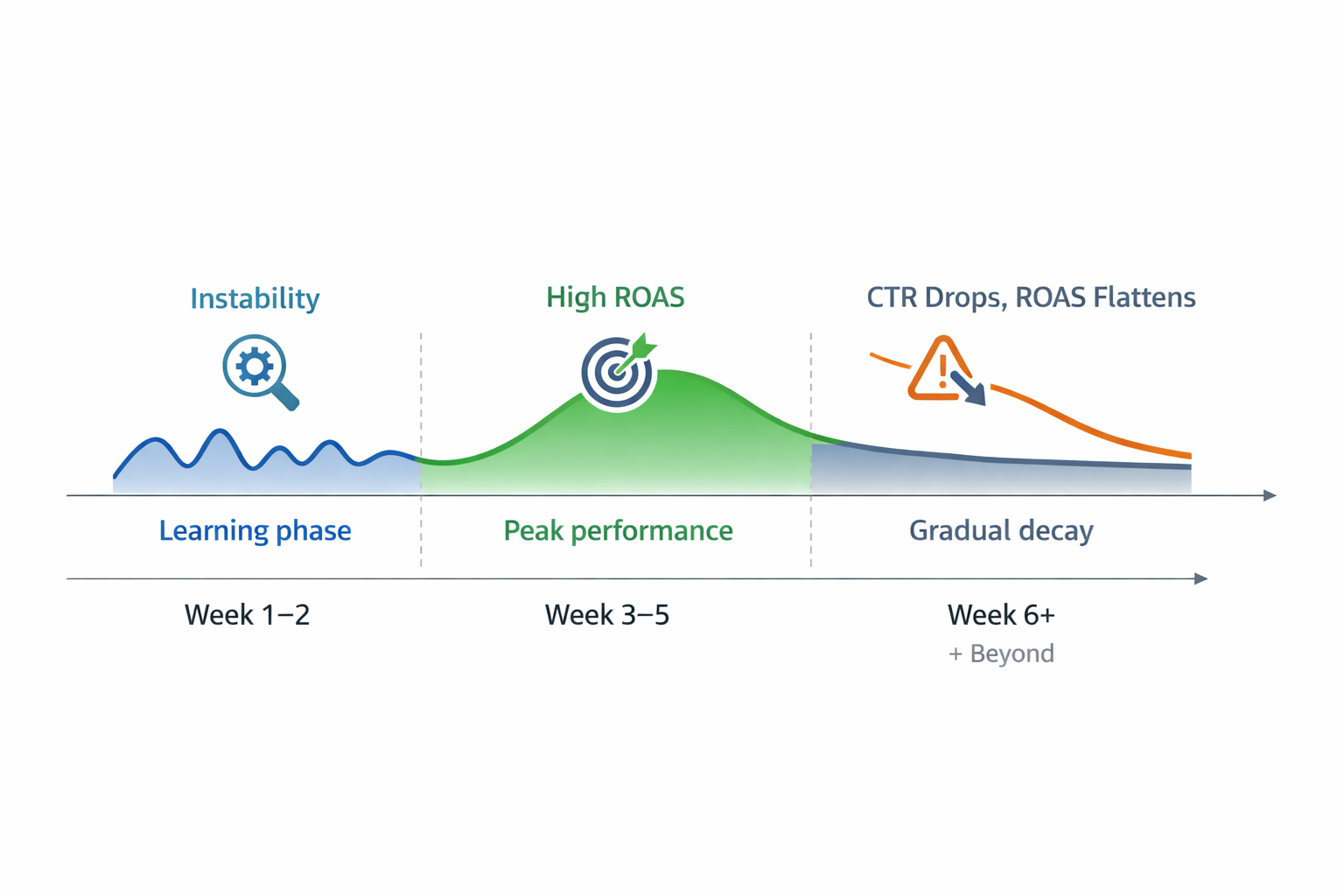
Week 1–2: the learning phase
Every new campaign enters a learning phase where the algorithm gathers conversion data. Changing creatives, targeting, or budgets too early resets this process — and delays optimization.
Avoid judging results during the first 7–10 days unless you see extreme signals like very high CPAs or near-zero CTRs.
Week 3–5: early scaling
If the campaign exits learning, this phase is about observation and restraint.
Focus on trend direction rather than daily swings. Compare current metrics against previous periods and account-level averages. Let winners stabilize before touching them.
If results stagnate here, the issue is often structural rather than creative. This is a common reason campaigns fail to scale — as explained in Why your Facebook ads stop scaling (and how to fix it).
Week 6 and beyond: optimization and refresh
Creative fatigue often appears subtly. ROAS may flatten or CTR may drift downward — without a sharp collapse.
At this stage, focus on controlled changes:
-
Test new creative angles while keeping the offer stable.
-
Introduce new audiences using proven ads.
-
Adjust placements or formats without rebuilding campaigns.
Incremental changes protect data quality better than full resets.
How to spot early signs that a change is needed
Waiting for performance to collapse usually means reacting too late. Instead, watch for early indicators.
Signal 1: Rising frequency, dropping CTR
A frequency above 4 paired with declining CTR often signals creative fatigue. The audience still fits — but the message no longer cuts through.
Refreshing visuals while keeping the core message usually restores performance faster than changing targeting.
Signal 2: Engagement without conversions
If ads generate clicks and comments but few conversions, the problem is often post-click. Landing page friction, unclear offers, or mismatched intent are common causes.
This scenario is covered in Why your Facebook ads aren’t generating leads and how to fix it.
Signal 3: Lookalike or broad audiences underperform
When previously reliable lookalikes stop converting, seed data quality or recency is often the issue.
For deeper context, see Why your lookalike audiences underperform (and what to do about it).
Signal 4: Performance plateaus despite budget increases
Flat results over several weeks usually indicate a performance ceiling. Increasing spend alone rarely solves this.
This is often the right time to test consolidation or campaign restructuring.
How to time strategy updates based on campaign type
Different campaign objectives age at different speeds.
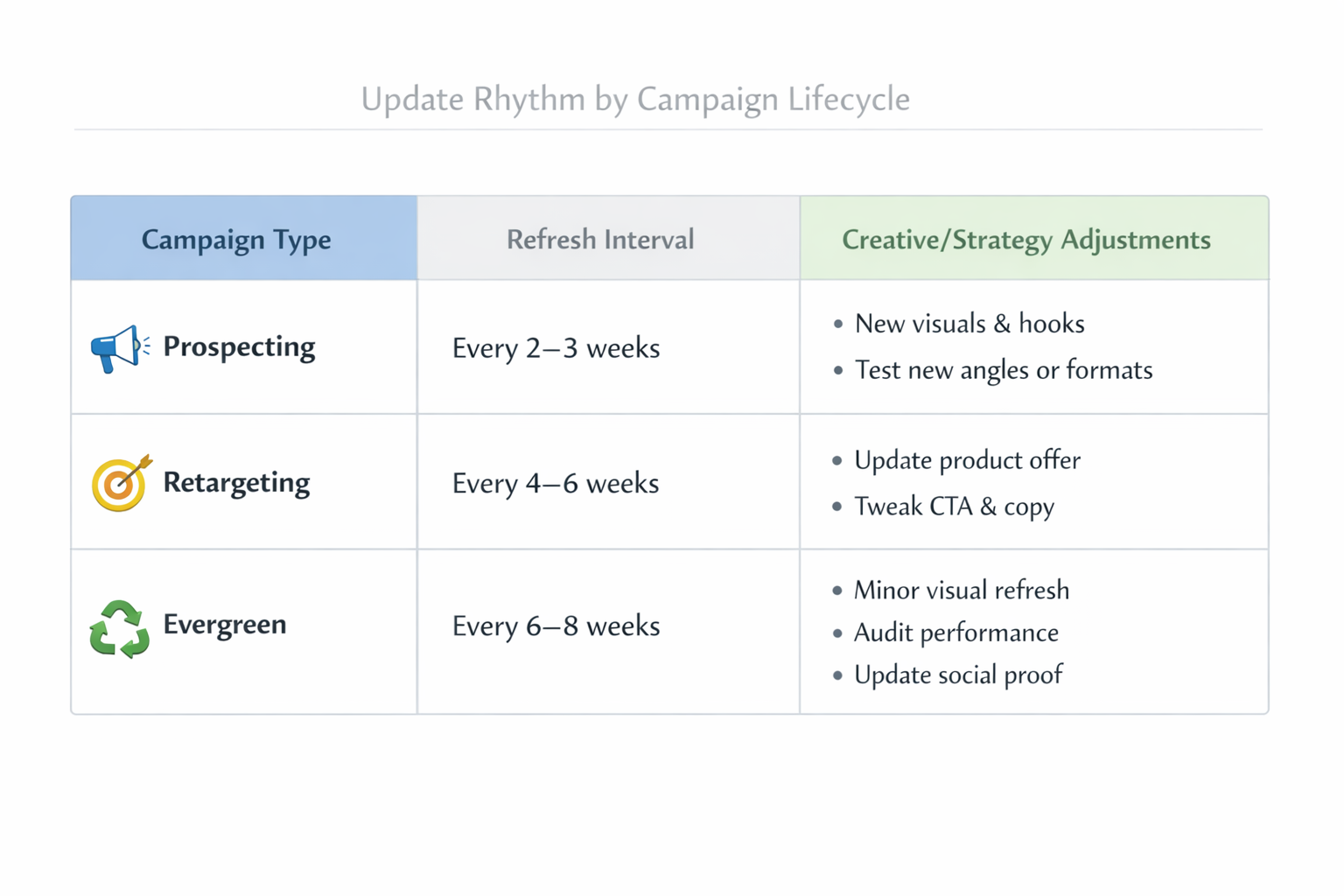
Prospecting (cold acquisition)
Cold traffic requires novelty. Creative wearout often starts after 2–3 weeks — even when metrics still look acceptable.
Plan creative refreshes proactively to avoid efficiency drops.
Retargeting (warm remarketing)
Smaller audiences fatigue faster due to frequency — but performance drops are often delayed.
Rotate creatives or offers once frequency approaches 4. For a safe refresh process, refer to When and how to refresh a Facebook campaign without losing momentum.
Evergreen offers (lead magnets, bundles)
Evergreen campaigns last longer — but messaging still needs refreshing every 6–8 weeks.
Reframing the same asset around seasonality or urgency often restores performance without funnel changes.
When you need a full strategic reset — not just a tweak
Some issues go beyond fatigue.
Launching a new product, changing pricing, or scaling aggressively often breaks assumptions built into your existing structure. In these cases, partial fixes usually fail.
A full reset should reassess audiences, funnel logic, and success metrics — beyond short-term ROAS.
How to make change a system — not a scramble
The goal is predictable iteration — not constant reaction.
A simple rhythm works well:
-
Review creative performance every two weeks.
-
Audit funnels monthly.
-
Revisit strategy quarterly.
This approach reduces emotional decisions and keeps campaigns stable as they scale.
Final thoughts
Your advertising strategy shouldn’t change because the calendar flips. It should change because the data — and the business — require it.
Use lifecycle stages, fatigue signals, and campaign type to guide updates. Change less often, but with clearer intent.