A campaign can lose stability without any changes in targeting, creatives, or budget.
One common cause is user removal. The moment someone is removed from a Meta Business Portfolio, their access disappears across all assets. If that person was responsible for campaign execution, the account may continue running without active management.
This creates a gap that is not visible in setup, but becomes visible in performance.
What actually happens when you remove a user
Removing a person from a business portfolio is a full access reset.
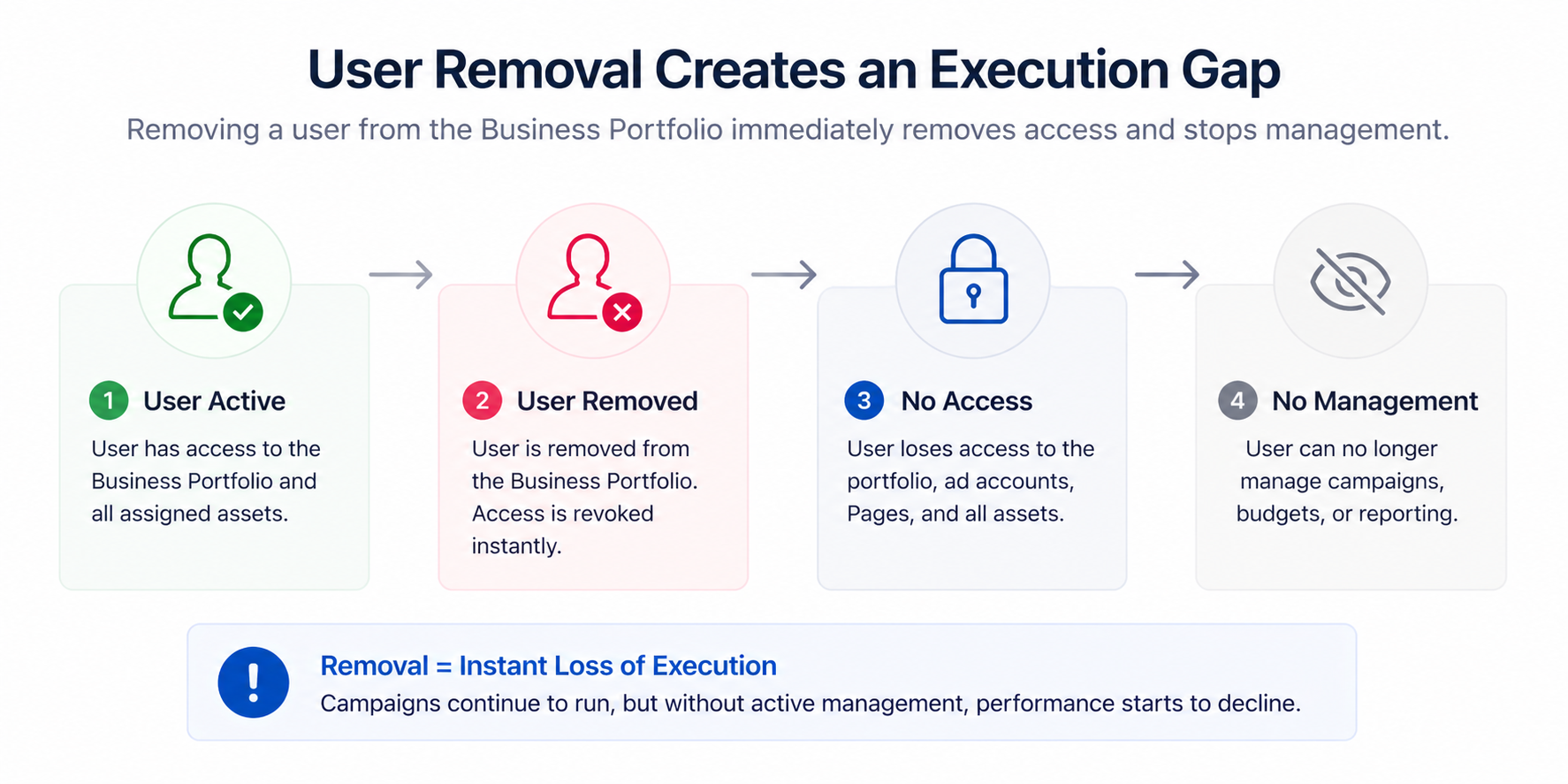
Once removed, the user immediately loses:
- Access to the business portfolio.
- Access to all assigned assets, including ad accounts and Pages.
- Ability to manage campaigns, budgets, or reporting.
This is different from removing access to a single asset. In this case, the user is removed from the entire operational structure.
Another important distinction is that removing people is not the same as removing partners. Partners operate through shared access and require a different process.
Why this affects campaign performance
Meta campaigns are continuous systems. They do not pause when internal access changes.
If a user responsible for optimization is removed:
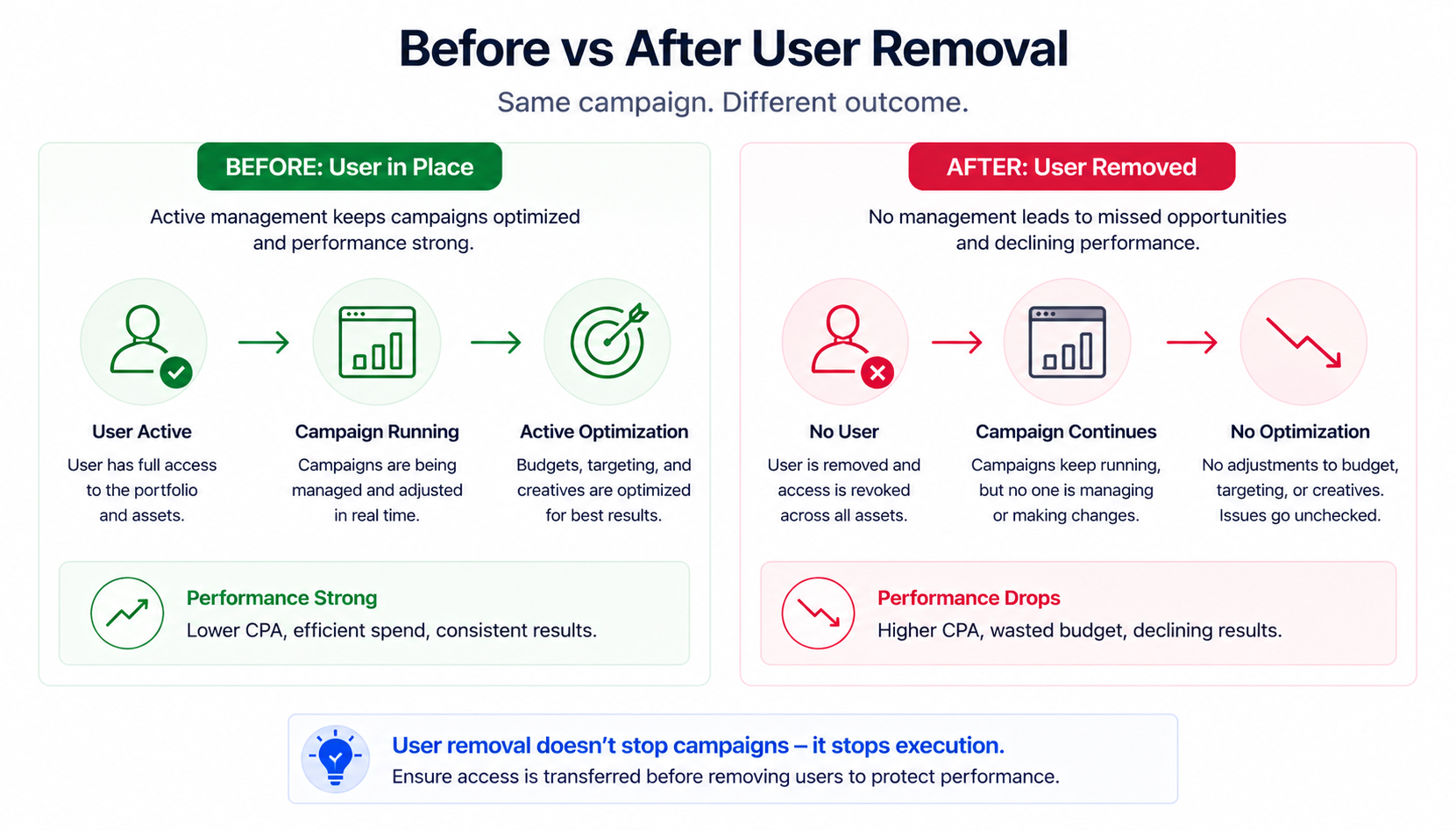
- Campaign adjustments stop.
- Budget inefficiencies remain uncorrected.
- Testing cycles are interrupted.
You can often see this in Ads Manager as stable spend combined with declining efficiency. The system continues delivering impressions, but without active optimization, performance degrades.
This situation often looks like a performance issue, but the root cause is operational. It is similar to cases where campaigns stop converting due to execution gaps rather than strategy, as explained in What to Do When Your Facebook Ads Suddenly Stop Converting.
Business impact
User removal introduces both immediate and delayed effects.
In the short term, campaigns may lose consistency. In the long term, repeated access gaps reduce the efficiency of the account.
Typical outcomes include:
- Higher CPA due to delayed optimization.
- Budget waste from unmanaged campaigns.
- Missed opportunities to scale winning ad sets.
These effects are not always tied directly to the removal event, which makes them harder to diagnose.
Requirements before removing someone
Before removing a user, the system must allow it.
This requires:
- Full control of the business portfolio.
- The user being part of the portfolio.
- Access to the People section in Meta Business Suite.
If you cannot access the People section, it usually means you do not have sufficient permissions.
In some cases, another admin with full control may need to approve the removal request through the Requests section.
Permission structure and its role in removal decisions
Removal decisions are tied to how permissions are structured.
Meta uses two main levels of access:
- Full control, which allows users to manage everything, including people and assets.
- Partial access, which limits users to specific tasks or assets.
Users with full control can assign and remove access across the portfolio. They can also automatically gain access to assets when needed.
Users with partial access are restricted to assigned tasks, such as managing campaigns or creating content.
Understanding this structure is important. Removing a user with full control has a much larger impact than removing someone with limited access.
Common scenarios where removal creates problems
Removal issues often appear in predictable situations.
For example, an agency is removed before internal team members are fully onboarded. Or a campaign manager is removed during an active scaling phase. In both cases, campaigns continue running but without proper oversight.
Another common case is removing inactive users without checking their access level. If that user had full control, the account may lose a key layer of administrative access.
These situations often lead to confusion, delays, and performance instability.
Security considerations
User removal is also a key part of account security.
Meta recommends removing users in several cases:
- Inactive users who have not logged in for extended periods.
- Users without two-factor authentication enabled.
- Users with public email domains not tied to the business.
Inactive or unsecured accounts are common entry points for unauthorized access.
Removing these users reduces risk, but must be done carefully to avoid disrupting operations.
This is especially important in complex accounts where multiple users interact with campaigns, budgets, and billing. Poor access control can lead to both security issues and operational inefficiencies, similar to the challenges outlined in The Hidden Costs of a Messy Ad Account.
Practical recommendations
User removal should follow a controlled process rather than a reactive action.
Before removing someone, confirm that all responsibilities have been reassigned. Campaign ownership, asset access, and reporting workflows should remain uninterrupted.
It is also important to review access regularly instead of waiting for a removal event. This helps identify inactive users, redundant permissions, and potential risks early.
In structured accounts, user removal becomes a routine maintenance task rather than a disruptive event. This approach aligns with broader operational discipline required for managing multiple campaigns and teams effectively, as discussed in How to Stay Organized When Managing Multiple Ad Accounts or Brands.
Final takeaway
Removing users from a Meta Business Portfolio is a high-impact action.
It affects access, execution, and security at the same time. When done with proper planning, it helps maintain control and reduce risk. When done without coordination, it creates gaps that slow down campaigns and reduce performance.
Access structure is not just an administrative detail. It is part of how campaigns run and scale.