Many Instagram posts look strong before they become ads.
They collect likes quickly, generate comments, and sometimes outperform every other post on the page. Advertisers often boost these posts immediately because the engagement creates confidence.
The problem is that visible engagement does not always translate into buying intent.
A Reel can attract attention because it is funny, visually satisfying, controversial, or trend-driven. Once budget enters the system, that same post may generate expensive clicks, weak conversions, and unstable ROAS because the audience never cared about the product itself.
This is one of the most common reasons boosted Instagram posts underperform.
The real problem with choosing posts based on visible popularity
Instagram rewards engagement behavior differently than Meta rewards conversion behavior.
Organic content spreads because users interact with it. Paid campaigns succeed because users take meaningful actions after seeing the ad.
Those are not always the same thing.
A skincare brand may publish a satisfying “before and after” Reel that generates massive reach organically. Users watch it because the transformation feels visually interesting. The company boosts the post expecting strong sales performance.
CTR initially looks healthy. Then problems appear:
- Add-to-cart rate stays weak.
- Product page engagement drops quickly.
- CPA rises after spend increases.
- Retargeting audiences fill with low-intent users.
The content generated curiosity, not commercial intent. This is where many advertisers misread Instagram engagement completely.
The solution: read engagement quality instead of engagement volume
Strong media buyers rarely evaluate posts by likes alone.
Before boosting content, they look for signals connected to evaluation, buying behavior, or delayed intent. These signals usually predict ad quality far better than surface engagement numbers.
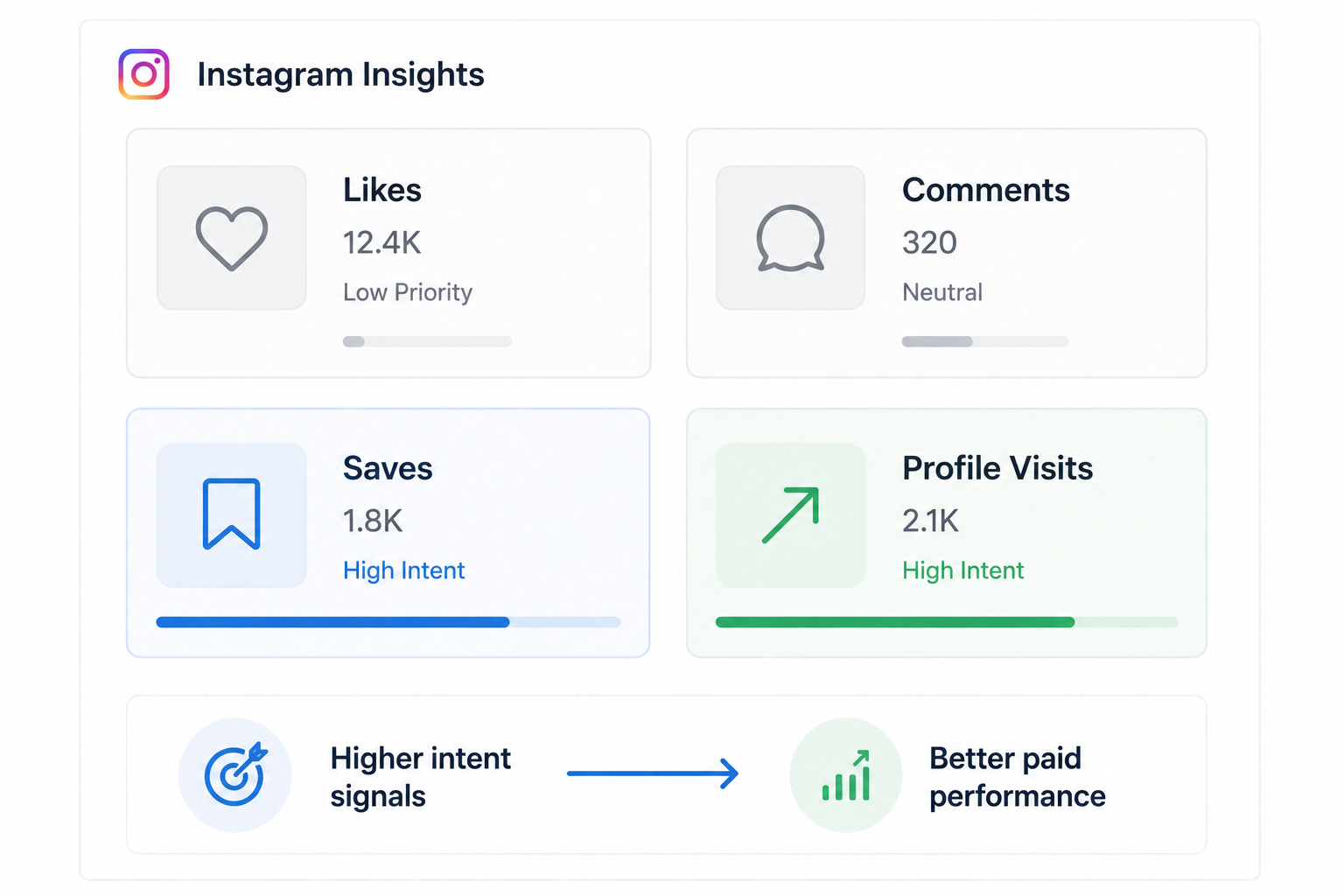
Here are the engagement patterns worth checking before boosting a post:
- Saves relative to reach.
Saves usually indicate future consideration. Users may want to revisit the content later, which often aligns better with conversion behavior than passive likes. - Profile visits after engagement.
When users move from the content into the profile, the post is creating deeper curiosity around the brand or offer. - Product-focused comments.
Questions about pricing, shipping, integrations, sizing, or product usage usually signal stronger purchase intent than emoji reactions. - Shares into direct messages.
Private sharing often reflects recommendation behavior or buying consideration.
A post with fewer likes but stronger intent signals will often outperform a viral post once paid traffic begins.
This becomes easier to spot when advertisers start using organic post learnings to guide ad creative instead of relying on vanity engagement metrics.
Why low-intent engagement creates expensive traffic
Meta optimization systems learn from the behavior surrounding the post.
If the original engagement came from passive viewers, entertainment-driven users, or low-quality audiences, Meta keeps searching for similar people during delivery expansion.
That creates a hidden budget problem.
The campaign may continue generating impressions and clicks efficiently while conversion quality deteriorates underneath. Advertisers often assume the issue comes from targeting or bidding when the real problem started with post selection.
One SaaS company boosted a founder meme because it produced hundreds of comments organically. Most users reacted to the joke itself. Demo requests stayed weak once the campaign scaled.
A different post later generated fewer comments but stronger product discussions. That campaign produced lower CPC and significantly stronger lead quality because the original engagement reflected actual business interest.
This is closely related to why clicks do not always signal real demand. Traffic quality matters more than visible interaction volume.
What experienced advertisers check before boosting content
Good advertisers treat organic posts like low-cost creative tests. Instead of asking “Did people engage?” they ask “What type of engagement happened?”
Before boosting a post, review Instagram Insights carefully:
- Did profile visits increase?
- Did website taps rise?
- Did users save the post?
- Did engagement continue after the first reach spike?
- Did comments discuss the product or only the content style?
One e-commerce apparel brand discovered their best-performing organic fashion Reels consistently produced weak purchases because users only interacted with styling aesthetics.
Their highest-converting ads later came from product comparison carousels with much lower engagement volume. The comments focused on fit, pricing, and material quality instead of entertainment.
The smaller engagement pool produced stronger buyers.
Advertisers usually get better results after studying creative signals that predict winning ads before increasing spend.
Why audience quality matters more than engagement size
Sometimes the post is not the problem. The audience behind the engagement is.
A niche B2B software company may generate stronger paid performance from 50 relevant saves than from 5,000 broad entertainment views. Small but commercially relevant engagement pools often produce cleaner optimization signals inside Meta’s delivery system.
This is especially important for startups and service businesses with limited budgets. Weak traffic compounds fast once Meta begins expanding delivery.
Some advertisers solve this by focusing more heavily on high-intent audiences built from relevant followers, engagers, or niche communities instead of broad social traffic.
The goal is not maximum engagement.
The goal is commercially useful engagement.
Final takeaway
The safest Instagram posts to boost are usually not the loudest ones.
Strong boost candidates generate signals connected to buying behavior: saves, profile exploration, commercial questions, repeat engagement, and meaningful interaction patterns.
Vanity engagement often creates expensive traffic without strong conversions. Before boosting any Instagram post, check whether the engagement reflects real intent — not just attention.