
In most paid campaigns, performance data accumulates unevenly. Waiting for final conversion numbers often means reacting too late. Strong creatives usually reveal themselves through early engagement and behavioral signals long before they reach statistical significance on conversions.
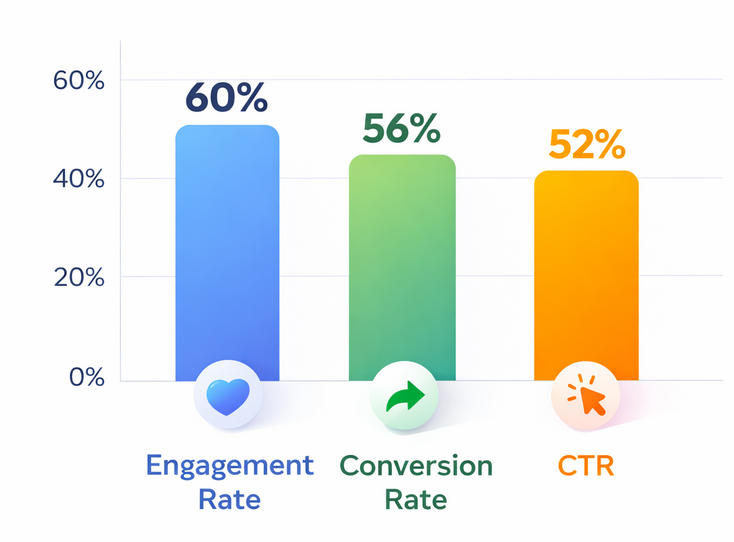
Engagement rate is the most highly prioritized KPI for video marketers, closely followed by conversion rate and CTR
Industry benchmarks show that top-performing ads often capture 30–50% higher early engagement (CTR, video view rate, or interaction rate) within the first 20–30% of spend compared to average performers. These early signals act as leading indicators of scalability and long-term efficiency.
Signal 1: Disproportionate Early CTR
A common pattern among winning creatives is a CTR that stands out immediately—even when impressions are still limited.
What matters is not the absolute CTR number, but relative CTR within the same audience, placement, and time window. Creatives that outperform peers by 25–40% or more in the first few thousand impressions are statistically more likely to remain top performers as spend increases.
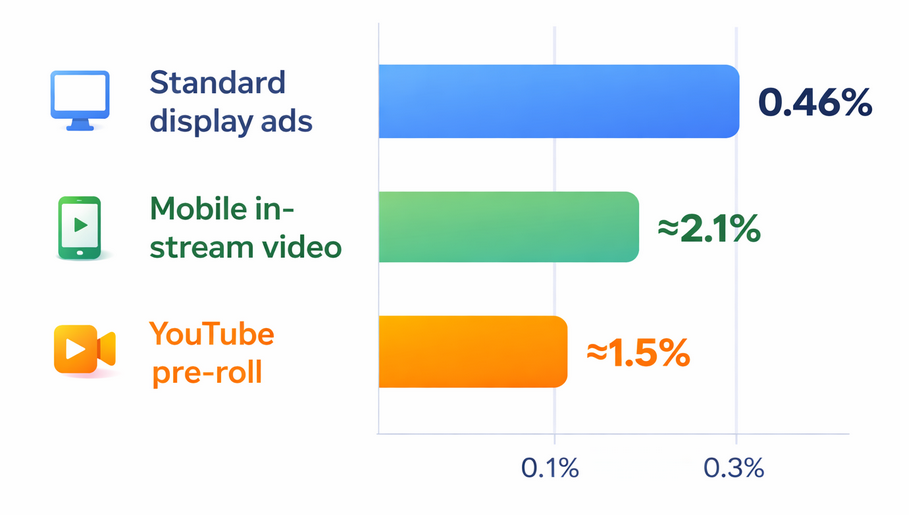
Average click-through rate (CTR) varies widely by ad format — richer formats like video often outperform standard display banners
High early CTR indicates strong message–market fit, clear value communication, and visual clarity.
Signal 2: Stable Engagement After Repeated Exposures
Many creatives launch with strong engagement but collapse once frequency increases. Predictive winners behave differently.
Winning creatives typically maintain at least 70–80% of their initial engagement rate after 3–4 exposures, while weaker creatives may lose more than half their engagement by the same point.
This stability signals that the creative is not relying solely on novelty, but on relevance and clarity.
Signal 3: Fast First Interaction
Time-to-first-action is an overlooked but powerful indicator.
Ads that generate clicks, swipes, or video completions within the first 1–2 seconds consistently outperform those that require longer attention. Multiple studies show that creatives prompting immediate interaction can produce 20–35% higher downstream conversion rates compared to slower-starting ads.
Fast interaction suggests strong visual hierarchy and an instantly understandable hook.
Signal 4: Consistent Performance Across Placements
Early winners rarely depend on a single placement to perform well.
If a creative delivers competitive engagement across feeds, stories, and other placements—with no extreme drop-offs—it demonstrates structural strength. Campaign data shows that creatives with less than 15% performance variance between placements are far more likely to scale efficiently.
Large placement dependency, on the other hand, often signals fragile performance.
Signal 5: Conversion-Assisted Signals
Even before conversions stabilize, winning creatives tend to influence assisted metrics.
Higher-quality creatives often generate:
-
Lower bounce rates
-
Longer session durations
-
Higher add-to-cart or view-content rates
Accounts analyzing these signals early report up to 25% faster identification of winning ads, reducing wasted spend during testing phases.
How to Use These Signals in Practice
Instead of waiting for full conversion data:
-
Compare creatives against each other, not against benchmarks
-
Evaluate performance within the same exposure window
-
Pause or deprioritize creatives that fail multiple early signals
-
Allocate incremental budget to creatives showing signal consistency
This approach allows teams to make confident decisions earlier without sacrificing accuracy.
Common Misinterpretations to Avoid
-
High CTR alone does not guarantee success if engagement collapses at higher frequency
-
Low initial conversions do not automatically mean failure if engagement signals are strong
-
Short-term spikes without stability usually fade under scale
Predictive analysis works best when multiple signals align.
Suggested Further Reading
To deepen your understanding of creative performance analysis, consider these related articles:
Final Thoughts
Winning creatives announce themselves early. By focusing on predictive engagement and behavior signals—rather than waiting for delayed conversion data—you can identify scalable ads faster, protect budget efficiency, and build a repeatable creative testing system.