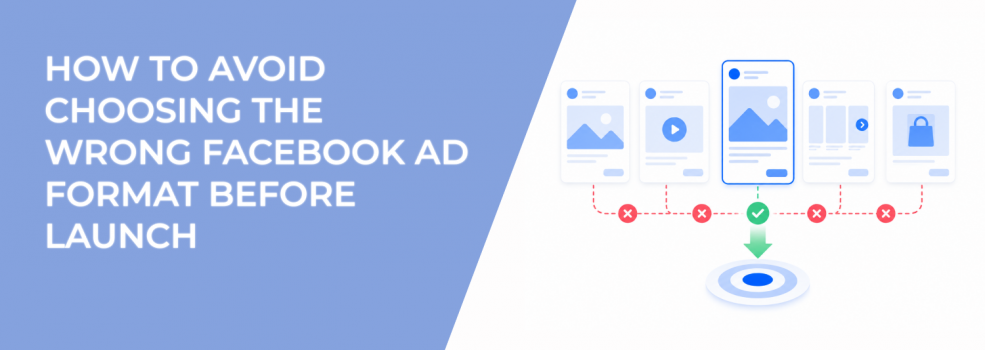
Many Facebook campaigns struggle before optimization even starts properly because the ad format does not match the buyer’s decision stage.
The creative itself may be strong. The audience may also be correct. But if the format delivers information in the wrong way, users often ignore the ad, misunderstand the offer, or click without enough intent.
That usually creates weak CTR, unstable CPA, or poor conversion rates early in the campaign lifecycle.
Problem: The Wrong Facebook Ad Format Changes How Users Understand the Offer
Different ad formats create different user behavior patterns.
A short video can build curiosity quickly but may fail to explain a complex B2B offer. A single image can work well for a simple local promotion but may struggle when multiple products or benefits need explanation.
Carousel ads often perform better when users need comparison, sequencing, or product variety. Lead forms can reduce friction but sometimes lower lead intent because users submit information too quickly.
The issue is not whether one format is universally better.
The issue is whether the format matches the amount of information the buyer needs before acting.
A common mistake appears when advertisers use short engagement-focused video ads for offers that require trust or explanation. The campaign may generate cheap clicks and strong engagement while producing weak conversions because users never fully understood the offer.
This becomes even more noticeable during scaling because Meta expands toward users reacting to the format itself instead of the buying intent behind it.
That is one reason advertisers eventually start testing how to choose the right format for each funnel stage.
Solution: Match the Ad Format to the Buyer’s Decision Stage
The best-performing campaigns usually choose formats based on what the buyer needs to understand before converting.
Cold audiences often need:
-
fast visual clarity,
-
simple positioning,
-
and low cognitive load.
Warm audiences can handle:
-
product comparisons,
-
testimonials,
-
demonstrations,
-
or multi-step explanations.
For example:
-
single-image ads often work well for simple offers,
-
carousel ads work better for product comparisons or feature breakdowns,
-
and video ads usually perform better when education or demonstration matters.
Placement context matters too.
A creative built for Feed may lose effectiveness inside Stories or Reels because users consume content differently in those environments. Text-heavy creatives often underperform in fast-scrolling placements while short visual hooks may struggle in placements where buyers expect more detail.
This is why advertisers often notice why the same ad performs differently across placements. The format changes how users process the message.
How to Detect Format Problems Early
Format problems usually appear in the first stage of campaign delivery.
Common signals include:
-
strong impressions with weak CTR,
-
high engagement but poor conversions,
-
cheap clicks with low landing-page quality,
-
or high watch time with low action rates.
A campaign can also attract the wrong audience behavior entirely.
For example, a visually entertaining Reel may generate low-cost engagement from users who were never likely to buy. Meta then continues optimizing toward similar engagement behavior because the format trained the algorithm in that direction.
That creates misleading early performance data.
The campaign may look healthy at the top of the funnel while conversion efficiency quietly weakens underneath.
Final Takeaway: Format Choice Shapes Buyer Behavior Before Optimization Begins
Facebook ad formats do more than change visual appearance.
They influence:
-
how users process information,
-
how quickly they understand the offer,
-
and what type of engagement Meta optimizes toward during delivery.
The wrong format can weaken campaign performance before the learning phase finishes.
The safest approach is choosing formats based on buyer intent, funnel stage, and placement behavior rather than using the same creative structure for every campaign.