
Meta advertisers often blame creative when performance drops. They rewrite copy, swap images, and adjust calls to action. Yet the same ad can scale in one placement and fail in another. The difference is usually context, not quality.
On Meta, context shapes how people interpret your message. Placement defines attention level, user intent, and tolerance for interruption. If you ignore those factors, strong ads look weak.
What “Context” Actually Means in Meta Placements
Context is not only screen size. It includes behavior patterns, platform norms, and the mental state of the user. Each placement creates a different expectation before your ad appears.
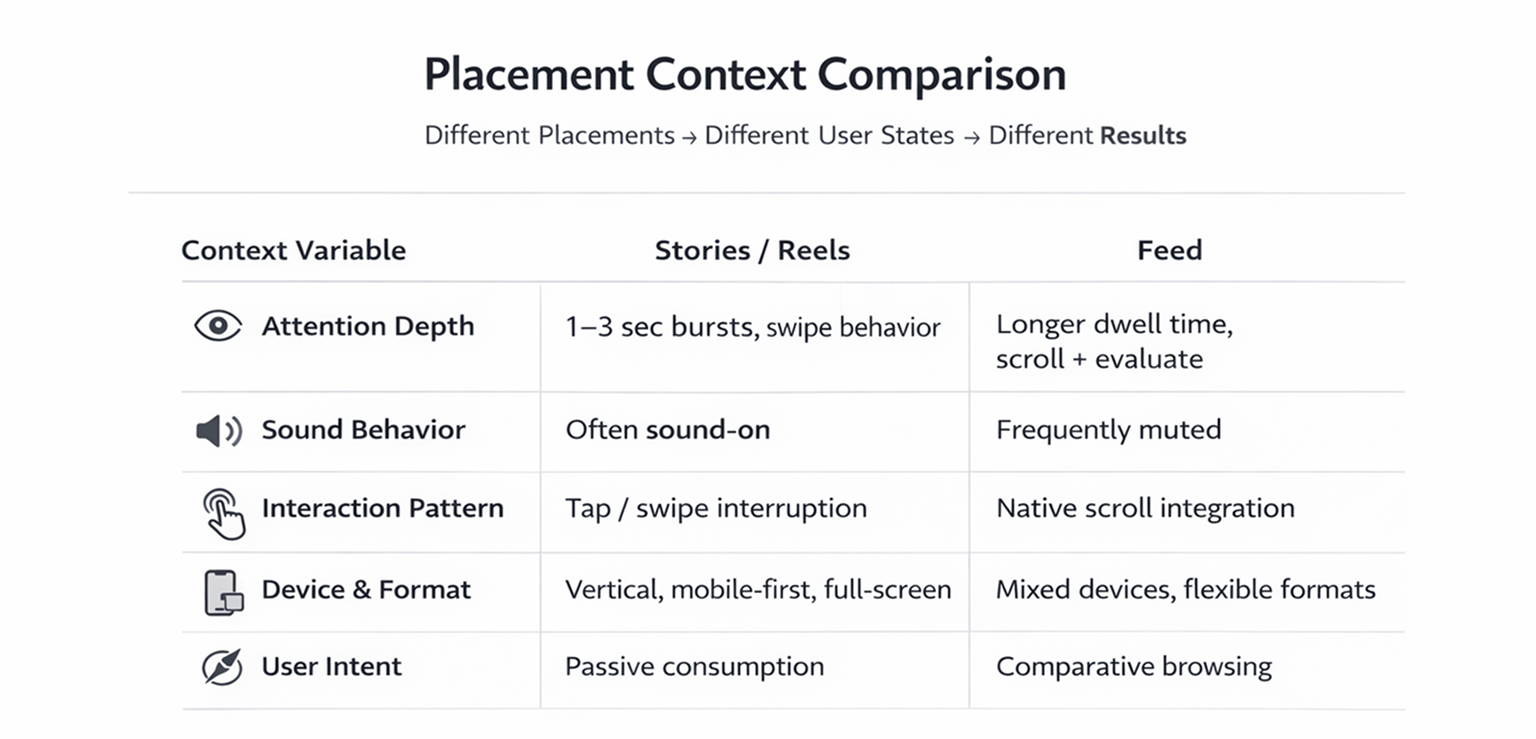
For example, a user scrolling Instagram Stories expects short, immersive content. A user browsing the Facebook feed expects mixed media and longer captions. As explained in Facebook vs Instagram ads: how user intent differs, behavior patterns shift across platforms even before creative loads.
Core Context Variables That Affect Performance
-
Attention depth; Stories offer fast swipes and short attention bursts, while feeds allow longer reading time.
-
Sound behavior; many feed users watch without sound, while Reels often play with audio enabled.
-
Interaction friction; in-stream video ads interrupt content, while feed ads blend into it.
-
Device dominance; Stories and Reels are almost entirely mobile, with vertical orientation.
-
Intent signal; some placements attract passive scrollers, others attract users exploring content more actively.
Each variable changes how your message is processed. That changes results.
Why a Winning Feed Ad Fails in Stories
An ad that performs in the Facebook feed often relies on context that Stories do not provide. Feed ads can use longer copy and social proof elements. Stories offer little space and almost no caption reading.
This difference is explored in depth in Feed ads vs Stories: which drives better conversions?. Conversion patterns often reflect environment, not creative strength.
Here are common failure points when moving feed ads into Stories:
-
Text density; long explanations become unreadable in vertical full-screen format.
-
Static visuals; Stories reward motion and native camera-style footage.
-
Weak hooks; feed ads can rely on curiosity, while Stories need immediate clarity.
-
CTA placement; feed users scroll down to buttons, Stories require obvious tap prompts.
The creative did not change. The processing environment did.
Placement Shapes Perceived Relevance
Relevance is contextual, not absolute. An offer may feel urgent in one placement and intrusive in another.
Reels users expect entertainment or fast value. A corporate-looking ad may signal advertiser immediately. That reduces watch time and engagement. This pattern is also visible in why the same ad performs differently across Meta platforms, where placement logic changes delivery signals.
How Context Changes Cognitive Load
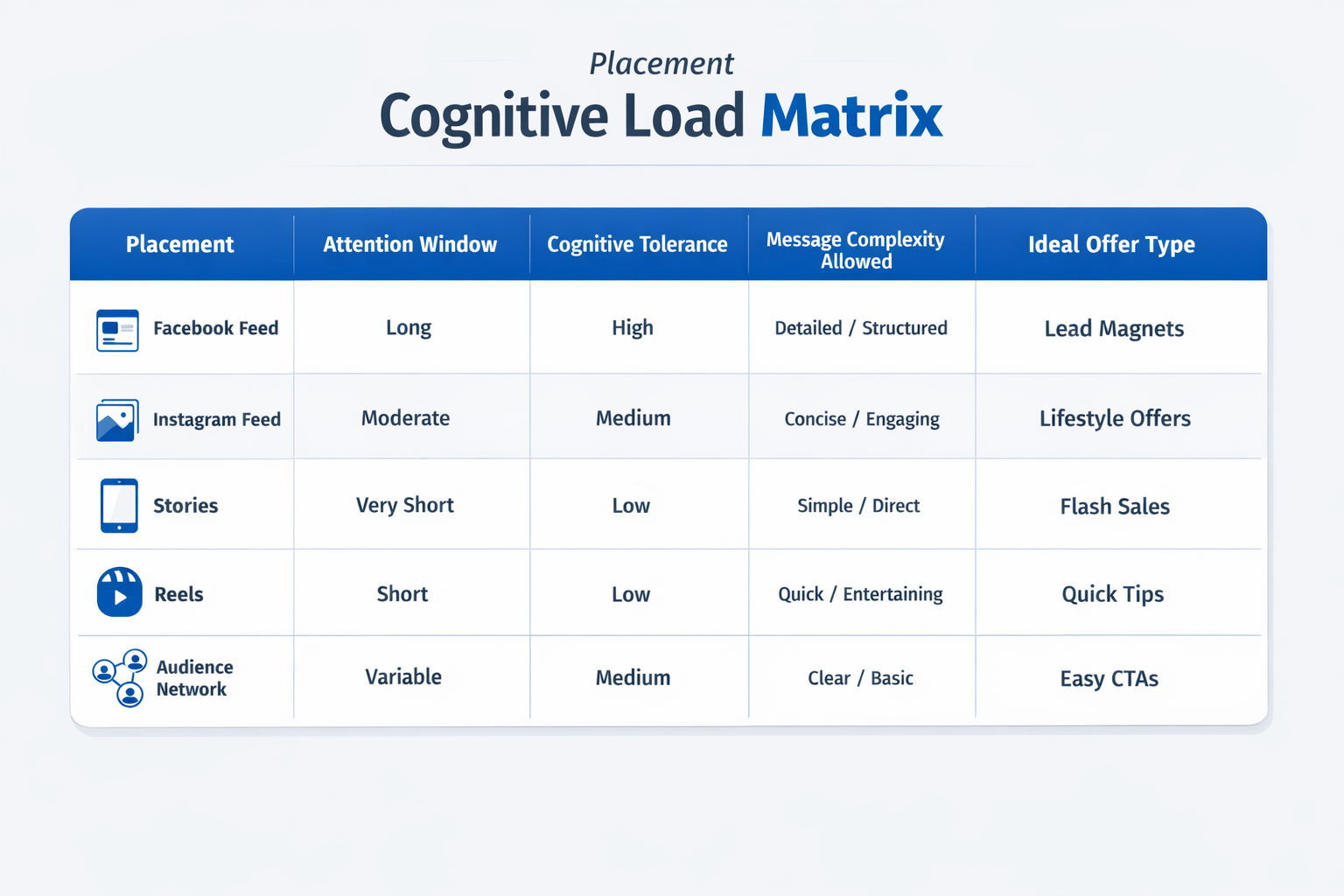
Cognitive load determines whether users engage or skip. Some placements allow more mental effort. Others punish complexity.
-
Feed placements tolerate structured messaging; users expect mixed content and ads.
-
Stories reward clarity within two seconds; hesitation leads to a swipe.
-
Reels prioritize pattern interruption; ads must match creator-style pacing.
-
Audience Network placements often require ultra-clear visuals; text-heavy formats underperform.
If your ad demands more effort than the placement allows, performance drops.
Creative Elements That React to Context
Creative is not a single asset. It is a set of variables interacting with placement rules.
Hook Timing
In feeds, hooks can unfold over several seconds. In Stories and Reels, the hook must land immediately. The first frame determines survival.
Framing and Aspect Ratio
A 1:1 square works well in feeds. Vertical 9:16 dominates Stories and Reels. Cropping a square into vertical rarely preserves focal points. Poor cropping is a known issue in why image cropping breaks your Facebook ads.
Caption Dependency
Feed ads can rely on primary text to explain value. Story ads must communicate value visually or with on-screen text. If meaning depends on captions, Stories suffer.
Social Proof Placement
Feed ads can display comments and reactions below the post. Stories hide that layer. If your persuasion relies on visible engagement, feed performance will look stronger.
The Algorithm Reacts to Context Too
Meta’s delivery system optimizes based on predicted engagement within each placement. If your creative fits one placement better, the algorithm pushes impressions there.
That creates misleading conclusions. You may think your ad works universally. In reality, it works where context supports it.
When you force placement expansion without creative adaptation, costs rise. The system struggles to find positive signals in weaker environments. For a tactical breakdown, see how to decide between automatic placements vs manual placements for Meta ads.
Diagnosing Creative vs Context Problems
Before rewriting your ad, isolate the placement effect. Use breakdown reports by placement and compare metrics carefully.
Focus on these differences:
-
Thumb-stop rate; does the ad earn initial attention in each placement?
-
Video hold rate; where do viewers drop off across formats?
-
CTR variance; is the click gap driven by visual framing or intent?
-
Conversion rate after click; does placement affect landing page alignment?
If conversion rates stay stable but CTR drops in one placement, context is likely the issue. If both collapse, creative relevance may be the problem.
Strategic Adaptation Instead of Duplication
Advanced advertisers do not duplicate the same asset across placements. They build creative variants aligned to context rules.
Build Placement-Specific Versions
-
Create vertical-first edits for Stories and Reels; adjust framing rather than cropping.
-
Shorten hooks for fast-scroll environments; remove delayed introductions.
-
Add bold on-screen text for silent viewing; avoid relying on captions.
-
Simplify offers in interruption-based placements; reduce cognitive friction.
Each version should preserve the core message. It should not copy the format.
Align Offer Complexity With Placement Depth
Complex B2B offers often struggle in high-speed placements. Consider matching funnel depth to context.
-
Use feed placements for detailed lead magnets; support them with structured copy.
-
Use Stories for high-intent offers; free audits or demos fit direct prompts.
-
Use Reels for authority positioning; short insights work better than long explanations.
Placement becomes part of your funnel architecture.
Creative Is Relative, Not Absolute
An ad is not good or bad in isolation. It is effective within a specific context. When performance shifts, the first question should be about environment, not design.
Meta placements create different user states. Those states change attention, tolerance, and perceived relevance. When creative respects context, performance stabilizes.
If you treat placements as interchangeable, even strong ads will look inconsistent.