Scaling Instagram ads before identifying buyers is one of the fastest ways to turn a promising campaign into a wasteful one.
At low spend, the campaign may look healthy. CPC is acceptable. Leads come in. Purchases start to appear. The team increases budget, expecting more of the same.
Then performance changes.
Traffic volume rises, but quality drops. CPA climbs. ROAS weakens. Sales teams complain about poor-fit leads. The campaign did not fail because scaling is bad. It failed because the advertiser scaled before proving where the buyers were.
The Problem
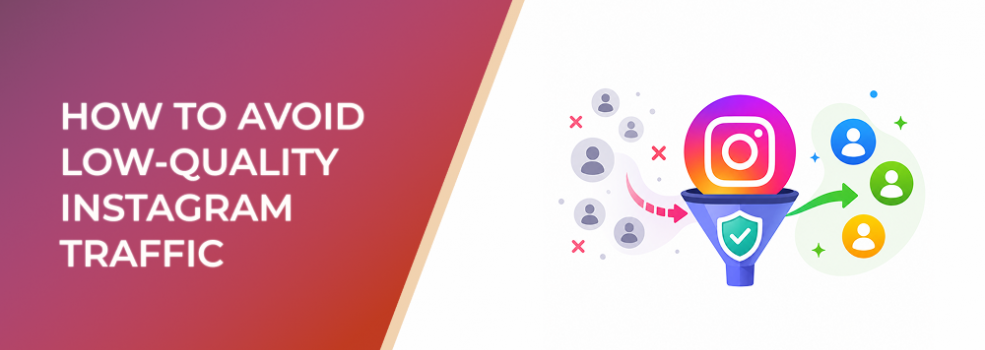
The problem is low-quality Instagram traffic caused by scaling too early.
A campaign can produce early results from a small pocket of strong users inside a broader audience. When budget increases, Meta may expand delivery into weaker users who are easier to reach but less likely to convert.
If the advertiser has not identified which segment contains the real buyers, scaling amplifies the wrong traffic.
This is especially risky when the campaign is optimized around reach, engagement, traffic, or low-friction lead forms. Those signals can produce volume without proving purchase intent or customer fit.
Why This Problem Hurts Performance
Low-quality traffic damages performance across the funnel.
At the ad level, budget goes toward impressions and clicks that do not create value. At the landing page level, conversion rates weaken. At the sales level, teams spend time on poor-fit leads. At the reporting level, platform metrics may look active while business outcomes decline.
The impact shows up as rising CPA, higher CAC, lower ROAS, weak lead-to-sale conversion, poor sales productivity, lower average order quality, and unstable scaling.
Low-quality traffic also creates signal pollution. If Meta learns from poor-fit clicks and shallow conversions, it may continue finding more users who behave the same way.
Once that pattern develops, fixing the campaign becomes harder than preventing the problem in the first place.
Common Scenarios Where This Happens
An ecommerce brand scales a campaign after a few early purchases, then discovers that new traffic clicks but does not complete checkout.
A B2B company increases budget on a low-CPL Instagram lead campaign, but sales rejects most of the additional leads.
A local service business broadens its audience to reach more people, but many inquiries come from users outside its ideal service area or budget range.
An affiliate marketer scales based on cheap CPC, but payout-driving actions do not increase proportionally.
An agency scales a client campaign because the first week looked promising, then has to explain why lead quality dropped once spend increased.
Why the Problem Happens
This problem happens because early results are often mistaken for scalable proof.
A few conversions do not necessarily mean the audience can support more budget. Early performance may come from the easiest-to-reach buyers, a temporary creative novelty effect, or a small high-intent cluster inside a mixed audience.
Another cause is judging traffic quality too shallowly. CPC, CTR, and CPL are useful, but they do not prove buyer quality. Low-cost traffic can become expensive if it does not convert downstream.
The problem also happens when marketers scale before segmenting. If the campaign does not separate likely buyers from broad traffic, there is no clear path for budget expansion.
The Solution
The solution is to identify buyer segments before increasing Instagram ad spend.
Start by defining what buyer quality means. For ecommerce, that may include purchases, checkout starts, AOV, repeat purchase potential, and ROAS. For lead generation, it may include qualified leads, booked calls, sales acceptance, pipeline value, and CAC.
Then segment the audience before scaling.
Useful pre-scale segments may include:
- Competitor or adjacent-brand followers.
- Niche Instagram profile followers.
- Instagram engagers around product or offer content.
- Facebook group community audiences.
- LinkedIn-derived professional-fit audiences.
- Website visitors who reached high-intent pages.
- Customer-list or qualified-lead-based audiences.
- Custom social-profile audiences tied to relevant buyer behavior.
Run a controlled test before raising budget. Compare a broad baseline against one or two higher-intent buyer segments. Keep the offer, creative theme, landing page, objective, and conversion event consistent.
Look for scale-readiness signals:
- The segment converts at an acceptable CPA.
- Lead or purchase quality holds beyond the first few conversions.
- Frequency does not rise too quickly.
- Conversion rate remains stable as spend increases.
- Retargeting pools contain users worth retargeting.
- The segment has logical adjacent audiences for expansion.
Only scale after the campaign proves that it can find quality users beyond the first easy conversions.
How LeadEnforce Helps
LeadEnforce helps advertisers build stronger pre-scale audience tests.
For Instagram campaigns, LeadEnforce can help create audiences from Instagram followers and engagers. It can also support audiences from Facebook groups, LinkedIn-derived professional data, and custom social-profile sources.
This is useful before scaling because advertisers need to know which audience sources contain likely buyers.
An ecommerce brand can test competitor followers or niche product-profile audiences before increasing spend. A B2B team can compare professional-fit audiences against broad business interests. A local business can test community-based relevance before expanding reach.
LeadEnforce does not guarantee traffic quality by itself. It helps advertisers create more relevant audience inputs. The campaign still needs strong creative, a clear offer, reliable conversion tracking, and downstream quality measurement.
Risks and Considerations
Pre-scale testing reduces risk, but it does not remove uncertainty.
A buyer segment may perform well at low spend and still weaken under higher budget. A small high-intent audience may fatigue quickly. A broader audience may need more conversion signals before it stabilizes.
Do not scale only because CPC is low. Cheap traffic is not useful if it does not convert. Do not scale only because CPL is low. Cheap leads are not useful if sales rejects them.
Creative fatigue can also look like audience failure. If performance drops after repeated delivery, refresh the message before assuming the buyer segment is exhausted.
Finally, avoid overreliance on one channel. Instagram can be powerful, but buyer validation should include funnel and business data where possible.
Prerequisites and Dependencies
You need reliable conversion tracking and clear success metrics.
You need a defined buyer profile. Without it, you cannot tell whether the traffic is high quality.
You need enough budget to test buyer segments before scaling. A pre-scale test does not need to be large, but it must be large enough to produce useful signals.
You need downstream feedback. Sales quality, purchase behavior, pipeline progression, and revenue outcomes should influence scaling decisions.
If LeadEnforce is used, you need relevant source profiles, groups, professional criteria, or social-profile data that map to likely buyer behavior.
Practical Recommendations
Do not increase budget just because early results look promising.
First, identify which segment produced those results. Separate broad traffic from higher-intent audiences. Compare performance by CPA, conversion rate, lead quality, ROAS, CAC, and buyer fit.
Scale gradually. Move from one strong buyer segment to adjacent segments rather than jumping immediately into broad reach.
Protect retargeting quality. If the cold audience is weak, retargeting will inherit that weakness.
Use LeadEnforce before scaling when you need cleaner buyer-oriented audience sources to test.
Final Takeaway
Low-quality Instagram traffic becomes more expensive when you scale it.
Before increasing budget, identify which audience segments contain real buyers. Test for quality, validate downstream performance, and expand from the strongest signals instead of chasing more traffic too soon.
To build cleaner pre-scale Instagram audience tests from higher-relevance social and professional sources, join the free 7-day LeadEnforce trial period.
Related LeadEnforce Articles
- Stop Facebook Ads From Reaching People Who Never Convert — Explains how low-quality delivery creates wasted spend and signal pollution.
- Test Audience Width Before Scaling — Directly relevant for validating audience scale-readiness before increasing budget.
- Change Broad Facebook Ad Targeting Before It Wastes Budget — Useful for advertisers trying to avoid broad, undefined traffic.
- Smarter Lookalikes: How to Use LeadEnforce to Reach High-Intent Audiences — Helps connect stronger audience seeds to scalable high-intent prospecting.