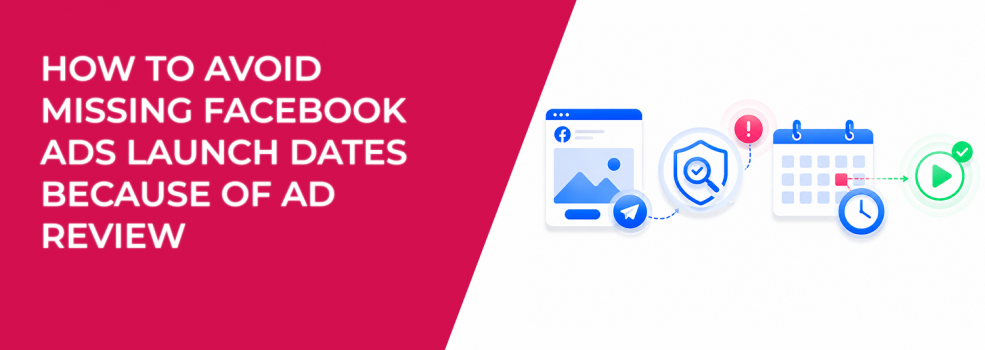
A missed Facebook ads launch date usually comes from late submission.
The key problem is that the campaign is planned around the public launch time, but not around Meta’s review time. If ads are submitted too close to the launch, approval can become the blocker.
This is especially costly for product launches, webinars, events, seasonal offers, and limited-time promotions. In these cases, traffic timing affects revenue, lead volume, and follow-up speed.
Why launch dates get missed
Most teams plan the visible parts of a campaign.
They plan the offer, creative, landing page, budget, and reporting. But they often forget the review window. The ad is finished at the last minute, then submitted when it should already be running.
That creates a timing gap. The campaign may still launch, but it does not launch when the business needed it to launch.
For example, a webinar campaign submitted on Monday morning may not start early enough to capture the full workday. A sale campaign submitted on Friday afternoon may miss the strongest weekend buying window.
The solution: create an internal submission deadline
The public launch date should not be the same as the ad submission deadline.
Set an internal deadline before the launch. For normal campaigns, submit at least one business day early. For sensitive offers or important launches, submit earlier.
A simple planning structure works well:
- Creative ready date. The ad assets are final and approved internally.
- Tracking ready date. Pixel, CAPI, UTMs, forms, and landing pages are checked.
- Review submission date. The ads are published for Meta review.
- Public launch date. The approved ads begin delivery.
This makes review part of the workflow instead of a surprise.
For ongoing planning, plan a Facebook Ads calendar so review time is included in every campaign cycle.
Use scheduling to protect the real launch window
Scheduling helps when ads are submitted early.
If the ad is approved before the scheduled time, it can start at the right moment. If the ad is submitted too late, scheduling cannot save the launch window.
This is why timing matters. Submit the campaign early, schedule the delivery for the real launch time, and avoid edits after approval.
For example, if a product drop starts Wednesday at 10 a.m., the ads should be submitted before Wednesday. The campaign can be scheduled to start at 10 a.m., but review should already be cleared by then.
For more timing control, connect this process with mastering ad scheduling.
Prepare backup ads for important launches
A time-sensitive launch should not depend on one ad.
If that ad is delayed or rejected, the campaign stalls. A backup ad gives the campaign another approval path.
The backup does not need a new strategy. It should be a safer version of the main message.
For example:
- Main ad: “Stop wasting budget on bad leads.”
Backup ad: “Reach audiences more likely to match your lead criteria.” - Main ad: “Struggling to fill your sales pipeline?”
Backup ad: “Build a more focused pipeline from high-intent audiences.” - Main ad: “Fix low-quality Facebook leads.”
Backup ad: “Improve lead quality with stronger audience signals.”
This keeps the message useful while reducing policy risk.
Align launch timing with business operations
Ad approval should match the rest of the business plan.
If sales needs leads Monday morning, the ads must be approved before Monday morning. If inventory goes live on a specific day, the campaign should not wait for review on that day.
This matters for B2B teams, too. A delayed campaign can send leads outside the best follow-up window. That can lower contact rates and make paid social look weaker than it really is.
For product campaigns, Facebook ads best practices for promoting a new product launch can help connect launch timing with the full campaign plan.
Final takeaway
To avoid missing Facebook ads launch dates, submit ads before the real launch window.
Plan review time, schedule delivery after approval, prepare safer backup ads, and make the internal deadline earlier than the public launch date.