Digital advertising in 2026 is not defined by how well you target or how much budget you spend. The strategies that drive results now are adaptive, signal-based, and built around how users behave — not how marketers want them to.
This article outlines a practical, advanced framework for building a digital advertising strategy that fits today’s landscape. Each step is designed to help you build systems that learn, scale, and improve over time.
The 7-Part Framework for Performance-Driven Ad Strategy
1. Signal Architecture: Teach the Platform Before You Optimize for Sales
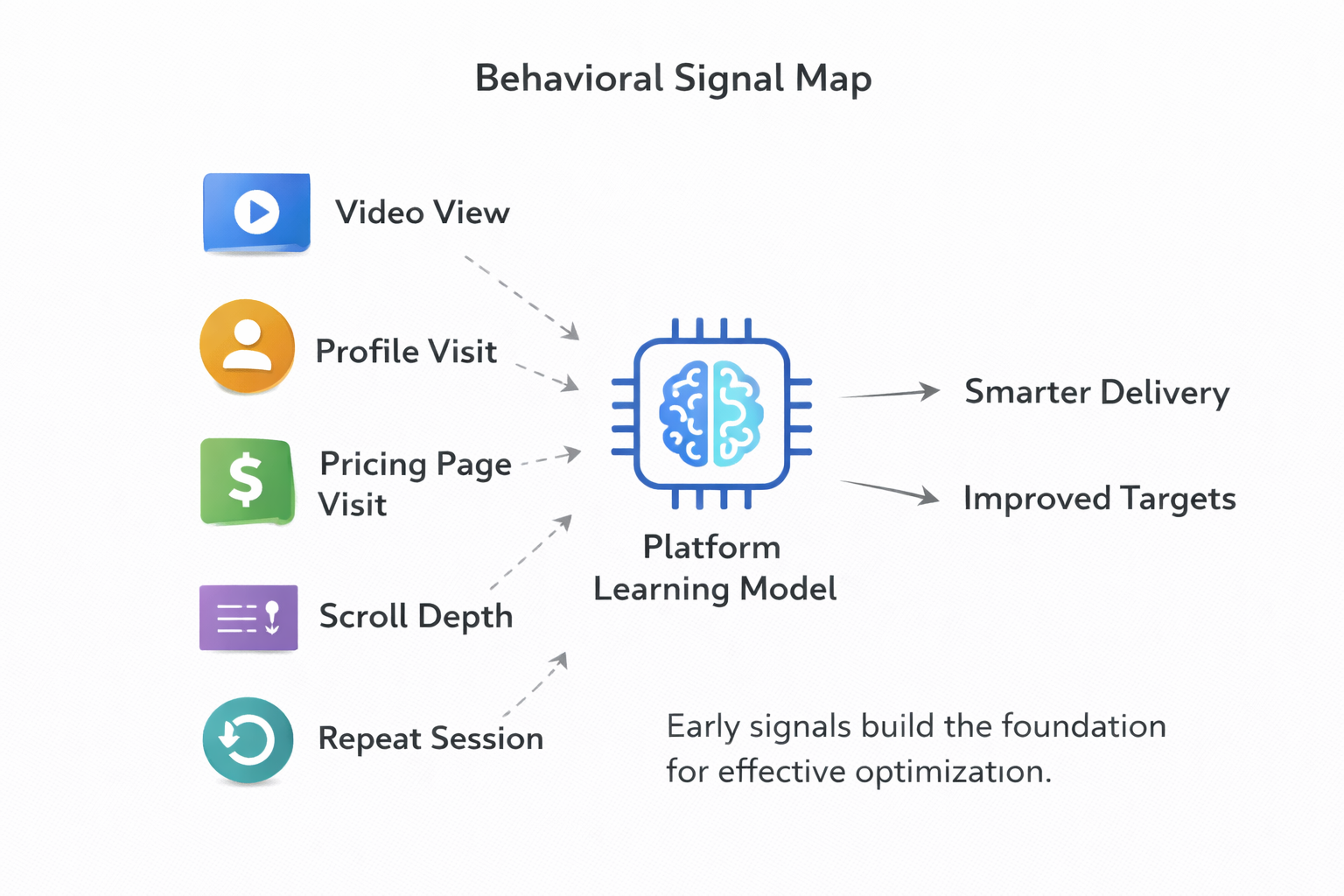
Modern advertising platforms rely on behavioral modeling to deliver results. They learn by watching what types of users interact with your ads — and how they behave afterward.
Before you focus on conversion objectives, your first job is to teach the system what success looks like.
How to do it:
-
Launch early-stage campaigns that optimize for engagement, profile visits, or video views — all actions that cost less per user but generate signal-rich data.
-
Track meaningful on-site behavior such as visits to your pricing page, scroll depth on product pages, and return sessions within 48 hours. These signals often correlate with future conversions.
-
Use retargeting campaigns to reinforce platform learning. For example, show different creative to someone who visits your pricing page twice in 3 days, compared to someone who visited your homepage once.
The platform can’t optimize what it doesn’t understand. Use your first few campaigns to build a behavioral model — not just to make a sale.
2. Audience Inputs: Use Behavior-Based Sources, Not Static Segments
Interest-based and lookalike audiences are increasingly less effective due to limited tracking and signal loss. In 2026, you need audience inputs based on observable behavior and community alignment — not just profile data.
This is where LeadEnforce comes in.
What works now:
-
Create custom audiences from Instagram followers of competitor accounts or adjacent brands. These users are already engaged with similar products or topics.
-
Build audiences from Facebook group members whose discussions indicate aligned interests, problems, or intent — for example, groups about home fitness, startup marketing, or baby sleep training.
-
Layer these audiences with high-intent behavior. For instance, target users who follow a competing account and visited your features page in the last seven days.
These aren’t assumptions. They’re source-based audiences tied to real communities and behavior. With LeadEnforce, you can access these sources — even when platforms don’t allow direct targeting.
Learn how to build these audiences effectively in How to Select Facebook and Instagram Sources for Targeting with LeadEnforce.
3. Creative Structure: Build a Modular System for Iteration
In 2026, creative performance is often the biggest lever in your ad results. But most brands can’t afford to produce 30 new ads every week. The solution isn’t more production — it’s better creative structure.
Build creative components you can mix and match:
-
Hooks: Try variations like “Struggling to find time to cook?” or “Why 32,000 busy parents use this meal system.”
-
Value propositions: Highlight different angles — price savings; time efficiency; health benefits; social proof.
-
Formats: Test short vertical video, carousels, and high-contrast static images. Each suits different placements and user behaviors.
-
Calls to action: Try both soft (“Learn more,” “See how it works”) and direct (“Subscribe now,” “Get 40% off today”).
By combining elements dynamically, you can create dozens of ad variants without producing entirely new assets. Track performance by element, not just by ad. For example: which opening lines consistently appear in your top-performing ads across different campaigns?
4. Offer Design: Match the Offer to User Readiness
Strong creative can generate attention — but attention alone won’t convert. Your offer is the conversion driver, and in 2026, the best-performing offers are built around user intent — not just price or discount.
Use funnel-specific offers to improve performance:
-
Top-of-funnel: These users are still learning. Offer something low commitment — a free guide, a tool, a comparison checklist, or a quiz to personalize recommendations. Example: “Take the 1-minute quiz to see which skin care plan fits your needs.”
-
Mid-funnel: Here, education matters more. Show testimonials, reviews, comparisons, and use-case content. Example: “See why 9,300 remote workers switched from X to Y.”
-
Bottom-funnel: Now it’s about reducing friction. Use urgency (“Offer ends at midnight”), incentives (“Get a bonus item free”), or guarantees (“Cancel anytime with no penalty”).
Treat your offer like a system variable. The more aligned it is with user context, the less push you need to drive action.
5. Funnel Mapping: Map Real Behavior, Not Theoretical Steps
Traditional funnels assume that people go from awareness to interest to action in a straight line. That’s not how users behave anymore. In 2026, the journey looks more like a loop — with restarts, skips, and sidetracks.
Map user behavior signals instead:
-
Entry points: Some users discover you through Instagram Stories, others via blog posts or Reels. Track what kind of content brings the most engaged traffic.
-
Key signals: Identify behaviors that lead to conversion, like multiple pricing page visits, long session times, or tool usage (e.g., starting a product quiz).
-
Drop-off zones: Where do high-intent users stall? Is it at checkout? After viewing testimonials? Use retargeting and creative changes to respond.
This gives you a real funnel map, shaped by what people do — not what your campaign flowchart assumes.
6. Forecasting and Feedback: Score Users Based on Intent
Not all leads or clicks are created equal. As attribution gets fuzzier, you need a way to estimate who is likely to convert — even if you can’t see the full path.\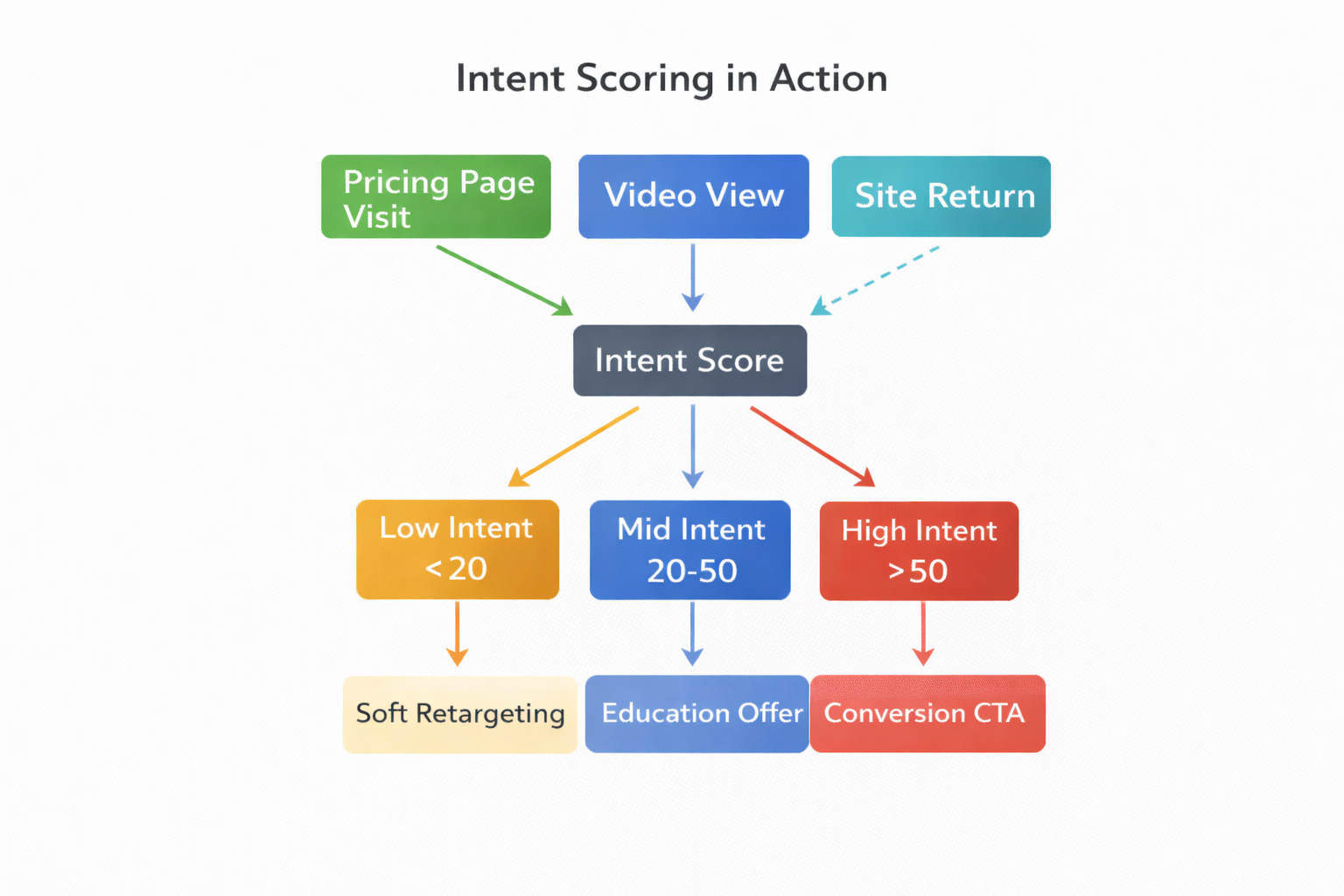
Build a scoring model around behavior:
-
Assign points to key actions: for example, +3 for viewing the pricing page; +5 for watching a full testimonial video; +8 for returning to the site within 48 hours.
-
Use intent tiers to trigger specific campaigns. High-intent users can see bottom-of-funnel offers, while low-intent ones may get softer re-engagement ads.
-
Track which intent patterns consistently lead to conversion, and push that feedback into your campaign strategy.
You don’t need perfect attribution to make smart decisions — you need a consistent model for forecasting intent and reallocating attention.
For a practical implementation guide, read the Step-by-Step Guide to Retargeting with LeadEnforce.
7. Budget Allocation: Shift Based on Funnel Pressure, Not Predefined Ratios
Most budget plans split spend between awareness, consideration, and conversion using fixed percentages. But that model breaks down when real performance shifts from week to week.
Instead, treat budget as flexible — a tool for relieving pressure where the funnel is stuck.
How to manage it:
-
Monitor real-time indicators: low video view-through rate means creative needs work; high CTR with no conversions means the offer isn’t landing.
-
If your middle funnel is overloaded (e.g., too many people clicking but not converting), slow top-funnel spend and reinforce mid-funnel education.
-
Shift spend weekly, not monthly. Performance doesn’t follow calendar cycles.
A responsive budget strategy helps your system self-correct — without waiting for the next planning meeting.
Final Thoughts: Build a Strategy That Teaches, Learns, and Scales
You don’t need more complexity in 2026. You need a system that responds to how platforms operate and how users behave.
To recap:
-
Start by training the algorithm with early signals, not just sales objectives.
-
Use LeadEnforce to build custom audiences from real followers and group members — people already aligned with your offer.
-
Design modular creative so testing is constant and efficient.
-
Match your offer to funnel stage instead of using the same message for everyone.
-
Map funnel behavior dynamically, not based on rigid models.
-
Score and segment based on intent, not just attribution data.
-
Adjust budgets weekly, based on funnel pressure, not fixed rules.
This isn’t a campaign checklist. It’s a framework for building a digital advertising system that improves over time.