The best-performing ad accounts aren’t the ones with the biggest budgets—they’re the ones with the fastest learning cycles. A “learning loop” is a structured, repeatable process that turns every impression, click, and conversion into a system for ongoing optimization. Instead of guessing, you train your campaigns to self-improve.
Below is a practical framework you can apply to almost any paid channel.
Why Learning Loops Matter
A learning loop ensures that your campaigns never stagnate. It replaces intuition with data, breaks long optimization cycles into fast sprints, and compounds performance gains.
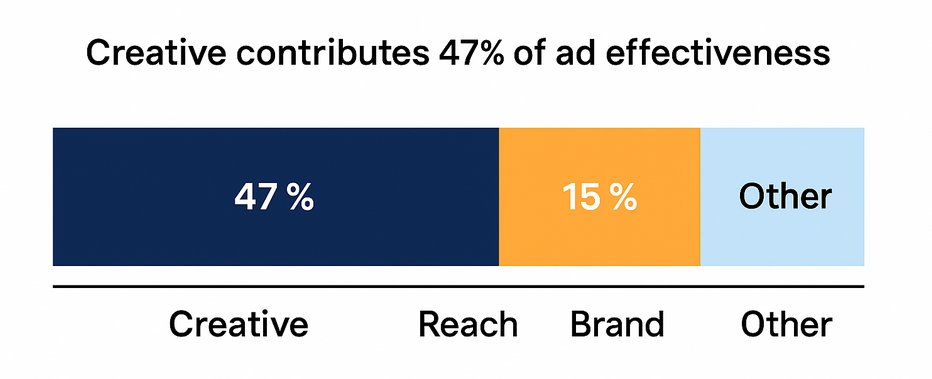
Creative quality drives nearly half of ad effectiveness — more than reach or brand alone
Useful statistics that highlight the impact of continuous iteration:
-
Advertisers who run structured tests at least biweekly see up to 30% lower CPA on average.
-
Brands that refresh creatives every 2–3 weeks report 20–40% more stable ROAS compared to those refreshing monthly or less.
Step 1: Define Clear Inputs
Inputs are the controlled variables you want to test. These may include:
-
Creative formats
-
Messaging angles
-
Targeting segments
-
Offers and CTAs
-
Landing page variations
Inputs should be specific, measurable, and limited. A good rule is to test one major variable at a time so the signal is clean.
Step 2: Collect Data Quickly
A learning loop cannot function without speed. You want actionable signals within days, not weeks.
Ways to accelerate data collection:
-
Use broad-enough audiences to avoid delivery limitations.
-
Allocate enough budget to generate statistical patterns.
-
Run tests simultaneously rather than sequentially.
A study on testing cycles shows that teams optimizing weekly drive up to 2.5x more learnings than teams running monthly experiments.
Step 3: Evaluate Against Benchmarks
Benchmarks prevent misinterpretation. For example:
-
Top-25% CTR benchmarks for most social platforms fall roughly between 1.5% – 2.5%.
-
A landing page loading in under 2 seconds typically delivers far higher conversion rates.
Compare results not only to your internal history but also to external performance tiers.
Build a simple scorecard evaluating:
-
Engagement metrics
-
Conversion metrics
-
Cost metrics
-
Quality rankings
-
Creative fatigue indicators
Step 4: Identify What’s Repeatable
Not every win leads to a repeatable insight. A strong learning loop focuses on patterns, not exceptions.
Ask:
-
Which creative patterns consistently outperform?
-
What audience segments maintain stable results across cycles?
-
Which hooks or offers reliably generate high intent?
A reliable insight improves performance in at least two consecutive testing cycles.
Step 5: Deploy Learnings Into the Next Sprint
Once you identify a winning variable:
-
Scale budget thoughtfully (10–20% increments).
-
Use insights to create new hypothesis-driven variants.
-
Retire underperformers to avoid algorithmic drag.
The cycle should then restart immediately, with each loop building on the previous one.
Over time, this creates compounding optimization — campaigns get more efficient not just from changes, but from the rate of learning.
Step 6: Systematize the Loop
To ensure the loop runs continuously:
-
Create weekly or biweekly testing rituals.
-
Maintain a central log of hypotheses, results, and insights.
-
Assign ownership so decisions do not get delayed.
-
Keep the number of active tests manageable.
Teams with standardized testing frameworks report up to 45% faster decision-making and significantly more stable performance.
Example of a Simple Learning Loop
-
Hypothesis: Vertical video with a clear first 2 seconds increases engagement.
-
Test: Run 2–3 variants against your current best-performing creative.
-
Measure: Compare CTR, CPC, hold time, and conversion rate.
-
Learn: If performance improves, expand variations and scale. If not, document why and test a new hypothesis.
-
Repeat: Launch new tests weekly.
This simple rhythm helps you unlock steady, compounding gains.
Final Thoughts
A well-built learning loop eliminates randomness from advertising. It makes every result—good or bad—a source of progress. When you run campaigns as ongoing experiments, you accelerate your ability to uncover what works and maximize performance all year long.