Running ads on Facebook or Instagram can feel like chasing a moving target. One week you're hitting your numbers. The next, performance drops and no one knows why.
If you’re tired of random wins and sudden losses, it’s time to build a system that works — one that helps you test smarter, learn faster, and scale more efficiently.
Let’s walk through how to create a social ads workflow that’s actually built to last.
Why Ad Results Often Fall Apart
Many advertisers start strong. They find an audience that clicks, a few creative ideas that convert, and they scale up. Then everything stalls.
Here’s what usually goes wrong:
-
The same ads keep running. Performance drops as people see them too often.
-
Changes are based on guesses. Teams tweak headlines or budgets with no clear reason.
-
No one knows what’s working. Too many variables change at once, so results are unclear.
-
Creative and media teams don’t talk. One team launches new ads; the other doesn’t know why.
A sustainable workflow solves these problems before they start. For a deeper dive into where Facebook campaign structure often fails, see The Facebook Ad Optimization Framework Every Marketer Should Use.
Step 1: Stop Building Full Ads From Scratch
Producing 10 new ads a week isn’t sustainable for most teams. The solution isn’t working harder — it’s working smarter.
Break Your Ads Into Pieces
Think of every ad as a mix of parts. You don’t need to rebuild the whole thing each time. Just swap out key elements.
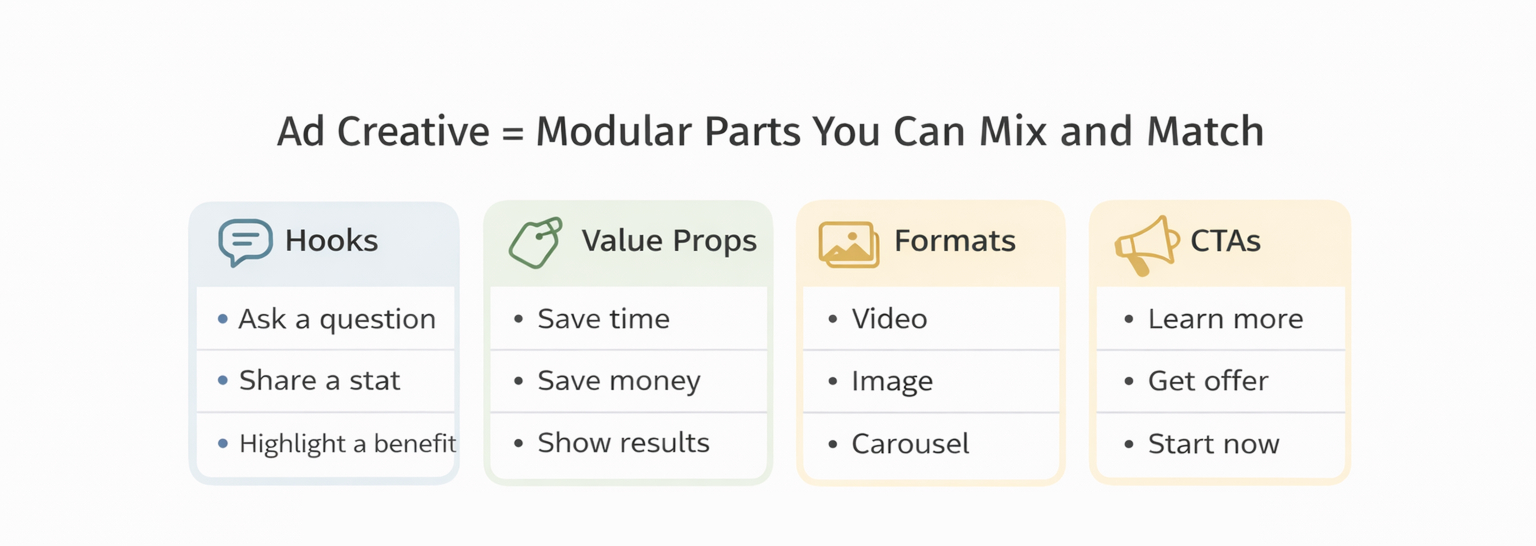
Here’s how that looks:
-
Hooks: Try different openings. For example: “Tired of skipping lunch because you're too busy?” vs. “Why 22,000 remote workers use this app to plan meals.”
-
Value props: Highlight one benefit at a time — speed, price, convenience, or results. For example: “Save 5 hours a week with our scheduling tool” vs. “Cut your no-shows by 40%.”
-
Formats: Use vertical video for Reels, static images for Stories, and carousels for product comparisons.
-
Calls to action: Test both soft and strong CTAs. “Learn how it works” vs. “Get started now.”
Instead of building one-off ads, you’re creating a flexible system that lets you test combinations — and scale what works. To manage this easily, create a shared creative asset library. Here’s a quick guide: How to Build an Ad Creative Bank for Faster Campaign Launches.
Step 2: Test Like You Want a Real Answer
If you’re changing the image, headline, and audience at the same time, you won’t know what actually worked.
Keep Your Testing Clean
Let’s say you want to test a new hook. Don’t change anything else. Keep the image, targeting, and CTA the same. That way, if results go up or down, you know it’s because of the hook.
Real-life example:
You run two versions of the same video ad. The only difference is the opening line:
-
Version A: “Struggling to get leads from Instagram?”
-
Version B: “Here’s how small businesses turn Instagram into a lead machine.”
You spend $100 on each. Version B gets twice the CTR and 30% lower cost per lead. That’s a clear win — and something you can build on.
Need help setting this up? Use this Creative Testing Matrix for Faster Wins to track variables and interpret results clearly.
Avoid Audience Overlap
Testing two ads to the same audience at once? That muddies the waters. Use different ad sets with minimal overlap so your data stays clean.
Step 3: Plan Your Creative Like a Campaign, Not a To-Do List
If your creative team is just responding to “We need more ads,” you’re stuck in reactive mode. That leads to rushed work and messy launches.
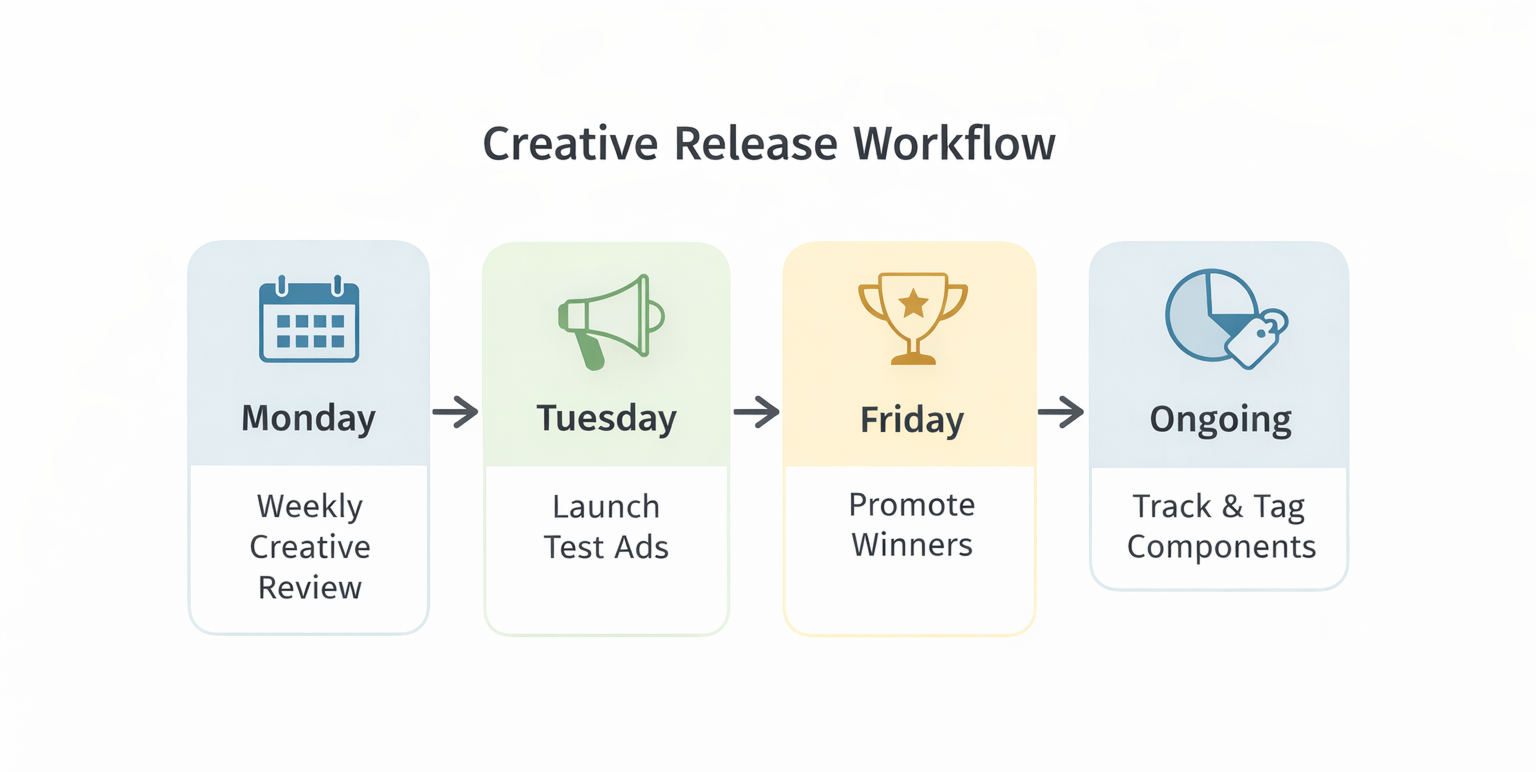
Set a Simple Creative Release Schedule
Pick a rhythm that works for your team. For example:
-
New test creatives go live every Tuesday.
-
Winners get moved into scaling campaigns by Friday.
-
Creative reviews happen on Monday mornings.
This way, everyone knows what’s happening, when, and why.
Example: an ecommerce brand testing UGC videos sets a rule — every week, they test two new openings, one new product angle, and one bold image variation. Within a month, they find their top-performing combo: real customer talking to camera + bold claim in the first 3 seconds + soft CTA. That format becomes their scaling base.
Step 4: Don’t Just Optimize for Cost — Optimize for Learning
Chasing the lowest CPA can trap you into short-term thinking. What you should really be asking is: how quickly are we learning?
Track Learning Velocity
Each week, check:
-
How many creative variations did we test?
-
Which ones gave clear results — good or bad?
-
What patterns are showing up across tests?
For example, if ads that mention “free trial” keep underperforming while those highlighting customer results outperform, you know what to do next week — more proof, less push.
Even failed tests are useful if they teach you something. The only wasted test is one that leaves you guessing.
Step 5: Run Weekly Reviews That Actually Improve Your Ads
Too many teams skip regular check-ins or just look at high-level metrics. Make your weekly reviews a core part of your workflow.
Use a Simple Format
Every week, go over:
-
What did we test? A list of new creatives or audiences launched.
-
What did we learn? Which messages or formats performed best.
-
What’s next? Decide what to scale, kill, or tweak based on real data.
Example: after 4 weeks of testing, a lead generation agency notices that carousels featuring “Before and After” client results drive 40% more leads than static images or testimonial quotes. That insight reshapes their entire Q2 creative plan.
You can automate some of this analysis to keep your team focused. Here’s how: How to Use Automated Rules to Improve Facebook Campaign Efficiency.
Final Thoughts
You don’t need to produce 100 new ads. You need a system that helps you find the right few — and scale them with confidence.
A sustainable workflow isn’t complicated. It’s just consistent. When your team knows what to build, when to test, and how to learn, everything gets easier and your results become more predictable.