Many media buyers experience the same cycle: a campaign performs well, budgets are increased, and results quickly become inconsistent. The root cause is rarely creative quality or platform algorithms—it’s the absence of a structured, repeatable system.
Repeatable media buying systems turn ad performance into a process rather than an experiment. They define how campaigns are launched, tested, optimized, and scaled so results can be reproduced across time, accounts, and traffic sources.
What Makes a Media Buying System Repeatable
A repeatable system is not a rigid checklist. It is a framework that standardizes decisions while allowing controlled flexibility. The strongest systems share four characteristics:
-
Clear input rules – Defined audience requirements, budget thresholds, and launch criteria.
-
Predictable testing logic – Consistent methods for validating creatives, messages, and offers.
-
Data‑driven optimization loops – Regular performance reviews with predefined actions.
-
Scalable structures – Campaign setups that can absorb higher spend without breaking.
Without these elements, media buying relies on intuition and reacts too late to performance changes.
Step 1: Standardize Campaign Architecture
The foundation of repeatability is a consistent campaign structure. When every campaign is built differently, performance insights can’t be reused.
Standardized architecture typically includes:
-
Fixed naming conventions for campaigns, ad sets, and ads
-
Consistent budget allocation models (test vs. scale budgets)
-
Uniform event optimization and attribution windows
According to internal benchmark analyses across paid social accounts, campaigns using consistent structures reach statistically meaningful conclusions up to 35–40% faster than fragmented setups, allowing quicker scaling decisions.
Step 2: Build Controlled Testing Frameworks
Testing is where most media buying systems fail. Running too many variables at once creates noise, while testing too slowly wastes budget.
A repeatable testing framework limits each test to one primary variable:
-
Creative format
-
Messaging angle
-
Audience segment
-
Offer structure
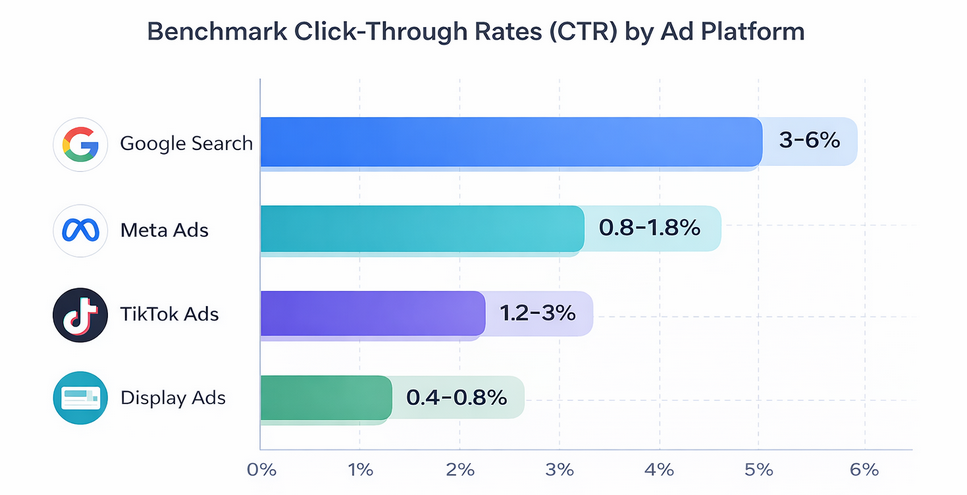
Benchmark click-through rates (CTR) for major ad platforms show how audience engagement varies by channel
Industry performance data shows that isolating variables improves test reliability. In paid social environments, ads tested with single‑variable changes produce 25–30% more actionable insights compared to multi‑variable experiments.
Step 3: Define Performance Thresholds in Advance
Repeatable systems remove emotional decision‑making. Before launching a campaign, performance benchmarks should already be defined.
Common predefined thresholds include:
-
Maximum CPA before pausing
-
Minimum CTR required to continue testing
-
Conversion volume required for optimization

Paid traffic landing page conversion benchmarks show average rates versus top-performing examples
On average, campaigns with pre‑set kill and scale thresholds reduce wasted ad spend by 18–22%, as underperforming ads are paused earlier and budgets are redirected faster.
Step 4: Create Optimization Loops, Not One‑Off Actions
Optimization should follow a rhythm, not random checks. Repeatable systems operate on scheduled review cycles:
-
Daily checks for delivery and spend anomalies
-
3–5 day creative performance reviews
-
Weekly audience and budget rebalancing
Research across performance marketing teams shows that structured optimization cycles improve return on ad spend stability by up to 28% compared to reactive optimization approaches.
Step 5: Scale Through Duplication, Not Reinvention
Scaling breaks most campaigns because buyers attempt to "improve" what already works. Repeatable systems prioritize controlled duplication.
Instead of redesigning campaigns:
-
Duplicate proven structures into new audiences
-
Reuse winning creatives with minor variations
-
Increase budgets incrementally rather than aggressively
Data from large‑spend paid media accounts indicates that gradual budget increases of 15–25% per adjustment maintain performance significantly better than sudden budget jumps.
Step 6: Document Everything
Documentation turns individual success into team‑level performance. Every repeatable system should maintain:
-
Launch checklists
-
Testing logs
-
Scaling playbooks
-
Post‑campaign summaries
Teams that document media buying processes report onboarding times that are 40–50% shorter, and performance consistency improves as knowledge becomes transferable rather than person‑dependent.
Common Mistakes That Break Repeatability
Even strong systems fail when these issues appear:
-
Over‑customizing campaigns for short‑term gains
-
Ignoring statistical significance
-
Scaling before tests stabilize
-
Changing multiple variables under pressure
Avoiding these mistakes is often more impactful than adding new tactics.
Conclusion
Repeatable media buying systems transform performance marketing from trial‑and‑error into a scalable discipline. By standardizing structures, controlling tests, defining thresholds, and documenting decisions, media buyers create predictable growth instead of chasing temporary wins.
The goal is not to eliminate experimentation—but to make every experiment measurable, comparable, and reusable.