When key metrics start slipping, many teams default to changing everything at once. New ads, new audiences, new landing pages. While that feels proactive, it often destroys valuable learning. Performance decay usually has a primary driver, and identifying it correctly can preserve efficiency while restoring growth.
Broadly, there are two dominant causes:
-
Creative fatigue: The audience has seen the same message too many times.
-
Audience saturation or misalignment: The ads are no longer reaching people likely to convert.
Knowing which one you’re facing determines whether to refresh creatives, audiences, or both.
When Creative Refresh Is the Right Move
Creative fatigue happens faster than most advertisers expect. Studies across major ad platforms show that click-through rate typically declines by 40–60% after the first 7–14 days of exposure to the same ad variation, even when targeting remains unchanged.
Signals That Point to Creative Fatigue
-
CTR drops while impression volume and reach stay stable
-
Frequency rises above 2.5–3.0 and keeps increasing
-
Conversion rate remains relatively flat despite fewer clicks
-
Performance rebounds temporarily after minor visual or copy tweaks
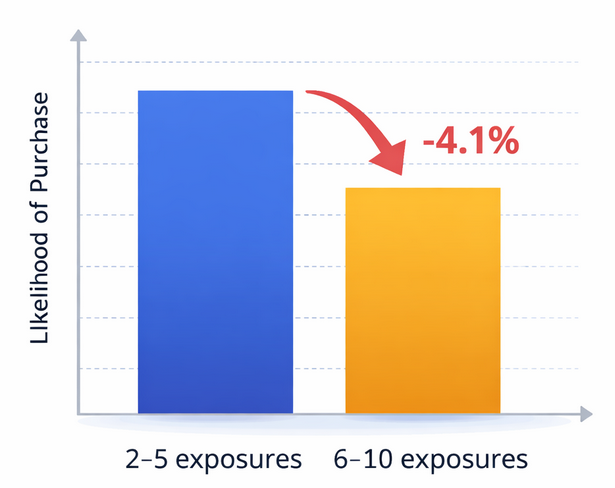
Likelihood of purchase drops with higher ad frequency: users seeing an ad 6–10 times are 4.1% less likely to convert than those seeing it 2–5 times
In these cases, the audience is still viable. They’re simply tired of the message.
What to Refresh in Creatives
Effective creative refreshes don’t require full reinvention:
-
New hooks or opening visuals in the first 2–3 seconds
-
Alternative value propositions addressing different objections
-
Format shifts (static to video, video to carousel)
-
Updated social proof or urgency framing
Data from paid social benchmarks shows that rotating 3–5 creative concepts per ad set can improve average CTR by up to 30% compared to running a single concept continuously.
When Audience Refresh Is the Better Choice
Sometimes creatives perform well initially but decay faster with each new variation. This often indicates audience saturation rather than creative issues.
Signals That Point to Audience Saturation
-
CTR remains low across multiple creative tests
-
Frequency stays below 2.0, but conversions decline
-
Cost per acquisition rises steadily despite creative changes
-
Lookalike or interest audiences show weaker performance over time
In these scenarios, the message still works—but not for the people seeing it.
How to Refresh Audiences Without Resetting Learning
Audience refresh doesn’t mean starting from scratch. Smarter approaches include:
-
Expanding lookalikes from 1% to 2–5%
-
Refreshing seed audiences with recent converters only
-
Layering new intent signals or exclusions
-
Testing broader targeting with optimized creatives
Platform-level studies indicate that broader audiences paired with strong creatives can reduce CPA by 15–25% compared to heavily constrained targeting once algorithms exit the learning phase.
When You Need to Refresh Both
There are moments when both creatives and audiences are the problem—usually after long scaling periods or seasonal shifts.
You likely need a dual refresh if:
-
CTR and conversion rate both decline simultaneously
-
Frequency is high and reach growth has stalled
-
New creatives fail immediately across all audiences
In these cases, reset strategically. Introduce new creative concepts and expand or rebuild audience structures, but do it in stages to isolate what drives recovery.
A Simple Diagnostic Framework
Before making changes, answer three questions:
-
Is reach stable or shrinking?
-
Is frequency rising faster than conversions?
-
Do new creatives improve CTR but not CPA?
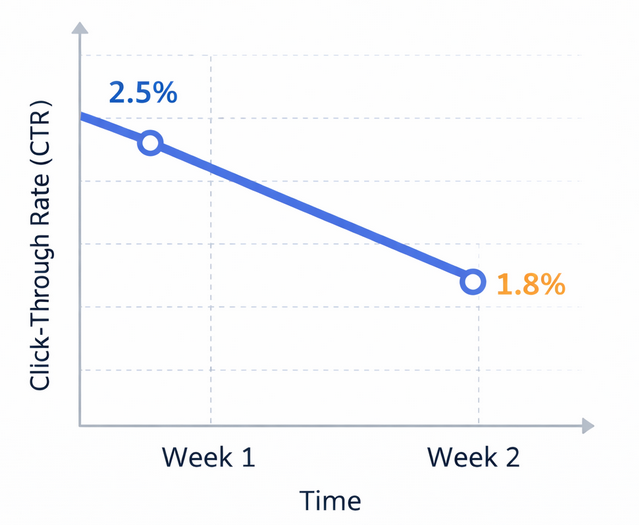
Click-through rate can signal fatigue: a drop from 2.5% to 1.8% over two weeks suggests creative needs updating
If reach is stable and frequency is high, refresh creatives. If reach is shrinking and new creatives don’t help, refresh audiences. If both are true, plan a phased reset.
Refresh Cadence: How Often Is Too Often?
Over-refreshing can be as harmful as neglect. Benchmarks suggest:
-
Creative refresh every 10–21 days for high-spend campaigns
-
Audience refresh every 4–8 weeks, depending on scale
-
Structural overhauls only after statistically significant decline
The goal is controlled iteration, not constant disruption.
Related Articles You May Find Useful
Final Thoughts
Refreshing creatives and audiences isn’t about reacting to fear—it’s about reading signals correctly. The fastest-growing campaigns aren’t the ones that change the most, but the ones that change the right thing at the right time.