Scaling creative testing is often seen as a shortcut to growth: launch more variations, collect more data, and let performance reveal the winners. In practice, however, increasing volume without structure frequently reduces clarity rather than improving it. As testing expands, small methodological mistakes compound, turning experiments into guesswork.
Below are the most common pitfalls teams encounter when testing creatives at scale — and why they can significantly distort results.
Pitfall #1: Testing Too Many Variables at Once
One of the most frequent mistakes is changing multiple creative elements simultaneously: headlines, visuals, CTAs, formats, and messaging all at once. While this accelerates production, it makes it nearly impossible to understand why a creative performed better or worse.
When several variables change together, results become correlated rather than causal. Teams may incorrectly attribute success to the wrong element, leading to ineffective creative iterations later.
Why it matters:
-
Ads with multiple changing variables can produce false positives.
-
Learnings cannot be reliably reused or scaled.
-
Winning creatives often fail when replicated.
Pitfall #2: Insufficient Data per Creative
At scale, budgets are often spread too thin across too many variations. This leads to creatives being evaluated on limited impressions or clicks, increasing the likelihood of random performance spikes.
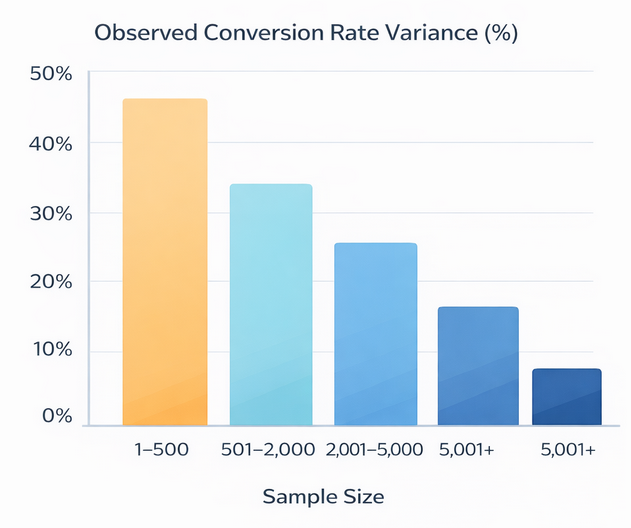
Conversion rate variance increases significantly as sample sizes shrink, making low-data creative results unreliable
Industry benchmarks suggest that conversion rate variance can exceed 30–50% when sample sizes are too small, especially in high-competition verticals. Decisions based on underpowered data frequently favor short-term luck over long-term performance.
Key risk: prematurely killing strong creatives or scaling weak ones due to statistical noise.
Pitfall #3: Ignoring Creative Fatigue Effects
Many teams analyze creative performance as if results exist in a vacuum. In reality, frequency and time-in-market play a major role in outcomes.
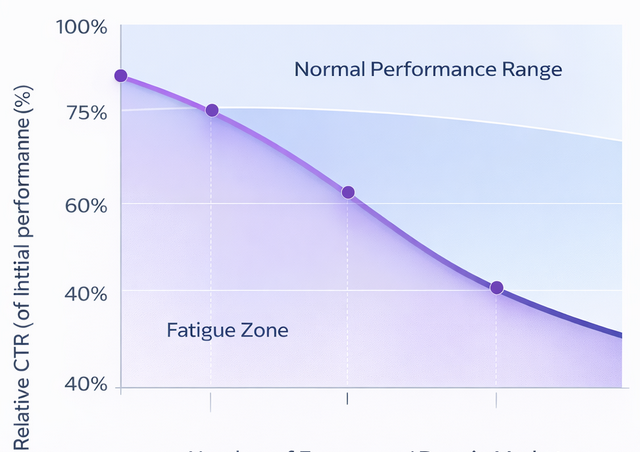
Click-through rates tend to drop sharply as audiences see the same creative repeatedly, emphasizing the need to monitor fatigue
Data from large ad platforms shows that click-through rates often decline by 40–60% after repeated exposure to the same creative. Without separating initial performance from fatigue-driven decline, teams may incorrectly label a strong concept as a failure.
Common symptoms:
-
Strong launch metrics followed by rapid performance drops
-
Frequent creative replacement without understanding root causes
-
Rising costs despite stable targeting
Pitfall #4: Evaluating Creatives in Isolation
Creative performance does not exist independently of audience, placement, or funnel stage. Testing creatives across mixed audiences or objectives without segmentation can severely distort results.
For example, a creative that performs poorly in cold traffic may outperform others in retargeting — but aggregated reporting hides this insight. According to internal platform studies, segmented creative analysis can improve return on ad spend by 20–35% compared to blended evaluation.
Pitfall #5: Optimizing for the Wrong Metric
At scale, it’s tempting to optimize for high-level indicators like CTR or CPC because they accumulate quickly. However, these metrics often have weak correlation with actual business outcomes.
Studies across performance campaigns show that high-CTR creatives can generate up to 25% lower conversion quality compared to creatives optimized for downstream actions. Scaling decisions based solely on engagement metrics can quietly degrade overall efficiency.
Pitfall #6: Lack of a Structured Testing Framework
Without a consistent framework — including naming conventions, test duration rules, and success thresholds — large-scale testing becomes chaotic. Teams struggle to track what has already been tested, duplicate experiments, and repeat past mistakes.
As volume increases, process discipline becomes more important than creative quantity. Scaling without structure rarely leads to scalable insights.
How to Avoid These Pitfalls
While scaling creative testing introduces complexity, most issues stem from process gaps rather than creative quality. Successful teams:
-
Isolate variables and test them sequentially
-
Ensure sufficient data before making decisions
-
Separate launch performance from fatigue effects
-
Analyze creatives by audience and funnel stage
-
Align optimization metrics with real outcomes
Conclusion
Creative testing at scale can be a powerful growth lever — but only when supported by disciplined methodology. Without clear structure, adequate data, and correct evaluation metrics, scale amplifies errors instead of insights.
By identifying and addressing these common pitfalls, teams can turn large creative volumes into reliable, repeatable performance gains rather than costly experimentation.