Many Facebook campaigns start wasting money before the first impression appears.
The problem is not always weak creative, poor targeting, or a bad landing page. Often, the campaign launches without a clear goal. Meta then optimizes toward a behavior that looks useful in Ads Manager but does not support the real business outcome.
A campaign built for traffic will not behave like a campaign built for leads. A campaign built for engagement will not behave like a campaign built for purchases.
Facebook ads goal selection tells Meta what kind of user behavior to prioritize. If that instruction is unclear or misaligned, CPC, CPA, lead quality, and ROAS can move in different directions.
Problem: Facebook Campaigns Waste Budget When the Goal Is Unclear
An unclear goal gives Meta a weak or misleading instruction.
This usually happens when advertisers choose the objective that feels easiest to win. Traffic looks attractive because clicks are cheap. Engagement feels safe because reactions appear quickly. Lead generation looks efficient because forms can produce volume fast.
But cheap activity is not the same as profitable activity.
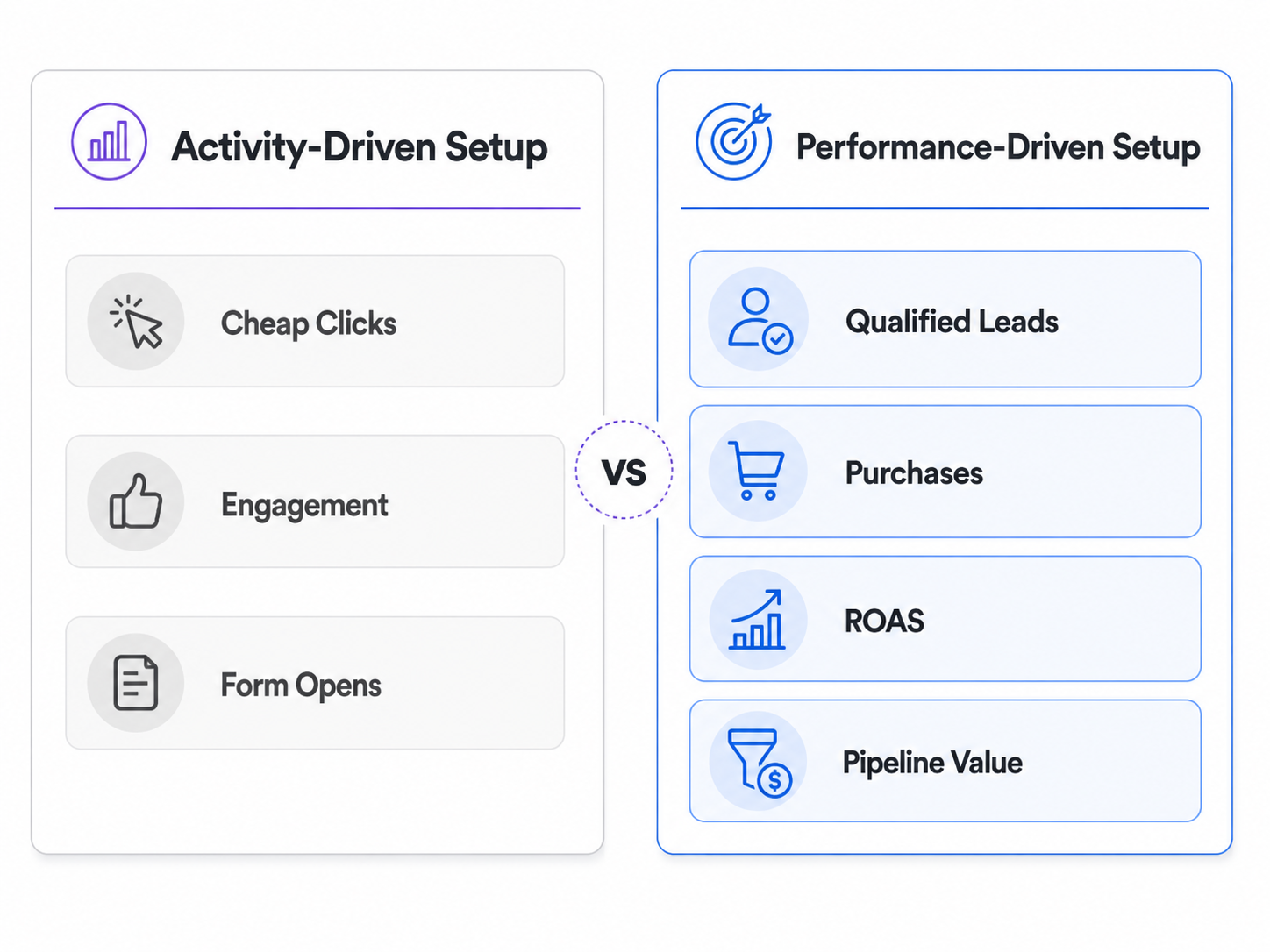
A traffic campaign can generate low CPC while conversion rate stays flat. A lead campaign can produce low CPL while sales rejects most of the contacts. An engagement campaign can create comments and reactions without moving users closer to purchase.
The campaign may not be broken. It may be optimizing exactly as instructed.
That is the dangerous part. Ads Manager can show movement while the business sees no meaningful progress.
Why the Wrong Goal Creates Bad Optimization Signals
Meta learns from the action you ask it to pursue.
If the campaign is optimized for link clicks, the system looks for people likely to click. If it is optimized for leads, it looks for people likely to submit forms. If it is optimized for purchases, it looks for users with stronger conversion patterns.
Those are different audiences inside the same platform.
A user who clicks many ads is not always a buyer. A user who fills easy forms is not always a qualified lead. A user who watches videos is not always ready for a sales offer.
This creates a signal problem. Meta keeps learning from the wrong behavior, then allocates more delivery toward users who repeat that behavior.
You can see this inside Ads Manager when CPC improves but CPA rises. You may also see lead volume increase while sales acceptance drops. In e-commerce accounts, product page views may climb while purchase ROAS stays below target.
The platform is collecting data. The problem is that the data does not represent real intent.
How Unclear Goals Distort CPC, CPA, and ROAS
A wrong goal often makes one metric look better while the business result gets worse.
For example, a SaaS company may promote a demo request using a traffic campaign. After three days, CPC looks efficient. Landing page views increase. The campaign looks active.
But demo bookings stay weak.
The issue is not only the landing page. Meta was asked to find users likely to click, not users likely to evaluate software.
In lead generation, the same problem appears as cheap form submissions. CPL drops, but the sales team reports poor fit, fake details, or low response rates. The campaign looks efficient at the form level while cost per qualified opportunity rises.
For e-commerce, the mismatch often appears as strong browsing activity with weak purchase volume. Product views and add-to-carts may look acceptable. ROAS stays below break-even because the campaign attracts browsers instead of buyers.
When the goal is wrong, optimization can reduce surface costs while increasing real acquisition cost.
What Goal Misalignment Looks Like in Ads Manager
Goal mismatch leaves observable patterns.
You do not need to wait a full month to diagnose it. The first few days often show whether Meta is optimizing for the right behavior.
Check for these signals:
-
Low CPC with weak conversion rate: The campaign is attracting click-prone users, but the traffic does not convert.
-
Low CPL with poor sales acceptance: Meta is finding people who submit forms, but they do not match the buyer profile.
-
High engagement with low landing page views: The ad gets reactions, but users are not showing enough intent to leave the platform.
-
Stable CPM with rising CPA: Auction cost may not be the core issue; the campaign may be optimizing for the wrong action.
These patterns prevent the wrong fix.
If CPC is low but CPA is high, changing the headline may not solve the problem. If CPL is low but close rate is weak, increasing budget can make the issue bigger. If engagement is strong but revenue is flat, the campaign may be optimized too high in the funnel.
A campaign should not be judged only by the result Meta was asked to generate. It should be judged by whether that result supports the business outcome.
Solution: Build a Goal-First Campaign Setup Before Launch
The solution is not to keep switching objectives after launch.
The better fix is a goal-first setup process before the campaign spends. That means defining the business outcome first, then choosing the campaign objective, funnel stage, optimization event, and KPI around that outcome.
This creates one clear instruction for Meta.
Instead of asking, “Which objective will get the cheapest result?” ask, “Which objective teaches Meta to find users most likely to create business value?”
That shift changes the campaign from activity-driven to performance-driven.
For deeper objective planning, use performance-driven Facebook campaign objectives as a setup reference.
Start With the Business Result You Need
The first decision should happen before Ads Manager opens.
Define the result that would make the campaign worth funding. “More traffic” is too vague. “More qualified demo requests under a target CPA” gives the campaign a clear direction. “More purchases above break-even ROAS” gives the setup a different path.
Your business outcome should answer three questions:
-
What action matters? This could be a purchase, booked call, qualified lead, trial start, appointment, or repeat order.
-
What metric proves success? Choose CPA, CAC, ROAS, cost per qualified lead, pipeline value, or lead-to-sale rate.
-
Where will quality be verified? Ads Manager alone is not enough for lead quality, sales value, or retention.
This step prevents the campaign from chasing cheap activity.
A lead campaign should not be judged only by lead count if the business needs qualified opportunities. A sales campaign should not be judged only by product views if the business needs profitable orders.
Match the Meta Objective to the Funnel Stage
Every campaign objective should match the user’s stage of awareness.
Cold audiences often need context before they convert. A new brand, complex offer, or high-ticket product may need education before asking for a purchase or consultation. In that case, a top-of-funnel objective can be useful if it feeds a clear next step.
Warm audiences need a different instruction.
Users who visited pricing pages, opened lead forms, watched product videos, or added products to cart have already shown intent. Optimizing them for engagement may waste that intent. They are closer to action, so the objective should usually push toward lead capture, sales, or another conversion event.
The offer should guide this choice.
A checklist, quiz, webinar, or consultation usually fits lead generation. A discount, bundle, free trial, or quote request usually belongs closer to sales. A broad educational video may fit awareness or engagement, but only if the next step is planned.
This is where Meta campaign objectives need to be mapped to funnel intent, not chosen from habit.
Choose an Optimization Event That Reflects Real Intent
The objective sets the direction. The optimization event sharpens the instruction.
This is where many campaigns lose efficiency. The objective may be reasonable, but the selected event is too shallow.
A sales campaign optimized for landing page views does not learn the same pattern as one optimized for purchases. A lead campaign optimized for easy form submissions does not behave like one connected to qualified leads, booked calls, or completed applications.
The best optimization event is usually the deepest reliable event.
“Deepest” means the event is close to business value. “Reliable” means it happens often enough for Meta to learn from it.
A purchase event is stronger than an add-to-cart event. A qualified lead event is stronger than a form open. A booked call is stronger than a basic contact submission.
But event volume matters. If purchases happen only a few times per month, Meta may struggle to stabilize delivery. In that case, use a higher-funnel event only when it strongly predicts the final outcome.
Do not train Meta on behavior that looks active but does not predict revenue.
Align the Offer With the Objective Before Launch
A campaign goal can still fail if the offer asks for the wrong action.
A high-friction offer paired with a cold audience often struggles. A direct demo request may be too aggressive for users who have never heard of the brand. A soft educational offer may be too weak for users who are already comparing vendors.
This mismatch creates noisy data.
For example, a demo offer inside a traffic campaign may get clicks but few bookings. A broad awareness video inside a purchase campaign may struggle because users are not ready to buy. A lead magnet inside a sales campaign may produce weak learning because the offer is not purchase-focused.
The offer, objective, and KPI need to point in the same direction.
Use align your offer with the right Facebook ad campaign objective when deciding whether the campaign should drive awareness, leads, or direct conversions.
Review Goal Fit Before Scaling or Editing
When performance looks weak, many advertisers change creative first.
That can waste time if the campaign goal is the real issue. New creative may attract more of the same wrong behavior if the objective still points Meta toward low-intent users.
Before scaling, editing, or duplicating a campaign, review goal fit.
Ask whether the campaign is optimizing for the same result the business needs. If the answer is no, fix the setup before adding budget. Scaling a misaligned campaign gives Meta more money to chase the wrong action.
This matters during the learning phase too.
If the campaign collects weak signals early, later optimization becomes harder. The system learns from users who clicked, submitted low-intent forms, or engaged casually. Those signals can shape future delivery even after the campaign has enough volume.
A goal-fit review should come before major changes.
Use it when CPC looks cheap but CPA is high. Use it when CPL improves but lead quality drops. Use it when engagement rises but revenue stays flat. These are not always creative problems. They are often goal problems.
How to Know the Goal-First Setup Is Working
A clean setup makes performance easier to read.
The campaign does not need perfect results immediately. It does need consistent alignment between platform activity and business outcomes.
You should see clearer relationships between Ads Manager metrics and downstream data. If clicks rise, landing page actions should rise too. If leads increase, qualified conversations should not collapse. If purchase volume grows, ROAS should stay within a realistic range.
The main sign is not one perfect metric.
The main sign is that CPC, CPA, lead quality, and conversion rate tell the same story. When those metrics conflict sharply, the campaign may be optimizing for an action that does not support the real goal.
Goal-first setup does not remove testing. It makes testing cleaner because each result has context.
Final Takeaway: Clear Goals Make Facebook Ads Easier to Optimize
Facebook ads do not waste budget only because of bad creative or broad audiences.
They often waste budget because the campaign goal is unclear before launch. Meta then optimizes toward the easiest measurable action, even when that action does not create revenue, pipeline, or qualified demand.
The fix is one goal-first setup process.
Define the business outcome. Match the objective to the funnel stage. Choose an optimization event that reflects real intent. Align the offer with the action you want. Review goal fit before scaling or editing.
If the goal is unclear, optimization only makes the wrong result cheaper.