Meta can technically hit your campaign goal and still hurt performance.
That sounds contradictory, but it happens often. A campaign gets leads, but sales says they are weak. A campaign gets add-to-carts, but checkout does not move. A campaign gets cheap landing page views, but no serious buyer behavior follows.
The problem is not always the campaign objective itself. Sometimes the objective is reasonable, but the signal Meta learns from is too shallow.
That is where advertisers lose control. Meta keeps finding more people who complete the selected action, even when that action does not predict revenue, pipeline, or real customer value.
Problem: Meta Can Hit the Selected Result While Still Hurting Performance
Meta does not judge quality the way your business does.
If you ask for leads, Meta looks for people likely to become leads. If the campaign is optimized for add-to-cart, Meta looks for people likely to add products to cart. If the event is landing page views, Meta looks for people likely to load the page.
Those actions are not always bad. The problem starts when they become weak proxies for the result you actually need.
A lead is useful only if it has a chance of becoming a customer. An add-to-cart matters only if it predicts purchase intent. A landing page view matters only if the visitor does something valuable after arriving.
This is why a campaign can look healthy inside Ads Manager while the business result gets worse.
The platform reports the result it was asked to find. Your CRM, checkout, or sales team reveals whether that result had value.
Why Platform Success Can Conflict With Business Success
Ads Manager often rewards volume before quality.
That creates a dangerous gap. Meta may see a campaign producing results efficiently, while the business sees a rising cost per qualified action.
For example, a lead campaign may deliver a low CPL. On paper, the campaign looks efficient. But if only 8% of leads book a call instead of the usual 25%, the real cost per qualified lead has increased.
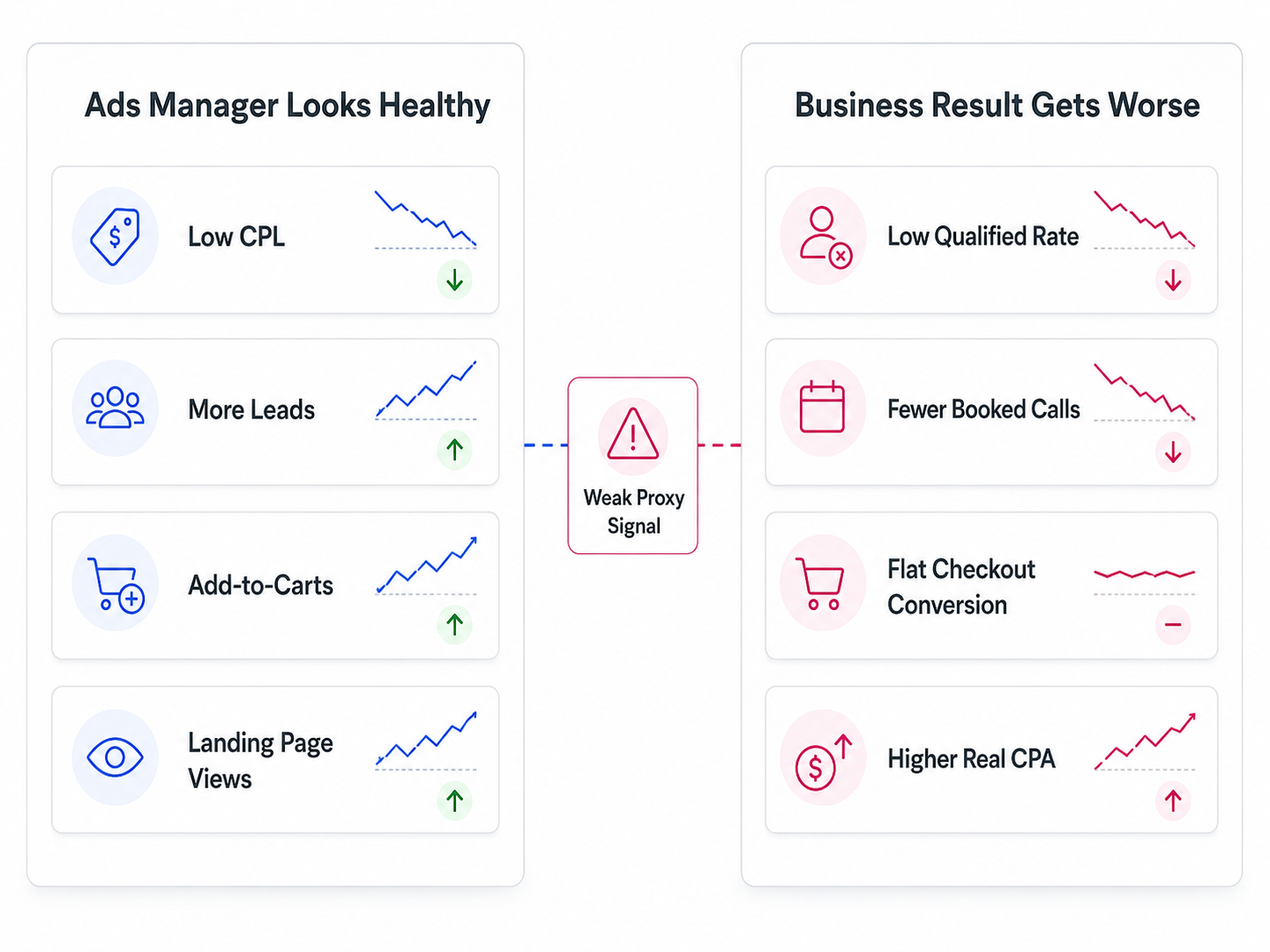
E-commerce accounts see a similar pattern. Add-to-cart volume rises, and Meta sees stronger mid-funnel activity. But if checkout conversion rate stays flat, the campaign may be attracting shoppers who like browsing but rarely complete purchases.
This is not just a reporting issue. It changes delivery.
Meta starts favoring users, ads, and placements that produce the selected result at the lowest cost. If that selected result is low-quality, budget shifts toward low-quality volume.
Cheap results become expensive when they teach Meta the wrong pattern.
What Wrong Optimization Looks Like After Launch
Wrong optimization usually shows up as a mismatch between spend allocation and real performance. The campaign may not look broken at first. Delivery continues. Results come in. Average CPA or CPL may even look stable.
The problem appears when you inspect where the budget is going.
Look for these patterns:
- One ad gets most of the spend because it produces easy actions. The ad may generate cheap leads, clicks, or carts, but downstream conversion quality is weaker than other ads.
- Lead volume rises while qualified lead rate drops. Meta is finding people who complete the form, not people who match your sales criteria.
- Add-to-cart volume improves without purchase growth. The campaign is learning from browsing behavior instead of buying behavior.
- Average CPA looks acceptable while revenue quality declines. The campaign may be driving lower-AOV purchases, refund-prone buyers, or weak-fit customers.
These signals are visible only when you look past the top-line result.
Averages can hide the problem. One ad set may produce cheap volume that pulls down blended CPA, while another produces fewer but better customers. If you judge only the average, Meta’s budget allocation can look smarter than it really is.
Solution: Fix the Signal Meta Learns From
The solution is not simply to change the campaign objective.
The better solution is to fix the signal Meta uses to learn. That means replacing weak proxy events, checking downstream quality, and stopping budget from flowing toward low-value actions.
This is a signal-quality problem.
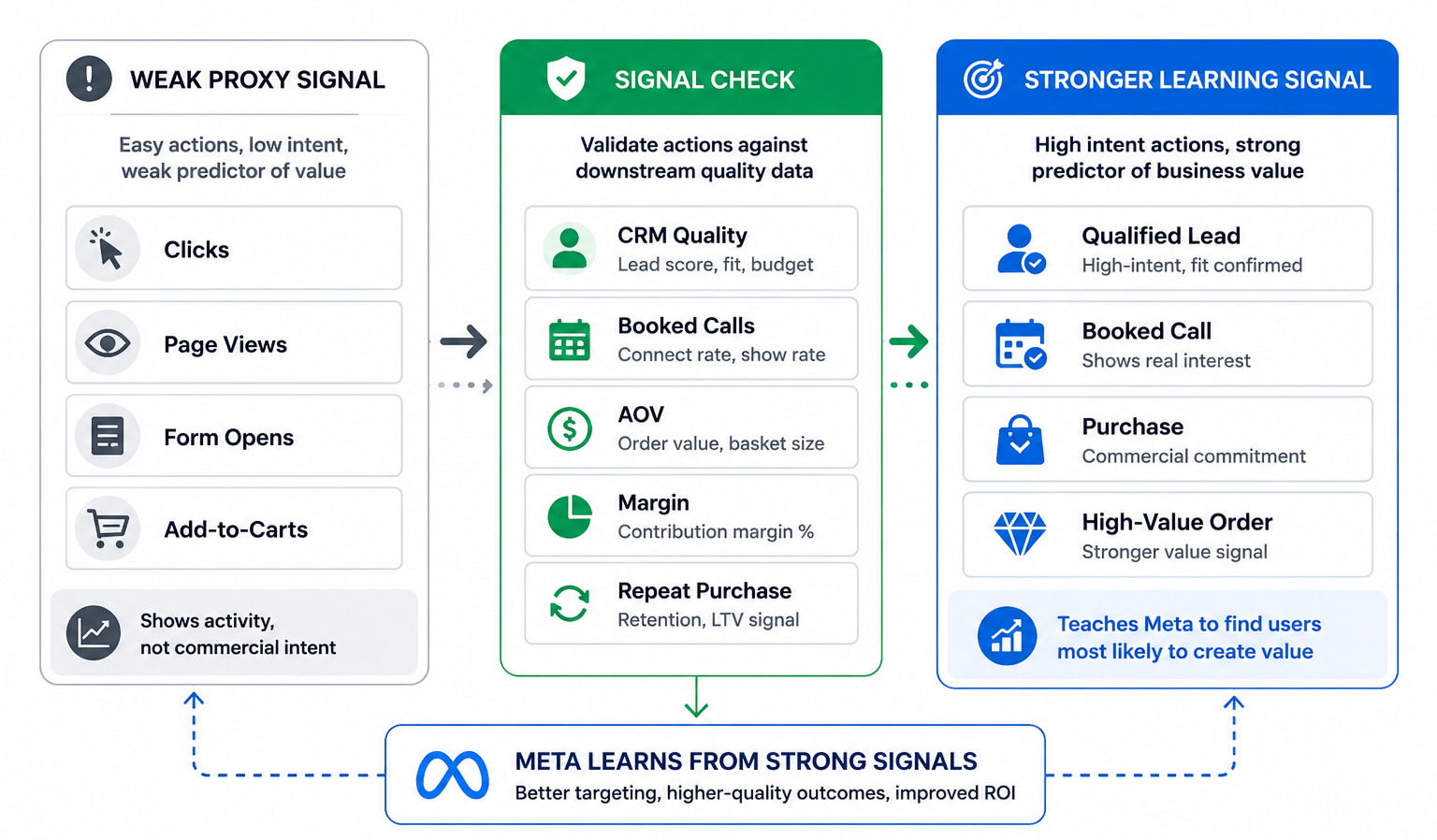
The campaign setup should help Meta learn from actions that predict business value. The reporting process should then confirm whether those actions continue through the funnel.
If the signal is wrong, optimization becomes misleading. If the signal is stronger, Meta has a better chance of finding users who create revenue, pipeline, or qualified demand.
For a deeper breakdown of this issue, review why Meta ads optimize for the wrong conversion event.
Replace Shallow Events With Stronger Intent Signals
A shallow event happens easily but says little about real intent.
Link clicks, page views, form opens, video views, and add-to-carts can all be shallow in the wrong context. They show activity, but they may not prove commercial interest.
A stronger signal sits closer to business value.
For e-commerce, purchase is stronger than add-to-cart. Initiate checkout is often stronger than product view. For lead generation, a completed qualified form is stronger than a form open. A booked call is stronger than a raw lead.
The key is not always to choose the deepest possible event. The event still needs enough volume for Meta to learn.
If purchases happen often enough, optimize toward purchases. If purchases are too rare, use an interim event only when it has a clear relationship with later purchases. If lead quality is weak, do not keep optimizing for the same easy form submission.
The event should predict the next valuable step, not just happen frequently.
Use Downstream Quality Data to Judge Campaign Success
Meta cannot see everything your business sees.
It may know that a lead was submitted. It may not know whether the lead had budget, answered the phone, booked a call, or became an opportunity. It may know that a purchase happened. It may not know whether the customer refunded, bought once, or returned later.
That is why downstream data matters.
For lead generation, compare Ads Manager results with CRM quality signals. Look at booked-call rate, sales acceptance rate, lead score, opportunity rate, and cost per sales-qualified lead.
For e-commerce, compare campaign results with AOV, refund rate, repeat purchase rate, contribution margin, and blended ROAS.
A campaign with a low CPL is not healthy if sales wastes time on poor-fit leads. A campaign with a low CPA is not healthy if it attracts low-value orders that do not cover margin.
This is why ignoring lead scoring skews campaign optimization. Raw conversion volume can push Meta toward the easiest users, not the most valuable ones.
Watch Budget Allocation, Not Just Average CPA
Meta’s spend distribution often reveals the real optimization problem.
If one ad receives most of the budget, check whether it also produces the best downstream value. Do not assume Meta is choosing the most profitable ad just because it spends the most. It may simply be choosing the ad that produces the cheapest selected event.
This is especially common in lead campaigns.
One creative may attract broad interest and generate low CPL. Another may produce fewer leads but stronger qualification. Meta may favor the first because the platform sees cheaper conversions. Sales may prefer the second because the leads are more serious.
The same issue happens in sales campaigns.
An ad that drives low-cost purchases may attract discount buyers with lower AOV. Another ad may produce fewer purchases but better order value. If you judge only CPA, the stronger business performer may look weaker.
Review spend distribution by ad, ad set, placement, and audience segment. Then compare those spend patterns with quality data.
If Meta spends most of the budget on the cheapest result but not the best customer, the campaign is optimizing for the wrong value signal.
Stop Scaling When Cheap Results Lower Customer Quality
Scaling should not be based only on CPA, CPL, or conversion volume.
Those metrics can look strong while quality falls. If you scale during that pattern, you give Meta more budget to find more of the same low-value users.
Before increasing budget, check whether quality holds.
For lead generation, lead-to-call rate should stay stable. Sales acceptance should not collapse. Cost per qualified lead should not rise faster than CPL improves.
For e-commerce, ROAS should hold within a realistic range. AOV should not drop sharply. Refunds and low-margin purchases should not increase.
If quality weakens during scaling, the campaign may be moving beyond the audience segment where the signal worked. Meta is still finding conversions, but the next layer of users may be less valuable.
This is where Meta ads optimization conflicts with business goals. The platform can keep improving delivery against its selected metric while the business absorbs worse economics.
Scaling should pause when cheap results start lowering customer quality.
How to Know Meta Is Learning From the Right Signal
A healthy signal creates alignment between platform results and business results.
That does not mean every metric becomes cheaper. In many accounts, better-quality users cost more to reach. CPM may rise. CPC may rise. Lead volume may fall.
That can still be a better campaign.
If the qualified lead rate improves, a higher CPL may be acceptable. If AOV increases, a higher CPA may still protect ROAS. If booked-call rate improves, fewer raw leads may create more pipeline.
The right signal usually creates cleaner decision-making. You know which ads produce valuable users. You know which events predict revenue. You know when a cheap result is actually hurting the funnel.
The campaign becomes easier to manage because the data points in the same direction.
Final Takeaway: Stop Optimizing for Easy Actions That Do Not Predict Value
Meta will always optimize toward the result it can measure.
The risk is that the measurable result may be too shallow. Leads, clicks, carts, views, and form submissions can look strong while CPA, CAC, ROAS, and sales quality move the wrong way.
The fix is to improve the signal Meta learns from.
Replace shallow events with stronger intent signals where possible. Use CRM, checkout, and sales data to judge quality. Watch where Meta sends budget, not just the blended CPA. Stop scaling when cheap results start lowering customer value.
Meta does not need more signals. It needs better signals.