Campaign spending limits look like a simple budgeting feature inside Meta Ads Manager. Set a maximum spend amount, protect the budget, and stop campaigns from overspending.
The operational impact becomes more complicated once campaigns begin scaling.
Many advertisers create campaign spending limits during testing phases and then forget they exist. Later, when delivery suddenly stops, they blame creatives, targeting, attribution, or Meta’s algorithm when the actual issue is the campaign cap itself.
Understanding how campaign spending limits work matters because they affect every ad set and ad inside the campaign once the threshold is reached.
What a Campaign Spending Limit Actually Does
A campaign spending limit is a cumulative cap applied to one campaign.
Once the campaign reaches that total spend amount, Meta pauses all ad sets and ads inside the campaign automatically. Delivery stops completely until the advertiser increases or removes the limit.
The feature exists primarily for spend protection.
Advertisers commonly use campaign spending limits for:
- controlled creative tests,
- short-term promotions,
- prepaid client campaigns,
- local campaigns with strict acquisition ceilings.
The important detail is that the limit itself does not optimize delivery performance while campaigns are active. Meta still allocates spend and enters auctions normally until the campaign reaches the cap.
Why Campaigns Often Stop During Strong Performance Periods
Campaign spending limits rarely become a problem during weak delivery.
Most issues appear when campaigns begin scaling successfully.
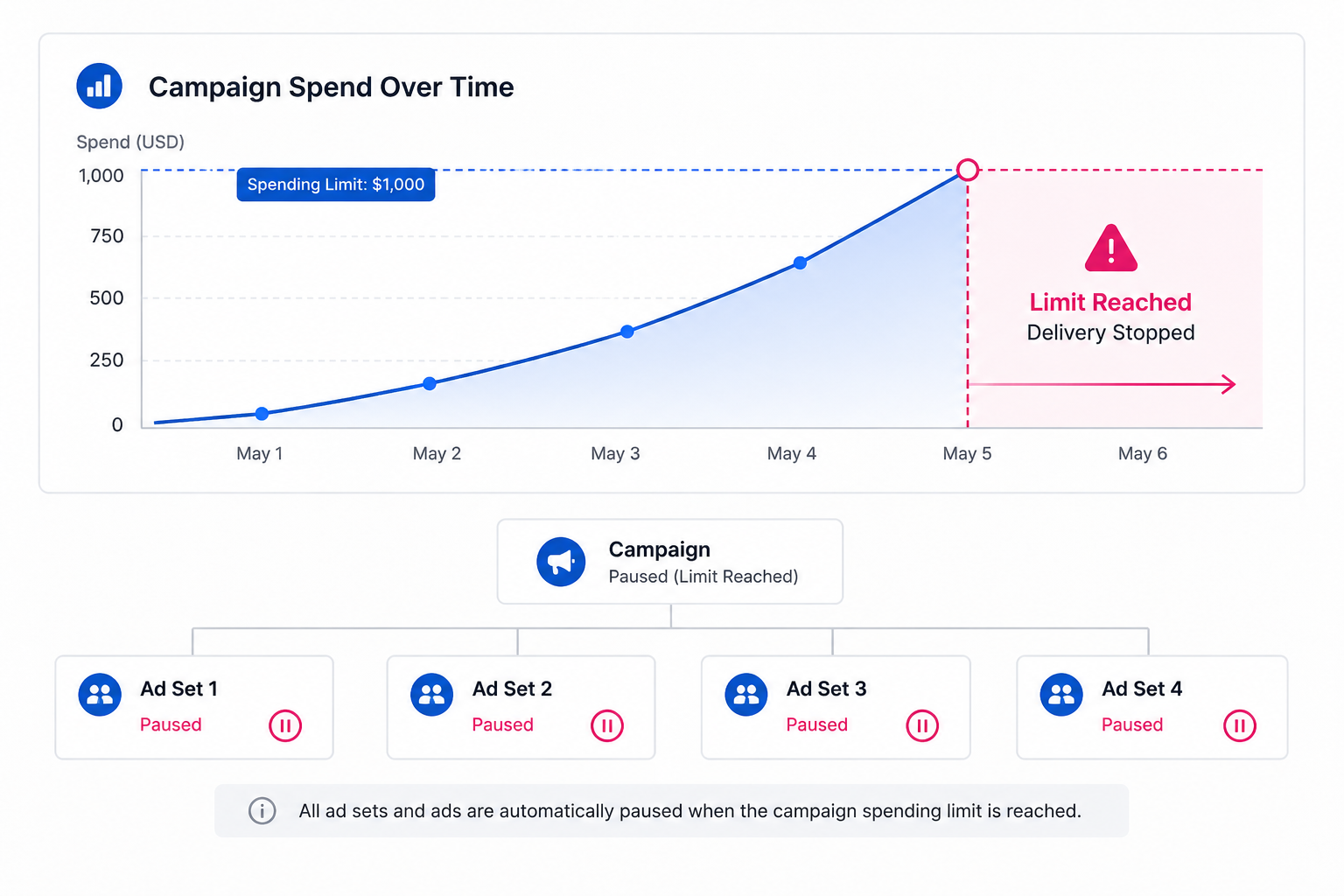
Imagine a lead generation campaign capped at $1,000 total spend. Meta identifies a responsive audience cluster, conversion rates improve, and spend accelerates faster than expected.
The campaign reaches its ceiling earlier than planned.
Inside Ads Manager, advertisers usually notice:
- spend freezing suddenly,
- impression delivery collapsing,
- leads stopping without warning,
- CPA volatility after restart,
- uneven recovery across ad sets.
Because the campaigns still appear structurally healthy, teams often misdiagnose the issue and begin editing campaigns unnecessarily.
Why Abrupt Campaign Stops Create Delivery Instability
Meta notes that campaign spending limits simply stop delivery once the cap is reached.
Operationally, the interruption affects more than budget control.
Meta’s optimization system relies on continuous conversion feedback and ongoing auction participation. When campaigns stop abruptly:
- conversion signal flow pauses,
- retargeting pools stop refreshing,
- pacing consistency weakens,
- spend distribution resets,
- learning stability declines temporarily.
This becomes especially noticeable in campaigns with lower conversion volume.
A B2B campaign generating several qualified leads daily may need time to stabilize again after a hard stop. Meta’s delivery system performs best under continuous conditions rather than repeated pause-and-restart cycles.
Why Campaign Spending Limits Are Not Compatible With Lifetime Budgets
Many advertisers confuse campaign spending limits with campaign lifetime budgets.
Meta treats them differently.
Campaign lifetime budgets already function as the campaign’s spending control when Advantage+ campaign budget is enabled. Because of that, Meta does not allow campaign spending limits and campaign lifetime budgets to operate together.
The difference matters because the systems behave differently operationally.
Campaign spending limits act as hard cumulative caps. Lifetime budgets distribute spend gradually across the scheduled timeframe instead of shutting campaigns off immediately after a threshold is reached.
Advertisers comparing pacing systems often benefit from understanding daily vs lifetime budgets for Facebook campaigns before deciding which structure fits their campaigns.
How to Create a Campaign Spending Limit in Meta Ads Manager
Meta allows advertisers to configure campaign spending limits directly inside the campaign editing interface.
The process itself is straightforward:
- open the campaign inside Ads Manager,
- select Edit,
- expand Campaign details,
- locate Campaign spending limit,
- enable the setting,
- enter the desired limit,
- save the changes.
Meta notes that changes are typically applied within about 15 minutes.
That timing matters during active scaling periods because delivery interruptions may continue temporarily after the limit is adjusted.
Why Reactive Budget Controls Create Reporting Problems
A common mistake is adjusting campaign spending limits reactively instead of strategically.
Advertisers often raise limits only after campaigns stop unexpectedly. That creates unstable reporting periods where:
- CPM fluctuates sharply,
- CPC trends become inconsistent,
- spend pacing compresses unnaturally,
- ROAS becomes harder to interpret.
The issue becomes worse when advertisers immediately edit creatives or targeting after reactivating campaigns. Multiple simultaneous changes make it difficult to isolate the real cause of performance swings.
This is one reason advertisers trying to keep ROAS on track with better budget pacing often prefer smoother pacing systems over abrupt hard stops.
When Campaign Spending Limits Make Sense
Campaign spending limits work best under controlled delivery environments where spend predictability matters more than uninterrupted scaling.
Examples include:
- fixed-budget local campaigns,
- seasonal promotional campaigns,
- short-duration ecommerce launches,
- isolated creative tests.
For evergreen campaigns or active scaling environments, hard spending caps require close monitoring. Otherwise, advertisers risk interrupting campaigns precisely when Meta begins finding efficient delivery opportunities.
Budget architecture should support optimization stability rather than repeatedly interrupting it.
Why Campaign Shutdowns Get Misinterpreted
Campaign spending limits create one of the most misleading troubleshooting scenarios inside Ads Manager.
Advertisers often interpret sudden delivery stops as:
- audience fatigue,
- ad rejection,
- tracking instability,
- attribution failure,
- or algorithm volatility.
The real issue may simply be the campaign limit.
Understanding when to pause, kill, or scale an ad set becomes important because not every delivery interruption signals poor performance. Sometimes the campaign stopped because the advertiser configured it to stop.
Final Takeaway
Campaign spending limits are budget protection tools, not optimization systems.
They work well for controlling financial exposure during testing or fixed-budget campaigns. But abrupt delivery interruptions can destabilize pacing, weaken learning consistency, and create misleading performance swings after campaigns restart.
Most campaign spending limit problems happen because advertisers forget the cap exists while Meta is actively scaling delivery successfully.