Knowing when to pause, kill, or scale an ad set is one of the most important — and misunderstood — skills in paid advertising. Many campaigns fail not because the idea was bad, but because decisions were made too early, too late, or based on the wrong signals.
This guide breaks down a practical decision framework you can use to evaluate ad sets objectively, protect your budget, and grow results with confidence.
First: Let the Data Stabilize
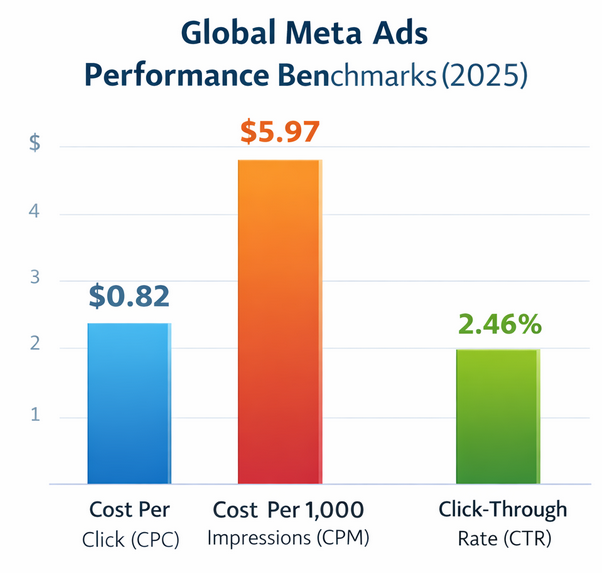
Global Meta Ads Performance Benchmarks (2025): CPC, CPM, and CTR
Before making any decision, the ad set needs enough data to be statistically meaningful.
As a general benchmark:
-
Allow 48–72 hours of delivery after launch or major edits
-
Aim for at least 1,000 impressions
-
Ideally collect 30–50 conversion events for conversion-optimized campaigns
Meta’s own delivery system relies on enough conversion signals to exit the learning phase. According to multiple platform benchmarks, ad sets that exit learning typically show 15–30% lower cost per result compared to those that remain unstable.
If you judge an ad set too early, you risk killing a potential winner.
When to Pause an Ad Set
Pausing is a temporary action. You pause when something isn’t working right now, but may work later with adjustments.
Consider pausing when:
-
Cost per result is 20–30% higher than your target
-
Click-through rate (CTR) is below 0.7% after sufficient impressions
-
Frequency rises above 2.5–3.0 in a short time frame
-
Performance declines after a strong initial run
Pausing is often the right move when:
-
Creative fatigue is suspected
-
Audience overlap is increasing
-
Budget was scaled too quickly
A paused ad set can often recover with refreshed creatives, budget changes, or timing adjustments.
When to Kill an Ad Set
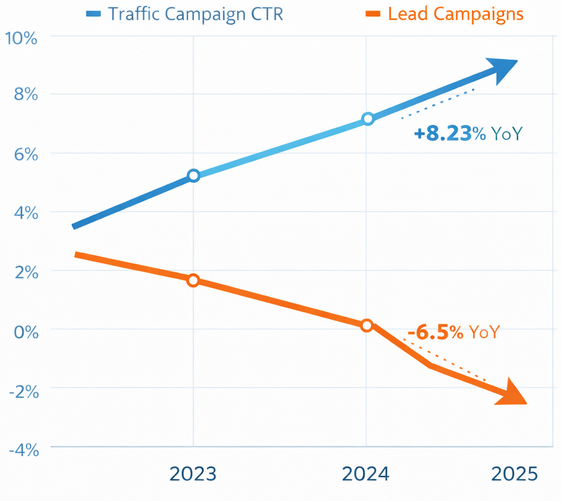
CTR Growth for Traffic Campaigns vs Conversion Trends for Lead Campaigns (Year-over-Year)
Killing is permanent. This decision should be data-driven and unemotional.
Kill an ad set when:
-
Cost per acquisition is 50%+ above your acceptable threshold
-
No conversions occur after 2–3x your target CPA in spend
-
CTR remains below 0.5% despite creative testing
-
Engagement signals (clicks, saves, comments) are consistently weak
Industry benchmarks show that top-performing advertisers routinely kill 60–80% of tested ad sets within the first testing cycle. This isn’t failure — it’s focus.
If an ad set shows no signs of life across multiple metrics, reallocating budget is almost always the smarter move.
When to Scale an Ad Set
Scaling is where growth happens — and where most accounts break.
You should consider scaling when:
-
CPA is 20–30% below your target for several days
-
Conversion volume is consistent, not spiky
-
Frequency remains under 2.0
-
Results hold after small budget increases
How to Scale Safely
-
Increase budget by 15–30% every 24–48 hours
-
Monitor CPA and frequency closely after each increase
-
Avoid editing creatives or targeting while scaling
Data from large ad accounts shows that gradual scaling preserves performance in 70%+ of cases, while aggressive budget jumps often reset the learning phase and increase costs.
A Simple Decision Matrix
| Situation | Action |
|---|---|
| No conversions, high spend | Kill |
| Slightly above CPA, weak CTR | Pause |
| Consistent conversions, low CPA | Scale |
| Performance dropped after scaling | Pause or reduce budget |
Using a clear matrix removes guesswork and emotion from optimization.
Common Mistakes to Avoid
-
Making decisions based on one day of data
-
Scaling multiple variables at once
-
Holding onto losing ad sets due to sunk costs
-
Ignoring frequency and creative fatigue
Advertisers who follow structured rules instead of instincts typically see 25–40% more efficient spend over time.
Final Thoughts
Pausing, killing, and scaling are not reactions — they are strategic decisions. The more disciplined your framework, the easier it becomes to grow profitable campaigns without burnout or wasted budget.
Treat every ad set as a data experiment. Let the numbers guide you, and your results will compound.