Not every Facebook post deserves paid promotion.
Some posts perform well organically because existing followers already understand the brand, the context, or the offer. Once those posts get boosted, engagement drops quickly because colder audiences do not react the same way.
Other posts behave differently.
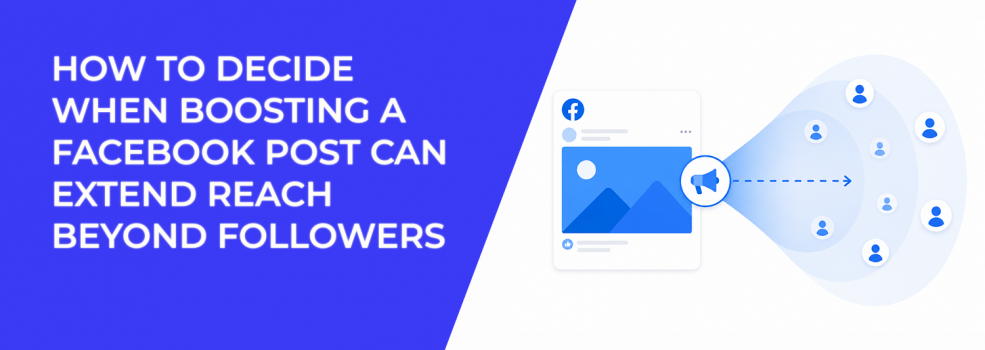
They continue attracting attention even after Meta expands delivery beyond followers. Reach grows efficiently, engagement stays stable, and the post starts pulling interaction from users who were never connected to the page before.
The challenge is knowing the difference before spending budget.
Why Many boosted posts stop performing once Meta expands beyond followers
A Facebook post can look successful inside a warm audience while failing completely in broader delivery.
This usually happens because followers behave differently from cold audiences.
Followers already recognize:
- the brand;
- the messaging style;
- the product category;
- the creator or company behind the content.
Cold audiences do not.
A post that performs well because of existing brand familiarity often loses momentum after boosting because the content lacks immediate clarity for people seeing it for the first time.
This pattern appears frequently inside boosted-post reporting.
The first delivery wave performs well, then engagement quality weakens as Meta expands distribution outward.
You can often spot this shift through signals like:
- declining engagement rate despite increasing reach;
- rising CPM after initial delivery;
- weaker outbound CTR from non-followers;
- frequency growth concentrated among existing engagers.
The issue is not necessarily the creative itself.
The post simply relied too heavily on follower familiarity.
That distinction becomes important because boosted-post success depends heavily on whether the content can survive outside the existing community.
Fix #1: Boost posts that already attract interaction from non-followers organically
The strongest boosted posts usually show signs of broader relevance before promotion even begins.
One of the best indicators is non-follower engagement.
If a post already receives:
- shares outside the page audience;
- comments from unfamiliar users;
- saves from non-followers;
- profile visits from new users,
Meta has stronger evidence that the content can travel beyond the existing audience cluster.
This matters because Facebook’s distribution system pays close attention to cross-network interaction behavior.
A post that generates engagement only from loyal followers often stalls during expansion. A post that naturally spreads outside the current audience usually scales more efficiently after promotion.
This is especially visible with:
- educational content;
- problem-focused posts;
- industry insights;
- broadly relatable pain points;
- visual demonstrations.
These formats usually require less brand familiarity to understand.
That is one reason improving Facebook organic reach before boosting posts often matters more than advertisers realize. Organic spread patterns reveal whether content already has expansion potential before paid delivery starts.
Fix #2: Prioritize posts with fast message clarity
Posts that scale beyond followers usually communicate value immediately.
Cold audiences decide quickly whether content deserves attention. If the post takes too long to understand, expansion efficiency drops fast once Meta broadens delivery.
The strongest boosted posts often contain:
- obvious visual context;
- simple framing;
- immediate relevance;
- fast problem recognition.
For example, a niche inside joke may perform extremely well among followers but collapse after promotion because cold audiences lack context.
A simple educational graphic explaining a common business problem often scales much further because broader audiences understand it instantly.
This becomes increasingly important as Meta pushes boosted delivery into larger inventory pools across Facebook and Instagram placements.
The platform rewards content that maintains stable engagement during audience expansion.
Fix #3: Watch relevance signals instead of raw reach numbers
Large reach numbers alone do not mean the post is expanding successfully.
Many advertisers boost posts, see reach increase dramatically, and assume performance improved automatically.
The better question is whether engagement quality remains stable while reach grows.
Healthy expansion usually looks like:
- consistent engagement rates;
- stable outbound CTR;
- increasing interaction from new users;
- reasonable CPM stability during scaling.
Poor expansion often creates the opposite pattern:
- impressions rise quickly;
- engagement rate declines sharply;
- comments become lower quality;
- clicks lose intent.
This is where many advertisers confuse visibility with actual audience expansion quality.
That is also why understanding the difference between impressions and reach matters when evaluating boosted-post performance. Large delivery numbers alone rarely explain whether the post is attracting the right people.
Final takeaway
A Facebook post can extend reach beyond followers successfully when the content works without requiring existing brand familiarity.
The best boosted posts usually show early signs of broader relevance before promotion begins:
- interaction from non-followers;
- share activity outside the page audience;
- fast message clarity;
- stable engagement as reach expands.
Posts that depend heavily on follower context often lose performance quickly once Meta pushes delivery into colder audiences.
That is why why audience quality matters more than broad reach becomes especially important during boosted-post expansion. Reaching more people only helps if the content still feels relevant after leaving the follower bubble.