The easiest paid media decision is not always the right one.
A Facebook boosted post can be useful. It is fast, familiar, and simple enough for small teams to launch without building a full campaign structure.
But the same simplicity becomes a weakness when the goal requires precision, testing, conversion tracking, or predictable CPA.
Meta’s indexed source lesson covers creating and boosting posts as part of Facebook and Instagram advertising, while related Meta Help snippets describe boosted posts as ads created from existing content and delivered in selected placements.
The Problem
The problem is that many marketers choose boosted posts because they are available, not because they fit the campaign goal.
That leads to poor decisions.
A boosted post may be fine for visibility but weak for lead generation.
It may be useful for engagement but weak for purchase optimization.
It may be good for quick content amplification but insufficient for structured testing.
Without a decision framework, marketers either overuse boosted posts or dismiss them completely.
Both extremes are wrong.
Why This Problem Hurts Performance
Choosing the wrong campaign type affects budget efficiency.
If you use a boosted post for a conversion goal, you may generate cheap activity but expensive acquisition.
If you use a full campaign for a simple visibility goal, you may spend unnecessary time and complexity on a lightweight objective.
If you choose the wrong tool repeatedly, testing slows down. You stop learning whether the issue is the post, audience, objective, placement, or offer.
That affects CPC, CPA, CAC, ROAS, lead quality, and scaling decisions.
Common Scenarios Where This Happens
An SMB owner boosts every post because it is easy, then wonders why sales do not grow.
An agency boosts a client’s strongest organic post without defining whether the goal is engagement, traffic, leads, or sales.
A B2B marketer wants demo requests but starts with a boosted thought-leadership post and no lead capture plan.
A local business wants event visibility and overcomplicates the campaign when a simple boost may have been enough.
An ecommerce brand boosts product posts without separating awareness, consideration, and purchase campaigns.
Why the Problem Happens
This happens because boosted posts sit between organic content and paid campaign strategy.
They look like a shortcut to advertising. Sometimes they are. But not every shortcut leads to the right destination.
Another cause is unclear campaign intent. If the advertiser cannot name the desired action, the boost becomes a default.
A third cause is audience uncertainty. When marketers do not know who they are trying to reach, they rely on broad delivery and hope the algorithm finds the right people.
Finally, many teams lack measurement discipline. They judge visibility, engagement, traffic, and sales with the same dashboard mindset, even though each goal requires different KPIs.
The Solution
The solution is to use a simple decision framework.
A boosted post fits when speed matters more than control.
It fits when the goal is awareness, lightweight engagement, social proof, local visibility, simple traffic, or fast content amplification.
It can fit when you want to test whether an organic post resonates with a broader audience.
A boosted post usually does not fit when you need predictable CPA, high-quality leads, purchase optimization, controlled A/B testing, audience exclusions, deep placement control, or scalable ROAS.
Use this rule:
If the campaign goal is attention, a boost may work.
If the campaign goal is acquisition, build a structured campaign.
How LeadEnforce Helps
LeadEnforce helps when the decision points toward a structured campaign or a more focused audience test.
If a simple boosted post is too broad for the goal, the next question is often: “How do we reach people who are more likely to care?”
LeadEnforce can help advertisers build audience inputs from Facebook groups, Instagram followers, LinkedIn-derived professional data, and custom social-profile sources. Its Custom Audience feature describes turning Facebook, LinkedIn, Instagram, and other profile links into custom audiences, and its Facebook group feature describes targeting pre-engaged group members.
This makes LeadEnforce useful when the campaign needs better audience relevance than a basic boost can provide.
For a B2B lead campaign, that might mean building audiences around professional criteria. For ecommerce, it might mean targeting followers of niche Instagram profiles. For local or community-based businesses, it might mean using relevant Facebook groups as audience sources.
Risks and Considerations
Do not assume boosted posts are useless.
They can be valuable when the goal is simple and the post is strong.
Do not assume structured campaigns always outperform boosts either. If the offer is weak, audience is wrong, creative is unclear, or tracking is broken, campaign complexity will not save performance.
If LeadEnforce is used, source quality matters. The selected groups, profiles, job titles, or social-profile data must match the ICP. Small or poorly matched audiences can limit delivery or create misleading test results.
Prerequisites and Dependencies
Before deciding, define the campaign goal, funnel stage, ICP, offer, budget, and success metric.
For boosted posts, make sure the creative is strong enough to stand alone in the selected placements.
For structured campaigns, make sure tracking, landing pages, audience strategy, and conversion events are ready.
If LeadEnforce is part of the plan, identify relevant source communities, profiles, or professional data before launch.
Practical Recommendations
Use boosted posts for simple visibility and engagement.
Use Ads Manager or structured Meta campaigns for lead generation, sales, conversion testing, and scaling.
Do not choose the tool before defining the outcome.
Keep boosted-post tests narrow: one post, one goal, one learning question.
When the goal requires audience precision, improve the audience input before increasing budget.
When performance matters commercially, measure CPA, CAC, ROAS, conversion rate, and lead quality instead of relying on likes, comments, or reach.
Final Takeaway
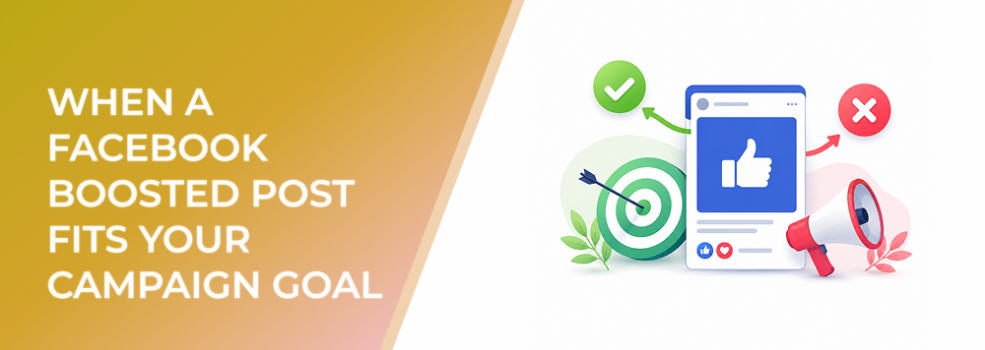
A Facebook boosted post fits when the campaign needs fast, simple distribution.
It does not fit when the campaign needs deeper control, precise targeting, conversion optimization, or reliable acquisition economics. Decide based on the goal first, then choose the campaign type that can realistically deliver that outcome.
To build more relevant audiences when a simple boosted post is not enough, join the free 7-day LeadEnforce trial period.
Related LeadEnforce Articles
- Should You Boost a Facebook Page Post? Performance Pros, Risks, and Better Uses — Helps evaluate when boosting is useful and when it becomes limiting.
- Choose the Right Facebook Page Ad Goal Before You Spend Budget — Provides a goal-first framework for Page-created ads.
- Avoid Wasting Spend On A Weak Starter Facebook Ads Audience — Useful when audience quality is the limiting factor before launch.
- How to Build a Better Facebook Ad Audience From Customer Traits — Shows how customer traits can become practical audience sources.