
Stable campaign structures produce consistent results. Unstable ones create volatility that looks like performance decline. Most issues blamed on targeting or creatives start at the structural level.
A stable structure controls signal flow, budget distribution, and learning stability. It reduces noise inside the delivery system. That control leads to predictable optimization.
This guide explains how to design structures that remain stable as spend increases.
Why Campaign Structures Become Unstable
Instability rarely comes from one setting. It emerges from interaction between segmentation, budget allocation, and event volume. Small inefficiencies compound over time.
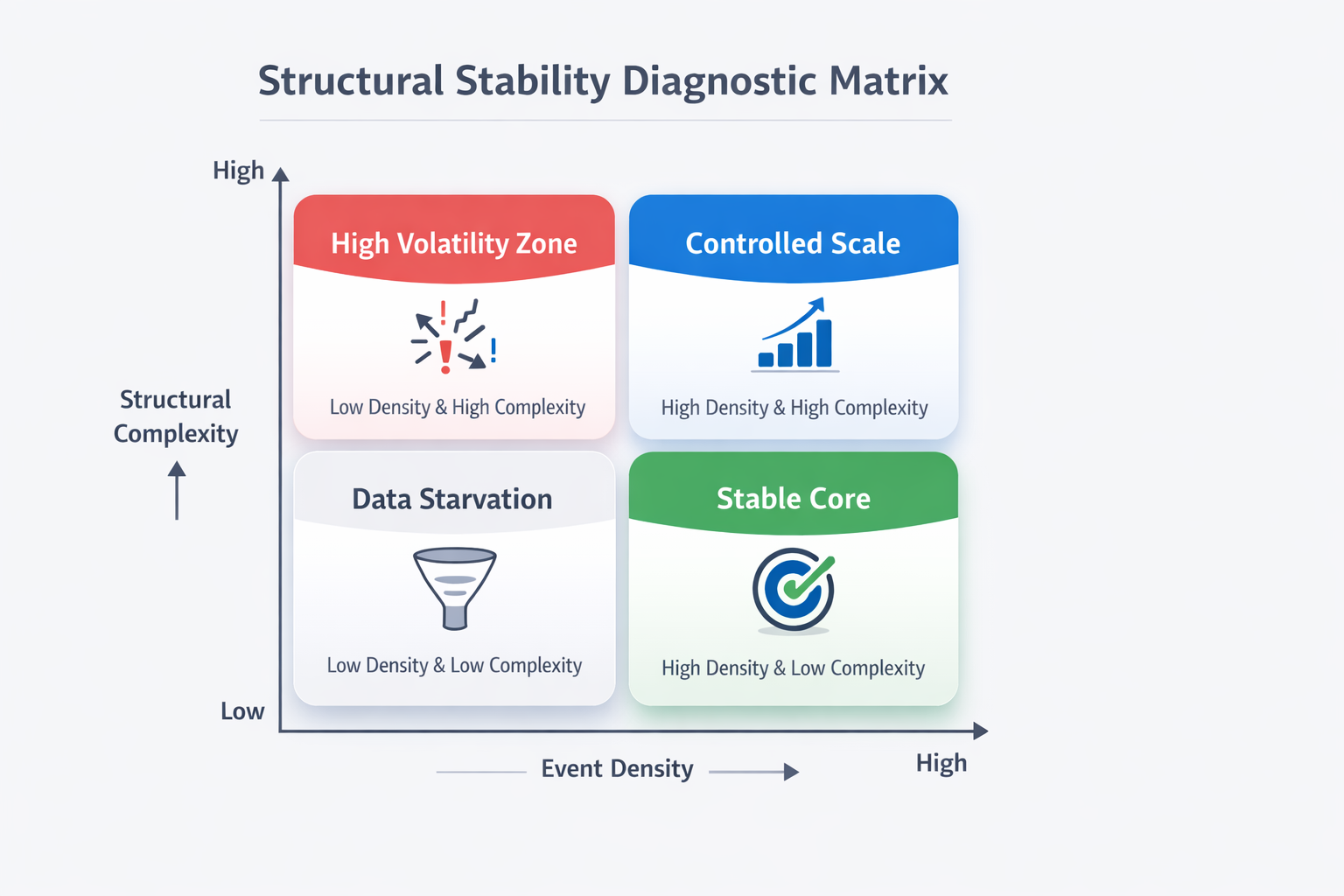
Common instability drivers include:
-
Too many ad sets; conversions spread thin across segments, slowing optimization.
-
Rapid budget changes; large increases reset learning and distort delivery patterns.
-
Overlapping audiences; internal competition inflates CPM and fragments data.
-
Low event density; fewer than 50 weekly optimization events per ad set reduces stability.
If you see performance decline without obvious causes, review why Facebook ads lose efficiency over time . Structural decay often hides behind surface metrics.
Most advertisers focus on creative fatigue first. Structure often fails earlier.
Core Principles of Stable Structures
Stable systems follow simple rules. They prioritize data density and controlled expansion. They avoid fragmentation.
Three principles govern structural stability.
Consolidate Where Signals Are Weak
Fragmentation reduces signal density. Each ad set receives fewer optimization events. The algorithm has less information per segment.
Consolidate audiences when weekly conversions per ad set fall below 50. Merge similar interests into broader groups. Combine lookalikes with overlapping intent.
Consolidation improves:
-
Learning speed; more events accelerate model calibration.
-
Cost stability; fewer segments reduce auction competition.
-
Reporting clarity; fewer moving parts simplify diagnosis.
If you are unsure how many ad sets you should run, review guidance on how many ad sets per campaign make sense . Over-segmentation is a common structural error.
Smaller accounts benefit most from consolidation.
Control Budget Distribution
Budget distribution determines which ad sets accumulate learning. Poor distribution creates random winners and unstable scaling.
Two stable approaches follow.
Advantage Campaign Budget
Advantage campaign budget centralizes budget control at the campaign level. It allocates spend toward stronger ad sets automatically.
Use it when:
-
Ad sets share similar objectives and optimization events.
-
Conversion volume supports redistribution.
-
Creative testing happens inside each ad set.
If you want deeper comparison logic, review the breakdown of campaign budget optimization vs ad set budgets . Budget architecture directly affects stability.
Ad Set Budget Optimization (ABO)
ABO fixes budget per segment. It protects experimental audiences from budget starvation.
Use ABO when:
-
Testing new segments with uncertain performance.
-
Evaluating creative against a specific audience.
-
Controlling spend during validation phases.
Switch to Advantage campaign budget after validation.
Maintain Event Density Thresholds
Event density determines optimization quality. Thin data produces unstable cost patterns.
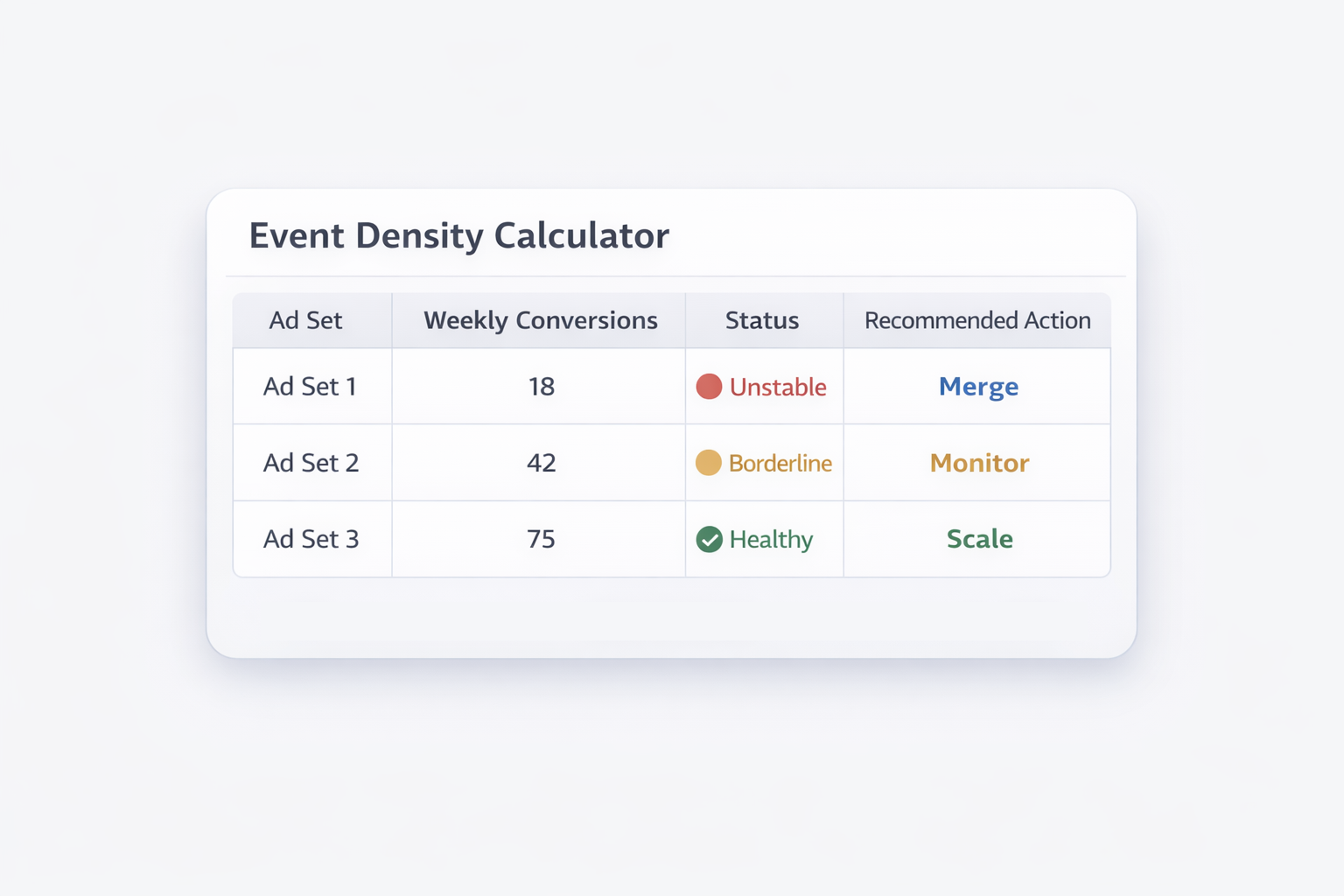
Monitor these thresholds:
-
Prospecting ad sets; aim for 50+ weekly conversion events.
-
Retargeting ad sets; aim for 30+ weekly events.
-
Purchase campaigns; ensure sufficient attribution window alignment.
If density drops, merge segments or reduce the number of active ad sets.
If campaigns remain stuck, study what “learning limited” means and how to fix it in this explanation of Facebook’s learning phase status . Structural fragmentation often triggers learning constraints.
Structural Models That Remain Stable
Different accounts require different frameworks. Stability depends on revenue size and event volume.
Broad Core Structure
Broad structures work when the pixel receives strong conversion signals. They rely on algorithmic expansion rather than manual segmentation.
Structure example:
-
One campaign per objective.
-
Two to four broad ad sets; wide interests or open targeting.
-
Multiple creatives per ad set.
If you want a framework comparison, review common Facebook campaign structures and when to use each one . Structural clarity prevents unnecessary complexity.
This model increases signal density per segment. It performs well once historical data exists.
Messaging-Based Segmentation
Segment by communication, not micro-targeting. Each segment should reflect a distinct problem or motivation.
Example segmentation logic:
-
Pain-driven audience; problem-focused creatives and urgency angle.
-
Outcome-driven audience; result-oriented messaging and proof elements.
-
Education-driven audience; longer-form explanation and credibility emphasis.
Here, segmentation aligns with message structure. Stability improves because targeting remains broad.
Funnel-Based Separation
Separate campaigns by funnel stage when event types differ significantly.
Typical separation:
-
Prospecting; optimize for leads or purchases.
-
Retargeting; optimize for purchases or higher-value actions.
-
Retention; optimize for repeat purchases.
Avoid splitting prospecting into many sub-stages. Keep upper funnel consolidated.
Scaling Without Breaking Stability
Scaling often destabilizes structure. Most instability appears after budget increases.
Apply Gradual Budget Changes
Increase budgets in controlled increments. Large jumps distort delivery distribution.
Practical guidance:
-
Increase budgets by 20 to 30 percent every three to four days.
-
Monitor cost per result and volume, not just ROAS.
-
Avoid simultaneous increases across all campaigns.
Stability requires measured expansion.
Avoid Structural Changes During Learning
Editing targeting, placements, or optimization events resets learning. Multiple resets reduce efficiency.
Do not:
-
Change conversion events mid-cycle.
-
Add or remove many ad sets at once.
-
Duplicate campaigns repeatedly during scale.
Stable systems reward consistency.
Hidden Structural Problems to Audit
Some issues remain invisible in basic reports. Regular audits prevent slow performance decay.
Overlapping Audiences
Use audience overlap tools. If two prospecting ad sets share more than 30 percent overlap, merge them.
Internal competition increases CPM and splits conversions.
Duplicate Exclusions
Excessive exclusions shrink reachable audiences. Small exclusions rarely improve performance meaningfully.
Remove minor interest exclusions unless they represent strong negative signals.
Uneven Creative Distribution
When one ad set contains many creatives and another contains few, learning skews unevenly.
Balance creative volume across major ad sets. Maintain comparable testing depth.
When to Rebuild the Structure
Rebuild only when structural limits block growth. Constant restructuring harms performance.
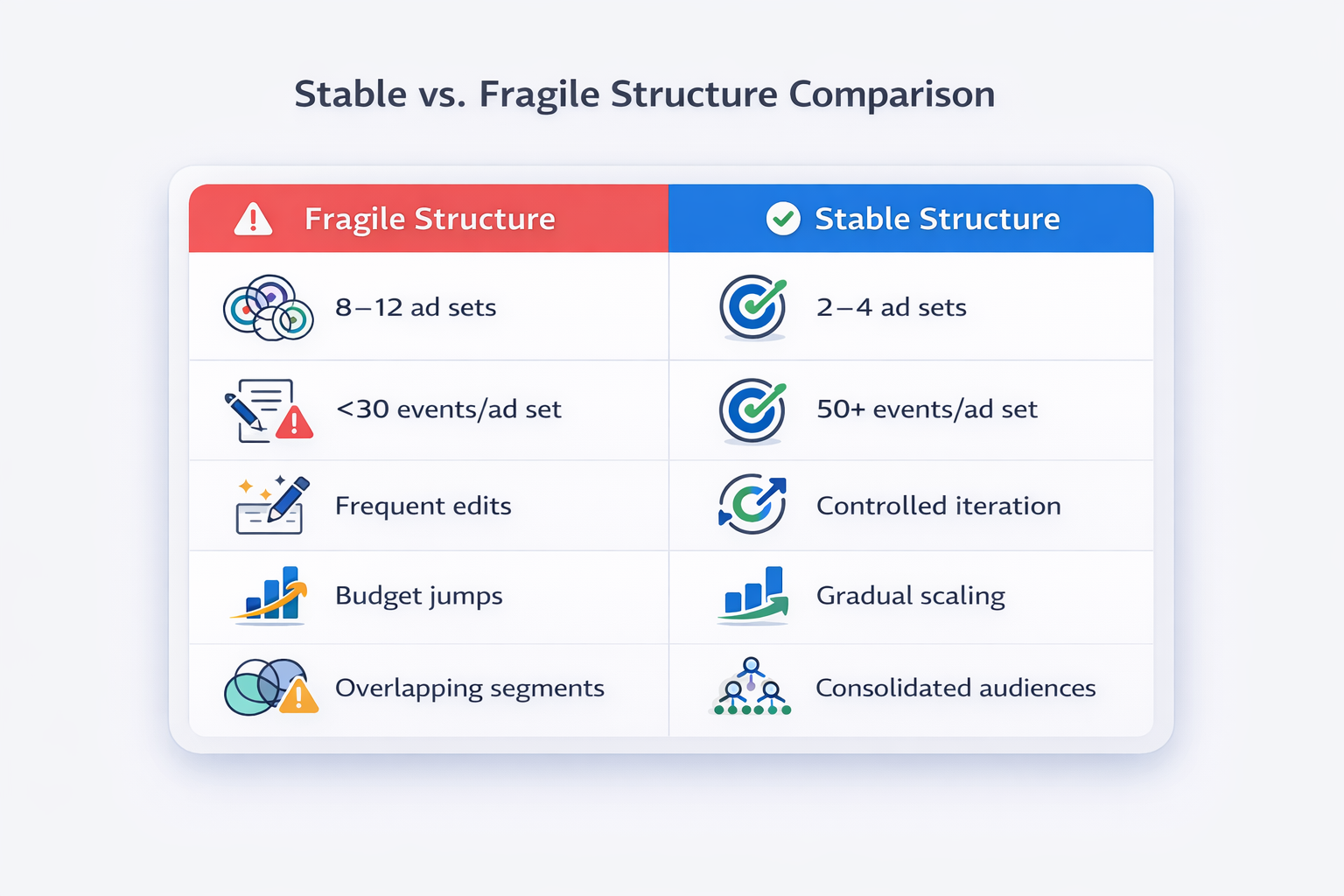
Rebuild if:
-
Event density cannot reach stability thresholds.
-
Audience overlap remains high despite consolidation.
-
Budget scaling produces cost spikes consistently.
Before rebuilding, simplify. Remove weak segments. Merge similar audiences. Then evaluate stability again.
Stable Structures Create Predictable Performance
Stable campaign structures are simple by design. They protect signal density and budget flow. They reduce unnecessary segmentation.
Optimization improves when data concentrates. Costs stabilize when segments compete less internally. Scaling becomes controlled instead of chaotic.
Design structure first. Creative and targeting perform better inside stable systems.