Meta ads either connect — or disappear into the scroll.
The difference? It's not just your targeting or your budget. Often, it’s your creative theme.
A strong creative theme makes your message stick. It shapes your visuals, tone, and story. It creates a thread that people feel, even if they can’t name it.
This article will show you how to find creative themes that actually convert. Not through guesswork, but by understanding intent, emotion, and structure. You’ll also get clear tactics you can apply right away — especially if you’re working across multiple audiences or campaign types.
What Is a Creative Theme?
A creative theme is the central concept or emotional message behind your ad. It’s not the CTA. Not the color scheme. It’s the big idea that holds everything together.
Think of it like this: if your ad were a movie trailer, the theme is the tone and storyline. Everything else — music, dialogue, actors — builds around it.
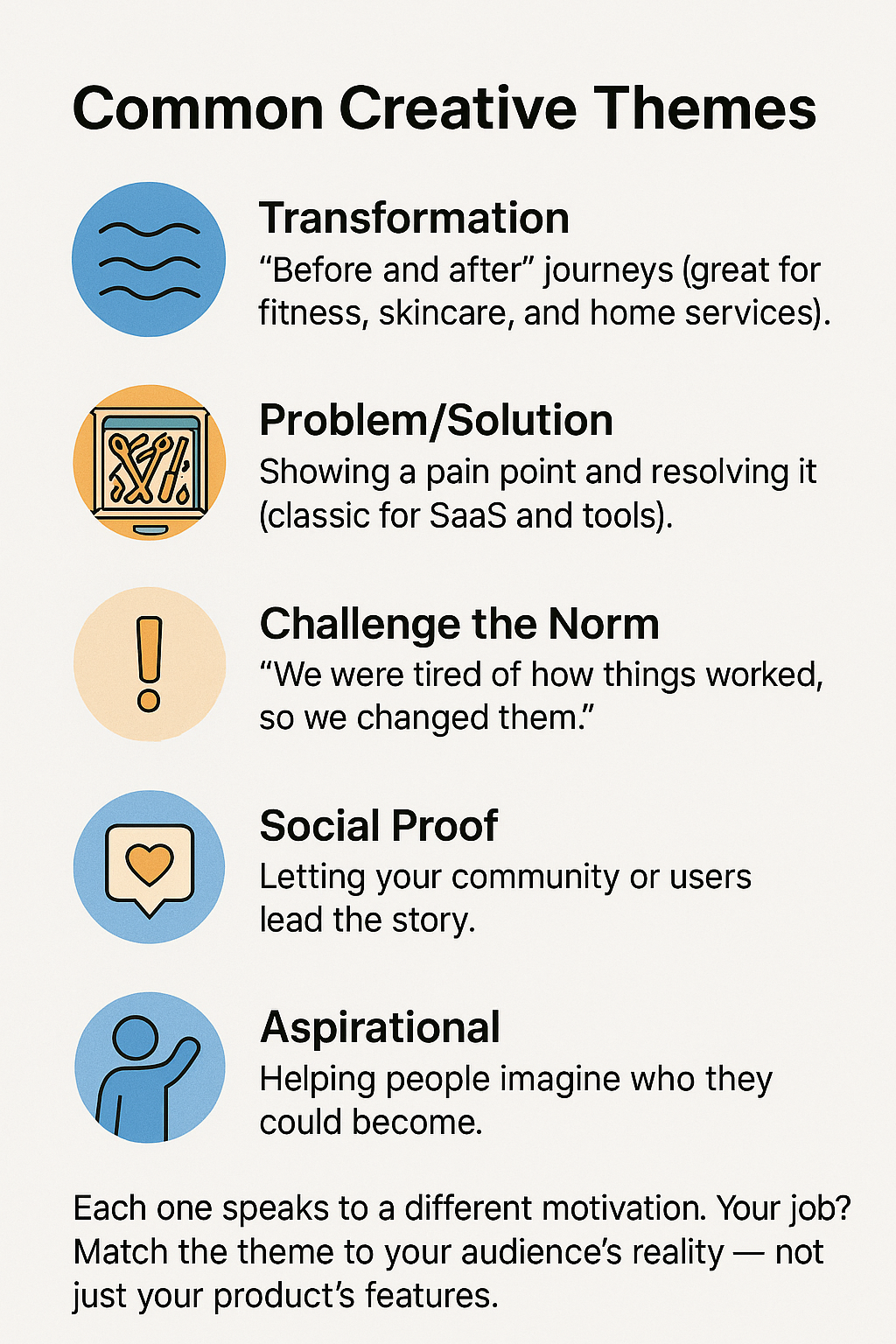
Common creative themes include:
-
Transformation — “Before and after” journeys (great for fitness, skincare, and home services).
-
Problem/Solution — Showing a pain point and resolving it (classic for SaaS and tools).
-
Challenge the Norm — “We were tired of how things worked, so we changed them.”
-
Social Proof — Letting your community or users lead the story.
-
Aspirational — Helping people imagine who they could become.
Each one speaks to a different motivation. Your job? Match the theme to your audience's reality — not just your product’s features.
1. Anchor Your Theme in Emotion, Not Specs
People don’t remember specs. They remember how something made them feel.
Before choosing a theme, get clear on the emotion your product or service taps into. Ask:
-
What’s the frustration my audience feels before finding this product?
-
What feeling do they want — relief, recognition, power, control, simplicity?
-
What moment or situation triggers them to look for a solution?
For example, if you sell noise-canceling earbuds, the theme doesn’t need to be “High-Def Sound.” That’s a feature. Instead:
-
Emotional angle: "Finally, focus in chaos."
-
Theme: Peace and productivity in loud environments.
That’s the hook that resonates — especially in noisy cities, open offices, or parenting situations.
Want to sharpen how you identify these emotional triggers? This guide to Facebook ad targeting can help you better understand the emotional mindset of your ideal audience.
2. Match Theme to Funnel Stage
Your ad’s creative theme should match where someone is in their buying journey.
For cold audiences, you’re creating awareness — and curiosity. For warm audiences, you’re pushing toward action.
Here’s how to align:
-
Top of Funnel (Cold):
-
Themes that educate or provoke curiosity.
-
Examples: “Why your shampoo may be damaging your scalp,” or “A new way to manage your to-do list in 3 minutes.”
-
-
Middle of Funnel (Engaged):
-
Themes that introduce transformation or contrast.
-
Examples: “Thousands switched to this planner — here’s why,” or “Busy moms swear by this 2-minute meal hack.”
-
-
Bottom of Funnel (Hot):
-
Themes that reassure, prove, or push urgency.
-
Examples: “In stock for 24 more hours,” or “Join over 50,000 customers who already upgraded.”
-
Not sure which campaign types are best suited to each stage? Read Meta Ad Campaign Objectives Explained for a full breakdown of when to educate, inspire, or convert.
3. Build Creative Buckets for Testing
Don’t rely on one theme — test several, strategically.
The best marketers work with creative buckets: predefined categories of themes that they rotate and measure.
Let’s say you’re running campaigns for a hydration product.
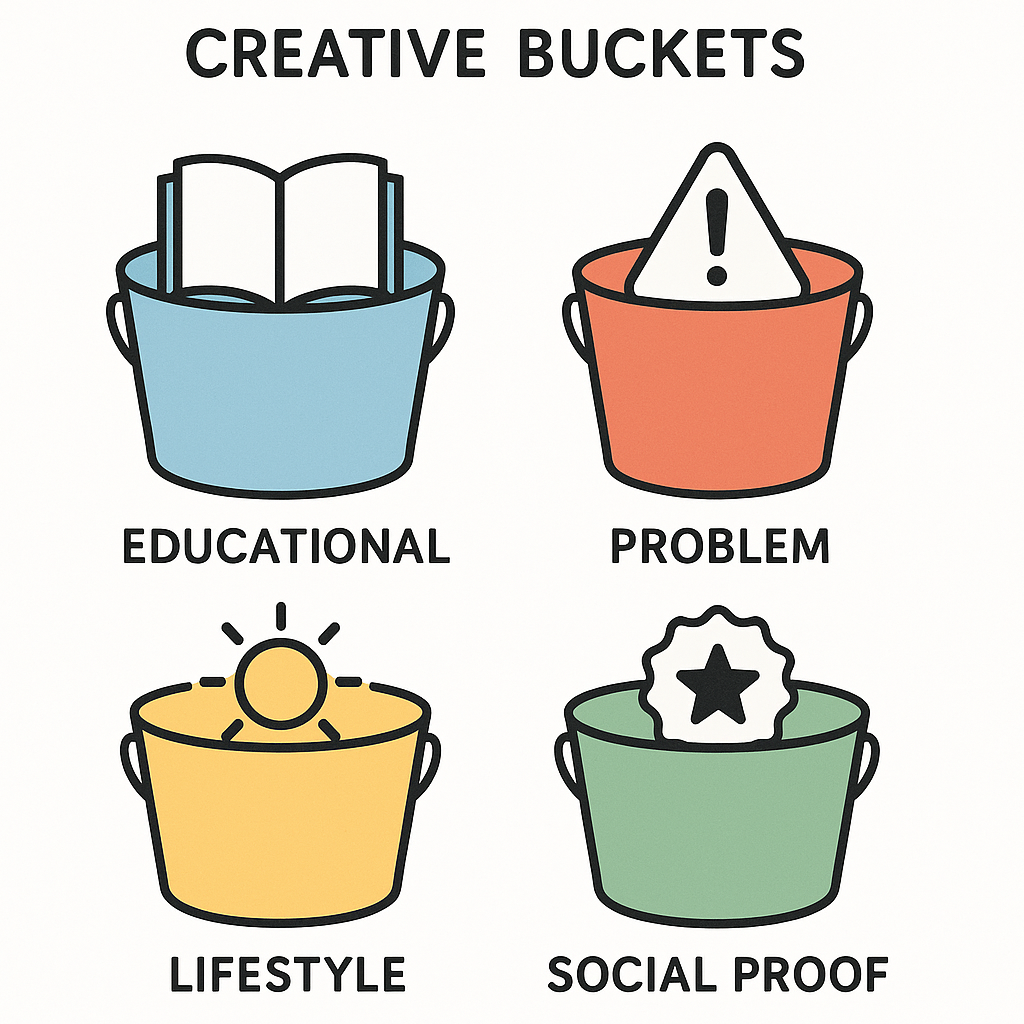
Your buckets might be:
-
Educational theme: “What dehydration does to your brain at 2 p.m.”
-
Problem theme: “Tired again before 3? It might not be your sleep.”
-
Lifestyle theme: “Fuel your energy like pro athletes do.”
-
Social proof theme: “12,000+ reviews — and counting.”
Each of these buckets can include multiple formats:
-
Static image ads,
-
Short-form videos,
-
Carousels,
-
Reels or story ads.
When you track results by theme bucket (not just format), you can understand what your audience connects with over time. If you're unsure which formats pair best with different ideas, check out The Ultimate Guide to Facebook Ad Formats.
4. Think Visually — Your Theme Needs to Look Right
A creative theme isn’t just a message. It’s a visual tone.
-
A “convenience” theme should feel clean, easy, and frictionless — avoid visual clutter.
-
A “rebel” theme should look bold, raw, even imperfect — break the rules a little.
-
An “elegant” theme should breathe — with negative space, refined fonts, muted tones.
Here are some visual consistency tips:
-
Match font to emotion — Sans-serif fonts feel modern; serif fonts feel classic; handwritten fonts feel personal.
-
Stick to a color story — Don’t mix pastels with neons unless contrast is part of your theme.
-
Use consistent lighting and photography — A “cozy” theme with harsh, direct light will feel off.
-
Keep your CTA design aligned — If your ad feels natural and warm, don’t use a cold, mechanical button.
Even small mismatches can break trust — your ad should feel like one coherent story.
5. Don’t Copy Other Brands — Study Their Structure
Many advertisers fall into the trap of copying ads that "worked for others." The problem? What works for one brand might fall flat for yours — because of audience, tone, or product differences.
Instead of copying, analyze structure:
-
What’s the emotional tone of the ad? Urgent, calm, curious, joyful?
-
How early does the product appear? Is it the hero, or part of a lifestyle?
-
What narrative flow does the ad follow — problem > solution > proof? Or before > after?
-
What visual cues are repeated across multiple ads?
You can use tools like Meta Ads Library — or analyze top-performing AI creative tools to generate and remix ideas while keeping your message original.
6. Repurpose Winning Themes — Don’t Abandon Them
When you find a theme that works, don’t burn it out or move on too quickly.
Strong themes can be reimagined. For example:
-
Rewrite it from a different persona’s point of view,
-
Test it with new visuals, voiceovers, or formats (carousel, reels, stories),
-
Add seasonal or cultural relevance — tie it into holidays or current events,
-
Change the offer or CTA, keeping the theme intact.
This gives your campaigns consistency — and lets you stretch your creative without creating new ideas from scratch every time.
Bonus Tip: Combine Themes with Audience Signals
Even without detailed behavioral targeting, you can infer a lot from engagement patterns and page interactions.
Ask:
-
What types of posts or stories do your best customers engage with?
-
What creatives get saved, commented on, or shared?
-
What theme did your top-performing post this quarter use?
These are clues. Build themes from what’s already working — not from a blank page.
You can also use A/B testing tools inside Meta Ads Manager to compare creative themes across the same audience. But keep all other variables constant — budget, CTA, placement — so your test is clean.
Final Thoughts
Finding the right creative theme isn’t just about aesthetics. It’s about strategic alignment.
When your message matches what your audience feels, wants, or fears — and when your visuals deliver that theme clearly — conversion follows.
So don’t rush the creative process. Start with emotion. Structure your testing. Learn from patterns. And always remember: what works best is what feels true to the person seeing it.
That’s what earns the pause — and the click.
Meta Ads Creative Theme FAQ
Q: What’s the difference between a creative theme and ad format?
A: A theme is the idea or emotional core of your ad. A format is the shape — like video, carousel, static image. One theme can be applied to many formats.
Q: How many themes should I test at once?
A: Start with 3–5 clear themes. It’s better to test a few properly than overload with scattered creative.
Q: Should I change themes every week?
A: Not necessarily. If a theme works, keep using it in new ways. Change only when performance drops or your audience moves to a new stage.