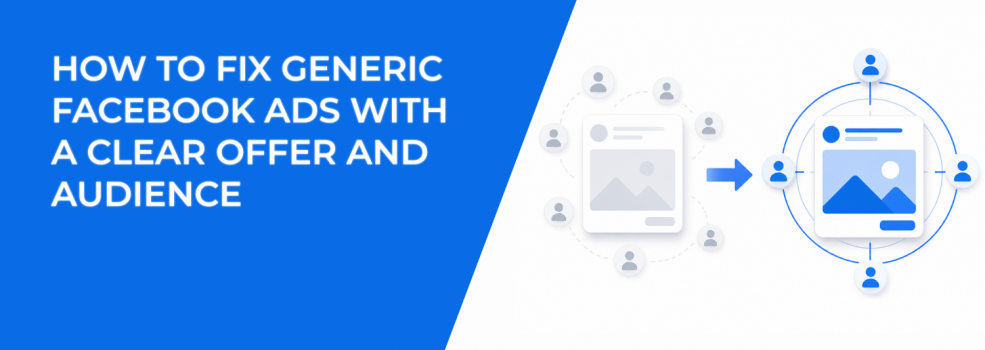
Many Facebook campaigns fail because the message is too broad. The ad may get impressions, clicks, and engagement, but users still do not understand why the offer matters to them.
Many advertisers assume the issue comes from creatives or targeting settings. In reality, the offer itself is often unclear.
Problem: Generic Facebook Ads Generate Traffic But Not Real Buyers
Many Facebook campaigns fail because the message is too broad. The ad may get impressions, clicks, and engagement, but users still do not understand why the offer matters to them.
This creates campaigns that drive activity without driving conversions. Inside Ads Manager, the issue usually appears as:
- CTR looks acceptable, but conversion rates stay weak;
- CPC increases after Meta tests broader audience pockets;
- Lead quality becomes inconsistent once the campaign scales;
- Sales teams report poor-fit leads, even when CPL looks reasonable.
Many advertisers assume the issue comes from creatives or targeting settings. In reality, the offer itself is often unclear.
Meta then receives weak signals. It sees clicks and engagement, but not enough consistent conversion behavior to understand who should receive more budget.
Solution #1: Make The Offer Specific Enough To Self-Qualify Users
Strong Facebook ads reduce interpretation effort. The user should immediately understand who the offer is for, what problem it solves, and what result they should expect.
For example, “Improve your marketing performance” is too broad for most paid social campaigns. It does not define the audience or the outcome clearly enough.
“Help SaaS sales teams reduce manual lead qualification time” works better because it combines audience, operational problem, and expected result in one message.
A clear offer should answer three questions:
- Who is this for? Name the buyer, role, business type, or use case clearly.
- What problem does it solve? Focus on a specific pain, not a broad category.
- What outcome should the user expect? Connect the offer to a measurable or practical result.
Specific offers improve performance because users self-qualify before clicking. Meta also receives cleaner optimization signals, which often stabilizes CPA and conversion rates.
Campaign structure matters too. If the campaign objective does not match the offer, Meta may optimize toward the wrong action. That is why advertisers should also align the offer with the right Facebook ad campaign objective.
Solution #2: Use Higher-Intent Audience Sources Instead Of Broad Interest Pools
Even strong messaging struggles when audience quality is weak. Many advertisers still rely heavily on broad interests or large demographic audiences.
That often creates inconsistent lead quality because the audience itself lacks clear buying intent.
LeadEnforce helps advertisers build high-intent audiences from Facebook groups, Instagram followers, and engaged social communities. Instead of targeting broad “business” or “marketing” interests, advertisers can target users already connected to relevant niches and industries.
For example, a B2B software company can build audiences around SaaS communities instead of relying only on generic business targeting.
This can improve campaign performance in several ways:
- Lead quality improves because the audience starts closer to the problem;
- Conversion consistency improves because users share clearer intent signals;
- ROAS becomes more stable because less spend goes toward irrelevant traffic;
- Scaling becomes easier because Meta receives stronger audience inputs.
It also helps solve situations where your target audience looks right but performs wrong.
Solution #3: Fix Positioning Before Testing More Creatives
Many advertisers test creatives too early. If the offer and audience positioning remain unclear, creative testing often produces misleading results.
One ad may temporarily outperform another without fixing the underlying conversion problem.
Before increasing budgets or launching aggressive testing, advertisers should validate whether the offer solves a defined problem, whether the audience recognizes itself in the message, and whether the landing page matches the ad promise.
The strongest Facebook campaigns usually have simple positioning. The message is clear, the audience is obvious, and the expected outcome is easy to understand.
That clarity improves both user response and Meta optimization.
Final Takeaway
Generic Facebook ads fail because they create weak signals. Users do not fully understand the offer, and Meta does not fully understand who should convert.
The platform starts optimizing toward low-quality engagement instead of profitable customer behavior.
The solution is not always more creative testing or broader targeting. Most campaigns improve when advertisers make the offer more specific, tighten audience intent, and align messaging with a clear business outcome.
When Meta receives stronger signals, campaigns become easier to stabilize, optimize, and scale.