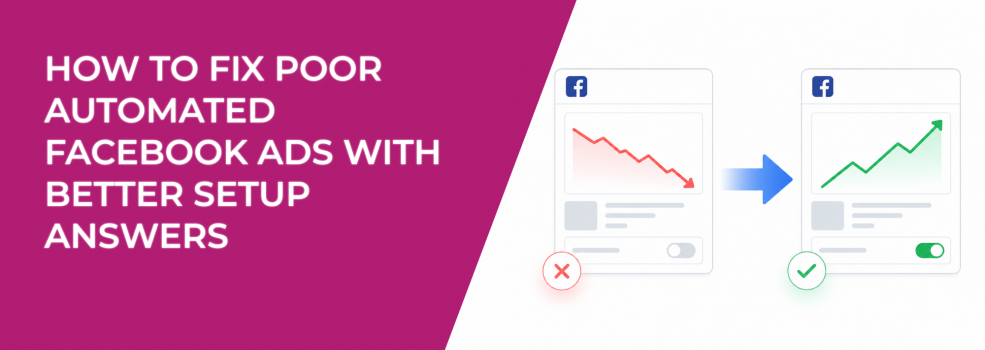
Automated Facebook ads remove a lot of manual campaign decisions. Meta asks a few questions, suggests a campaign setup, then handles optimization automatically.
That simplicity causes a common problem.
Many advertisers treat the setup flow like a formality instead of realizing those answers directly shape optimization behavior.
Meta does not understand your business automatically. Automated campaigns learn from the information you provide during setup. If the answers are vague, broad, or disconnected from actual business goals, the system starts optimizing toward the wrong outcomes immediately.
That usually leads to cheap traffic, unstable CPA, weak lead quality, and disappointing ROAS.
Problem: Generic Setup Answers Push Automated Ads Toward Low-Intent Actions
This problem starts during the initial campaign setup flow.
Meta asks questions like:
- What result matters most for your business?
- What type of customer action are you looking for?
- Are you focused on traffic, engagement, messages, or purchases?
- What kind of business are you running?
A lot of advertisers answer these questions too broadly.
An e-commerce brand selects “website traffic” because it wants more visitors. A SaaS company chooses engagement because CPC appears cheaper. A local service business selects awareness despite needing booked consultations.
The system then builds optimization around those signals.
That changes how Meta enters auctions and which users it prioritizes.
Instead of searching for likely buyers, the algorithm starts favoring people who frequently click, react, or engage with ads cheaply. Those users often generate activity without producing revenue.
Inside Ads Manager, this usually appears as:
- high CTR with poor conversion rates,
- cheap CPC paired with rising CPA,
- strong engagement but weak sales,
- large reach without qualified leads.
The campaign technically performs according to the selected objective. The problem is that the objective itself was poorly aligned with the business outcome.
Why Low-Intent Optimization Raises CPA Even When CPC Looks Cheap
Cheap traffic often creates misleading early performance signals.
Meta’s optimization system heavily rewards user behaviors that satisfy the selected campaign goal. If the setup emphasizes clicks or engagement, the platform searches for users most likely to generate those actions at low cost.
That creates a quality problem.
Many high-click users are not high-intent buyers. They simply interact with ads frequently across the platform. Meta detects those behavioral patterns quickly and increases delivery toward similar users.
The result is predictable:
- landing page bounce rates increase,
- lead quality declines,
- sales conversion rates drop,
- CPA rises later in the funnel.
A campaign can look healthy at the top level while profitability quietly deteriorates underneath.
This is one reason many advertisers think Meta automation “stopped working” after scaling. In reality, the campaign was trained on weak signals from the beginning.
Solution: Match Every Setup Answer to the Conversion You Actually Need
The fix starts before launch.
Instead of choosing goals based on surface metrics, setup answers should reflect the action that actually drives revenue.
That means asking:
“What user behavior predicts business value for this campaign?”
For some advertisers, that means purchases. For others, qualified demo requests, booked calls, or high-quality lead submissions matter more than clicks.
A stronger automated setup usually includes:
- selecting conversion-focused objectives instead of traffic goals,
- separating awareness campaigns from lead generation campaigns,
- optimizing around qualified conversion events,
- avoiding vague engagement optimization unless engagement itself is the business outcome.
This changes how Meta evaluates users during auctions.
The system starts prioritizing behavioral patterns associated with real conversions instead of low-cost activity.
Advertisers struggling with automated campaigns should also review launching Facebook ads with a clear goal, because unclear objectives often distort optimization long before creatives become the problem.
How Better Setup Answers Improve Meta’s Early Learning Signals
Automated campaigns rely heavily on early conversion data.
Meta studies the first wave of impressions, clicks, and conversion events to build prediction models. Those early patterns strongly influence future delivery behavior.
If the initial optimization goal attracts low-intent users, the algorithm keeps reinforcing those behaviors.
That is why some campaigns become difficult to recover even after creative updates.
A campaign optimized for cheap engagement may continue favoring reactive users long after the advertiser wants purchases instead. Meta already identified a low-cost behavioral cluster that satisfies the selected objective.
Better setup answers improve the quality of those early learning signals.
That usually creates:
- more stable CPA,
- stronger lead quality,
- cleaner audience expansion,
- better long-term ROAS consistency.
This is also why choosing the right Facebook ad objective affects performance much more than many advertisers realize.
The setup flow is not administrative. It directly shapes how the algorithm learns.
Using Stronger Audience Inputs to Support Automated Optimization
Audience quality also affects how automated systems learn.
Broad setup answers combined with broad targeting often weaken optimization even further. Meta expands aggressively when campaign signals lack specificity.
Some advertisers improve automated performance by pairing Meta automation with stronger audience intent signals instead of relying entirely on broad audience expansion.
LeadEnforce helps advertisers build audiences from Facebook groups, Instagram followers, and engaged social communities. Those audiences often provide stronger behavioral context than broad interest targeting alone.
The automation still handles delivery automatically. But the system receives cleaner signals about who is more likely to convert.
That becomes increasingly important as Meta relies more heavily on predictive optimization and less on manual targeting precision.
This shift is explained well in AI targeting isn’t enough without better inputs, especially for advertisers depending heavily on automation.
Final Takeaway: Automated Ads Need Clear Inputs Before They Can Learn Correctly
Poor automated Facebook ads are often caused by weak setup inputs, not weak algorithms.
Meta learns from the business goals, optimization choices, and audience signals advertisers provide during campaign setup. If those inputs are vague or disconnected from actual business outcomes, the system optimizes toward cheap actions instead of profitable conversions.
Better setup answers improve:
- audience quality,
- optimization stability,
- CPA efficiency,
- lead quality,
- ROAS consistency.
Automation works best when advertisers provide clear business direction instead of expecting the platform to infer intent automatically.