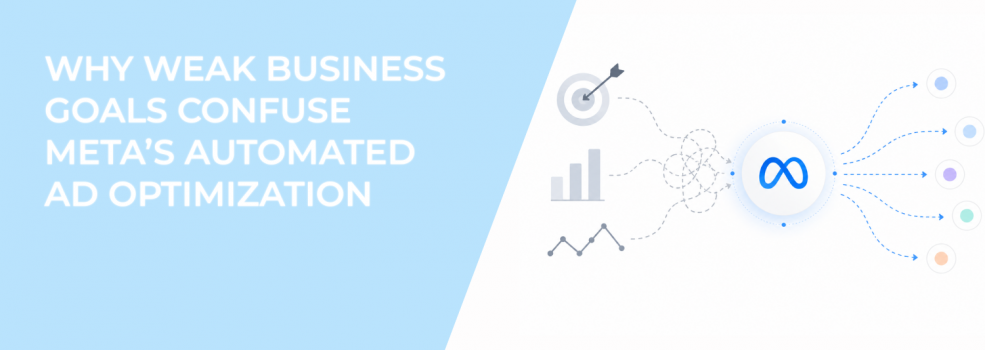
Meta’s automated campaigns rely on prediction systems. The platform studies user behavior, compares conversion patterns, then allocates budget toward users most likely to complete the selected objective.
That system works surprisingly well when campaign goals are clear.
It performs much worse when advertisers give Meta vague business direction.
A lot of campaign problems start before delivery begins. The issue is not always creative quality, audience targeting, or bidding strategy. Sometimes the algorithm is simply optimizing for the wrong business outcome because the campaign goal itself lacks precision.
That confusion spreads through the entire optimization process.
Problem: Weak Business Goals Train Meta to Prioritize the Wrong User Behaviors
Many advertisers choose campaign goals based on surface-level metrics instead of business outcomes.
An e-commerce brand wants “more traffic.” A SaaS company wants “more engagement.” A service business wants “more awareness.”
Those goals sound reasonable on paper. Inside Meta’s optimization system, they create major problems.
Meta needs a clear success signal.
If the campaign goal is too broad, the algorithm starts rewarding cheap actions instead of valuable ones. Traffic campaigns prioritize users likely to click. Engagement campaigns prioritize users likely to react, comment, or watch content.
Those behaviors do not always correlate with purchases or qualified leads.
Inside Ads Manager, the campaign may still look healthy:
- CPC stays low,
- CTR increases,
- impressions grow,
- engagement volume rises.
But deeper funnel performance weakens.
Lead quality drops. Conversion rates decline. CPA increases later in the customer journey.
The optimization system is not broken. It is following the behavioral patterns connected to the selected business goal.
Why Meta’s Automation Depends on Goal Clarity
Meta’s algorithm does not think like a marketer.
It does not understand profit margins, lead quality, sales team capacity, or customer lifetime value unless advertisers feed those signals back into the system.
The platform optimizes mathematically.
When advertisers select broad business goals, Meta searches for the cheapest available behaviors connected to that objective. That creates efficiency at the platform level, but not always at the business level.
A campaign optimized for landing page views may outperform a conversion campaign on CPC while producing significantly worse customers.
This disconnect becomes more obvious during scaling.
Weak business goals usually create unstable optimization because the system keeps widening delivery toward users who generate low-cost activity instead of high-intent actions.
That is one reason many campaigns scale traffic volume successfully while revenue efficiency deteriorates.
Solution: Define Business Goals Around Revenue-Correlated Actions
The strongest automated campaigns optimize around actions closely connected to business value.
That means campaign goals should reflect measurable outcomes instead of broad marketing activity.
Examples:
- E-commerce brands usually need purchase-focused optimization.
- B2B campaigns often perform better when optimized for qualified leads instead of form fills alone.
- Local businesses may benefit more from booked calls or appointments than engagement metrics.
The key is specificity.
Meta optimization improves when advertisers define exactly what type of conversion matters most.
That usually creates cleaner learning signals, more stable delivery, and better audience refinement over time.
Advertisers struggling with optimization drift should also review aligning your offer with the right Facebook ad campaign objective, because objective mismatch often starts much earlier than most advertisers realize.
Weak Goals Also Distort Audience Expansion
Broad business goals influence how Meta expands delivery beyond the original audience pool.
When optimization signals lack precision, audience expansion becomes less selective.
A campaign optimized for engagement may start reaching users who interact heavily with content but rarely convert. A traffic-focused campaign may drift toward habitual clickers instead of buyers.
This becomes especially problematic for smaller advertisers with limited budgets.
Large brands can absorb inefficient traffic during Meta’s learning process. Smaller businesses usually cannot.
That is why audience signal quality matters so much inside automated systems.
Some advertisers improve optimization consistency by combining Meta automation with stronger audience intent sources. LeadEnforce helps advertisers build audiences from Facebook groups, Instagram followers, and engaged social communities. Those audiences often provide clearer behavioral signals than broad targeting alone.
The automation still controls delivery. But the learning system starts from stronger intent data instead of generic engagement patterns.
How to Tell When Meta Is Optimizing for the Wrong Goal
Optimization drift usually leaves visible patterns inside campaign data.
A few warning signs appear repeatedly:
- CTR increases while conversion rate falls,
- traffic grows but revenue stays flat,
- CPM remains stable while CPA rises,
- engagement quality weakens after scaling,
- lead volume increases while sales acceptance declines.
These patterns often indicate that Meta found a cheap optimization path disconnected from actual business value.
The algorithm is succeeding mathematically while underperforming commercially.
This becomes easier to diagnose once advertisers understand how Meta interprets campaign goals internally.
That process is explained further in Facebook ads are optimizing for the wrong goal, especially for campaigns using automated optimization heavily.
Better Inputs Usually Matter More Than More Automation
A common mistake is assuming more automation automatically improves results.
Automation quality depends heavily on signal quality.
Weak business goals create weak optimization patterns regardless of how advanced the system becomes. Better campaign inputs often outperform additional automation features.
That matters even more now because Meta increasingly relies on predictive modeling instead of manual targeting precision.
Advertisers who feed the platform stronger business signals usually maintain more stable performance over time.
This shift is one reason AI targeting isn’t enough without better inputs, especially in automated campaign environments.
Final Takeaway: Meta Can’t Optimize Properly Around Vague Business Goals
Weak business goals confuse Meta’s automated optimization because the algorithm depends entirely on advertiser-provided success signals.
When campaign goals focus on cheap activity instead of revenue-correlated actions, Meta starts optimizing toward behaviors that look efficient inside Ads Manager but fail commercially.
Clearer business goals improve:
- audience quality,
- optimization stability,
- lead relevance,
- CPA consistency,
- long-term ROAS.
Automation performs best when advertisers define success precisely instead of expecting the algorithm to infer business priorities automatically.