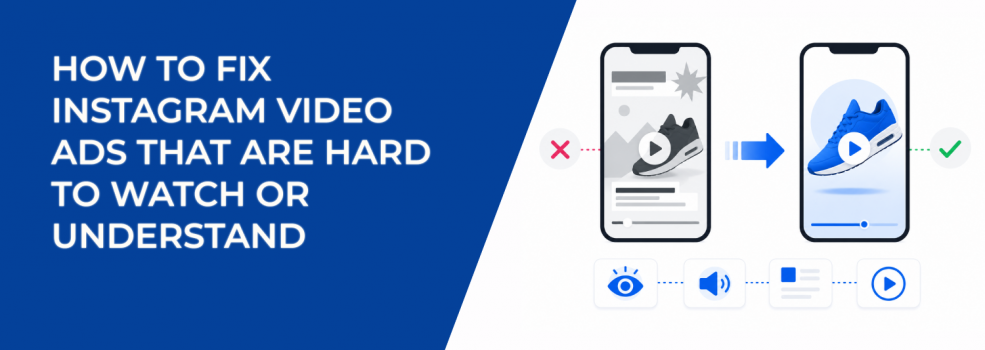
Some Instagram video ads lose performance because the viewer cannot process them fast enough.
The offer may be strong. The product may be relevant. The targeting may even be accurate. But if the ad is visually crowded, poorly paced, or unclear without sound, users scroll before they understand what is being shown.
This is a common problem in mobile-first placements. Advertisers review creative on large screens, approve it in a team chat, and then launch it into a feed where the viewer sees it for a few seconds on a phone.
What looked clear in preview becomes hard to follow in the actual environment.
When clarity breaks, performance metrics usually follow. CTR drops, CPC rises, and CPA increases because fewer users understand the reason to act.
The Problem: The Video Is Too Hard To Understand On A Mobile Screen
Instagram users do not study ads. They scan them.
That makes clarity a performance requirement, not just a design preference. If the viewer needs to read too much, follow too many scenes, or decode what the product does, the ad loses its chance to create intent.
Hard-to-understand video ads often share the same issues:
- Too much text appears on screen at once.
- Key details depend on sound.
- The product is too small or appears too late.
- Scenes change before the viewer understands the message.
- Visual elements compete instead of guiding attention.
These problems are especially damaging in Stories and Reels. Users move quickly, and the creative has less time to recover from confusion.
A B2B software company might run a product demo with a screen recording, small interface labels, voiceover, and animated captions. The team understands it because they know the product. A cold viewer sees a crowded screen and no clear reason to keep watching.
The result is not always low engagement. Some users may watch out of curiosity. The deeper issue appears in conversion behavior.
If users click without fully understanding the product, landing page conversion rate can drop. If they do not click at all, CPC rises because the ad fails to turn impressions into qualified traffic.
This is why visual hierarchy in Instagram ads matters. The viewer needs to know what to notice first, second, and third.
The Solution: Make The Video Easy To Process Without Sound Or Extra Effort
A clear Instagram video ad should make sense with the sound off, on a small screen, and in a fast-scroll environment.
That means the creative needs to simplify the viewing path. The user should not have to guess what the ad is about.
Start with the first frame. It should communicate the category, problem, or outcome before motion does the work. If the first frame could belong to any brand in any niche, it is probably too vague.
Then check the sound-off experience. Many users will not hear the voiceover, so the key message needs to be visible through captions, text overlays, or visual demonstration. This is where subtitles and captions in social ads become directly tied to performance.
A simple clarity checklist helps before launch:
- Can the viewer understand the offer without sound?
- Is the product or service visible within the first few seconds?
- Does each scene add new information?
- Is the CTA readable on a mobile screen?
- Can one main message be understood without pausing?
If the answer is no, the ad is probably asking the viewer to work too hard.
For example, a local dental clinic promoting clear aligners should not open with a slow lifestyle montage and small text about treatment options. A clearer version could show the problem, the aligner outcome, the consultation offer, and the CTA in a direct sequence.
The video does not need to feel basic. It needs to be easy to follow.
Readability also matters. Small text, low contrast, and crowded layouts reduce comprehension before the message has a chance to persuade. Issues like poor contrast and color choices can quietly weaken CTR because users skip what they cannot read quickly.
A stronger ad usually uses fewer words, larger visual cues, and one dominant action. The viewer should not have to choose between reading a caption, watching the product, and understanding the CTA at the same time.
The best test is simple: watch the video once, on a phone, with sound off. If the offer is not clear after one viewing, the ad is not ready for cold traffic.
Final Takeaway
Instagram video ads become expensive when users cannot understand them quickly.
Confusing creative does not only hurt engagement. It weakens click quality, lowers conversion rates, and gives Meta poorer signals for optimization.
The fix is to reduce processing effort. Make the first frame clear, design for sound-off viewing, simplify text, strengthen visual hierarchy, and ensure the CTA is visible before the viewer scrolls.
A clear ad gives the audience less work to do. That often gives the campaign better data to optimize from.