Facebook message ads often create a reporting trap. They generate visible activity quickly, so advertisers assume the campaign is working before checking what those conversations produce.
The problem is not the message format itself. The problem is reading message campaigns with the wrong metrics. If you judge them by clicks, conversations, or reply volume alone, you can keep funding campaigns that create activity without qualified pipeline.
Why Facebook Message Ads Get Misread When Engagement Metrics Replace Outcome Metrics
The core problem is that advertisers often treat engagement metrics as proof of campaign success.
A click-to-message campaign can show a strong click-through rate, low cost per conversation, and many replies. Those numbers look useful because they are easy to see inside Ads Manager. But they do not prove that users are qualified, ready to buy, or likely to become customers.
A campaign for a local legal consultation, for example, might generate many message threads. Some users ask serious questions about booking. Others ask for free advice, live outside the service area, or disappear after one message. If the report counts every thread the same way, the campaign appears stronger than it is.
This is one of the most common Meta Ads metrics most advertisers misread. The metric is not useless, but it becomes dangerous when it is treated as the business result.
Why Surface-Level Message Metrics Can Distort Campaign Decisions
Message campaigns have a softer conversion path than lead forms or purchase campaigns. The first action is easy, so the front-end numbers can look efficient even when sales quality is weak.
This matters because advertisers often make budget decisions from those front-end numbers. They pause ad sets with higher cost per conversation and scale ad sets with cheaper replies. That can push spend toward users who are more likely to chat, but less likely to convert.
The damage usually appears later:
- CPA rises after the sales team filters chats. The reported cost per conversation looks low, but the real cost per qualified lead is much higher.
- ROAS becomes disconnected from Ads Manager results. Campaign activity increases, but revenue does not move at the same pace.
- Sales follow-up becomes harder to prioritize. Every message looks similar in the ad report, even when only a few chats have real value.
- Creative tests produce false winners. The ad that starts the most conversations may attract more curiosity than buying intent.
This is why message ad reports need to be read differently from traffic or engagement campaigns.
How to Build A Reporting View That Separates Chats From Qualified Opportunities
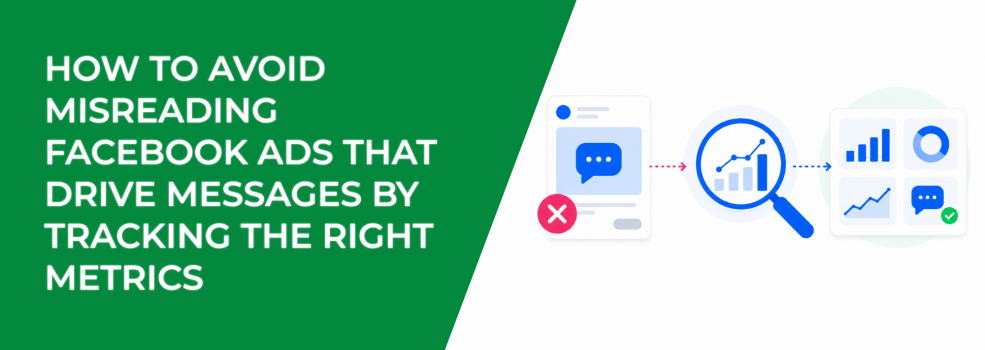
The solution is to create a reporting view that separates message activity from qualified opportunities.
A useful report should not stop at “conversations started.” It should show how many conversations became sales-ready leads, booked calls, quote requests, purchases, or closed deals. That is the only way to tell whether the campaign is producing commercial value.
For a service business, the reporting view might track message starts, qualified chats, booked appointments, completed appointments, and closed sales. For an e-commerce brand, it might track product questions, cart recovery chats, purchase completions, and revenue per chat source.
This turns message ads into a measurable funnel.
Instead of asking, “Which campaign got the cheapest replies?” the better question becomes, “Which campaign produced the lowest cost per qualified opportunity?”
How To Connect Message Ad Metrics To Sales Outcomes
Message ad measurement improves when each stage of the conversation has a clear status. Without that, the media buyer sees message volume while the sales team sees mixed-quality conversations.
A clean message funnel can use five stages:
- Conversation started. The user opened the chat from the ad, but intent is not clear yet.
- Qualified conversation. The user matches basic criteria, such as location, need, budget, or timeline.
- Sales-ready opportunity. The user shows enough intent to justify direct sales follow-up.
- Booked or purchased. The chat produced a call, appointment, order, deposit, or checkout.
- Closed revenue. The business can connect the conversation to actual income.
Once these stages are tracked, reading ad reports correctly becomes much easier. You can see where the campaign breaks instead of guessing from CTR or cost per message.
If many conversations start but few qualify, the issue is usually audience, offer, or ad promise. If chats qualify but do not book, the problem may be sales process, response speed, or pricing friction. If bookings happen but revenue stays low, the campaign may be attracting lower-value customers.
What To Do When A Message Campaign Looks Good But Sales Stay Flat
When message volume rises but sales stay flat, do not immediately change the budget. First, check whether the campaign is creating the right type of conversation.
Pull a sample of recent chats and classify them by outcome. This should include qualified leads, unqualified users, support questions, price-only inquiries, incomplete chats, and closed sales. Even a manual review of 50 to 100 conversations can reveal the real issue.
Then compare those outcomes by campaign, ad set, and creative. The ad with the lowest cost per conversation may not be the ad with the best qualified lead rate. The audience with the most messages may not be the audience creating the most revenue.
That comparison helps you adjust spend based on advertising KPIs that connect spend to results, not just engagement.
Final Takeaway
Facebook message ads get misread when advertisers treat visible activity as proof of performance.
The fix is to track the full path from message start to qualified opportunity, sale, and revenue. Clicks, replies, and conversation starts can help diagnose delivery, but they should not decide budget alone.
A message campaign is only performing when the conversations create measurable business outcomes.