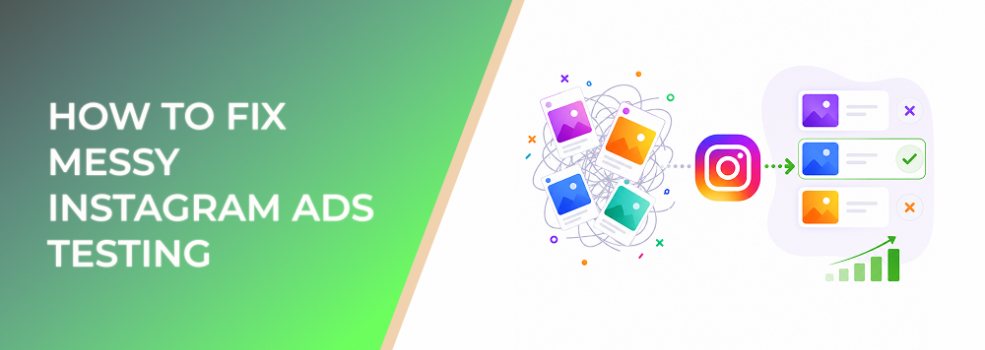
Instagram ads testing gets messy when every audience contains too many ideas at once.
A marketer launches one ad set with fitness interests, wellness influencers, supplement brands, gym memberships, and competitor accounts all grouped together. Another ad set contains broad lifestyle interests, a few lookalike audiences, and a retargeting layer. After a week, one audience performs better, but nobody knows why.
Was it the competitor signal? The wellness interest? The influencer followers? The broad category? The answer is unclear because the test was not built around clean audience themes.
This problem affects agencies, growth marketers, SMB owners, affiliate marketers, ecommerce teams, and B2B advertisers that need fast campaign learning without wasting budget on unreadable tests.
The Problem
The problem is messy Instagram ads testing caused by mixed audience logic.
Many advertisers think they are testing audiences, but they are actually testing bundles of unrelated assumptions. They combine several interest categories, behavioral signals, demographic filters, and audience sources into one ad set.
That creates a blended result.
A blended result may tell you that one ad set performed better than another, but it does not tell you which audience theme drove that performance. If the audience includes niche creators, competitor followers, category interests, and broad demographic targeting, the winning signal is hidden.
The real issue is not that the advertiser tested too many audiences. It is that the audience groups were not organized around clear themes.
Why This Problem Hurts Performance
Messy audience testing hurts performance because it slows decision-making.
When the results are unclear, marketers often make the wrong optimization move. They pause a strong audience too early, scale a weak audience because it looked good in aggregate, or rewrite creative when the real issue is audience quality.
This affects CPC, CPA, CAC, conversion rate, ROAS, and lead quality.
It also wastes the testing budget. Every test should teach the advertiser something useful. A messy test may spend the same amount as a clean test, but it produces weaker learning. That means the next campaign starts with the same uncertainty.
For agencies, messy testing also creates reporting problems. Clients want to know which audience worked. If the team can only say “the mixed interest ad set performed better,” the insight is not very actionable.
Common Scenarios Where This Happens
An ecommerce brand builds one Instagram audience around “beauty,” “skincare,” “makeup,” and several competitor brands. The campaign gets purchases, but the team cannot tell whether buyers came from competitor affinity or broad beauty interest.
A B2B SaaS company targets entrepreneurs, startup content, marketing influencers, and small business owners in one ad set. Leads come in, but qualification rates vary widely.
An agency creates a generic “niche interest stack” for a client because it wants enough audience size. The campaign gets clicks, but the best-performing sub-segment is impossible to isolate.
An affiliate marketer promotes an offer to a broad lifestyle audience and several product-category interests at once. The campaign drives cheap traffic, but payout-driving actions stay inconsistent.
A local business targets a full metro area plus broad service-related interests. The campaign reaches people, but many clicks come from users outside the realistic buyer profile.
Why the Problem Happens
This problem happens because advertisers often confuse audience size with test quality.
They add more interests because they worry a single theme will be too narrow. They combine several audience sources because they want Meta to have more room to optimize. They also want faster delivery, so they avoid small controlled tests.
The intention makes sense, but the result is noisy.
Another cause is weak audience documentation. If each audience is not named by hypothesis, the test becomes hard to interpret later. “Interest Stack 1” does not explain what was being tested. “Competitor_Followers_Skincare” or “Niche_Creator_Audience_B2B_Marketing” is much clearer.
The problem also happens when marketers build audiences from platform options instead of business questions. The better starting question is not “Which interests can I add?” It is “Which audience theme do I need to validate?”
The Solution
The solution is to segment Instagram ads audiences into clear interest themes before launching the test.
A clear interest theme is a single audience hypothesis. It groups users around one logical source of relevance.
For example:
- Competitor interest theme: users connected to competitor brands or similar offers.
- Niche creator theme: users connected to creators, influencers, or educators in the category.
- Community theme: users connected to Facebook groups or social communities around the problem.
- Professional-fit theme: users connected to job roles, industries, or company types.
- Product-category theme: users connected to the category but not necessarily a specific competitor.
- Warm-engagement theme: users who have already interacted with relevant social content.
Each ad set should test one theme, not a mixture of several themes.
Keep the creative, landing page, campaign objective, placement logic, and offer as consistent as possible. Change the audience theme only. That way, when results differ, you can make a more confident decision about audience quality.
Use a simple scorecard:
- Relevance: Does the audience respond to the message?
- Efficiency: How do CPC, CPA, CAC, and conversion rate compare?
- Quality: Do leads or buyers match the ICP?
- Scale potential: Can the audience support more budget?
- Learning value: Did the test reveal a useful audience pattern?
The goal is not to crown a permanent winner after one test. The goal is to learn which theme deserves the next round of budget.
How LeadEnforce Helps
LeadEnforce is useful when advertisers need stronger audience inputs for theme-based Instagram ads testing.
Instead of relying only on broad interests, advertisers can use LeadEnforce to build audiences from Instagram profile followers, Instagram engagers, Facebook groups, LinkedIn-derived professional data, and custom social-profile sources.
That makes it easier to create clean audience themes.
For example, an ecommerce brand could test one audience theme based on competitor Instagram followers and another based on niche creator followers. A B2B team could compare a LinkedIn-derived professional-fit audience against a broader category-interest audience. A local business could test community-based audience sources instead of targeting everyone in a large location radius.
LeadEnforce does not replace campaign strategy, creative quality, or conversion tracking. Its role is to help marketers start with more relevant and clearly defined audience sources so the test produces cleaner learning.
Risks and Considerations
Theme-based testing can still fail if the themes are poorly chosen.
A competitor audience may look relevant but convert poorly if your offer is not differentiated. A niche creator audience may engage strongly but lack buying power. A professional-fit audience may need educational creative before it is ready to convert.
Audience size also matters. If a theme is too small, delivery may be unstable. If it is too broad, the test may become noisy again.
Do not judge results by CPC alone. A theme with a higher CPC may still produce better leads, higher conversion rates, stronger ROAS, or lower CAC.
Also watch for landing page mismatch. If the audience theme is specific but the landing page is generic, the test may understate the audience’s real potential.
Prerequisites and Dependencies
Before running this type of test, you need a clear campaign objective. Do not compare one audience optimized for engagement with another optimized for leads and expect a clean result.
You also need a clear ICP, a strong offer, and enough budget to give each theme a fair read.
Your creative should match the general problem the audience cares about without becoming so specific that it violates privacy expectations or feels overly targeted.
If LeadEnforce is part of the workflow, you need relevant source profiles, communities, professional criteria, or social-profile data that genuinely represent the audience theme being tested.
Practical Recommendations
Start with three audience themes at most. More than that can fragment budget and make results harder to read.
Name every audience by hypothesis. Use labels such as “IG_Competitor_Followers,” “IG_Niche_Creator_Engagers,” or “B2B_LinkedIn_Professional_Fit.”
Keep the test controlled. Do not change creative, offer, landing page, and audience all at once.
Measure both platform and business metrics. CPC and CTR matter, but CPA, lead quality, sales acceptance, ROAS, and CAC should drive decisions.
Use LeadEnforce when your test needs cleaner audience sources than standard interests can provide. It fits best at the audience discovery and audience creation stage, before budget starts flowing into the campaign.
Final Takeaway
Messy Instagram ads testing usually comes from mixed audience logic.
When every ad set contains too many interest signals, the results become hard to read. Segmenting audiences into clear interest themes makes each test more useful, each result more actionable, and each next step easier to defend.
To build cleaner Instagram audience tests from more relevant social and professional audience sources, join the free 7-day LeadEnforce trial period.
Related LeadEnforce Articles
- How To Stop Instagram Ads From Plateauing With Audience Segment Testing — Explains how segment testing helps diagnose audience limits before performance stalls.
- Poor Instagram Audience Performance? Use Comparison Tests to Find the Real Constraint — Useful for separating audience problems from creative, offer, or funnel problems.
- How LeadEnforce Lets You Target Instagram Followers — Directly relevant for building follower-based Instagram audience themes.
- Why Instagram Ad Audiences Fail Without Follower And Engagement Data — Supports the idea that better audience signals create cleaner campaign inputs.