Most people check tracking after something breaks.
In reality, tracking issues show up in performance before they show up in Events Manager.
You’re usually looking at something like this:
-
CPA starts creeping up over a few days.
-
One ad set keeps spending, but purchases don’t follow.
-
Retargeting suddenly feels weaker, even though traffic didn’t drop.
Nothing is “broken” in a visible way. But something is clearly off.
In a lot of cases, this isn’t a creative or audience problem. It’s a signal problem — Meta is no longer getting a clean purchase signal it can rely on.
The System Doesn’t Need Perfect Data — Just Consistent Data
Here’s where people misread what’s happening.
When purchase events start dropping, Meta doesn’t stop optimizing. It just shifts.
If it can’t rely on purchase:
-
it leans harder on Add-to-Cart,
-
or even earlier signals like clicks and landing page views.
You can actually see this shift if you look closely enough.
One pattern that shows up often:
-
CTR holds or improves,
-
Add-to-Cart stays stable,
-
but purchases become inconsistent.
That’s not a funnel issue in isolation. It usually means the system is optimizing on a weaker proxy.
This is the same dynamic behind cases where ads get clicks but no sales — except here the problem isn’t just messaging, it’s the signal the system is allowed to use.
First Thing to Figure Out: Is the Event Missing or Just Invisible?
Before touching anything, you need to isolate the type of failure.
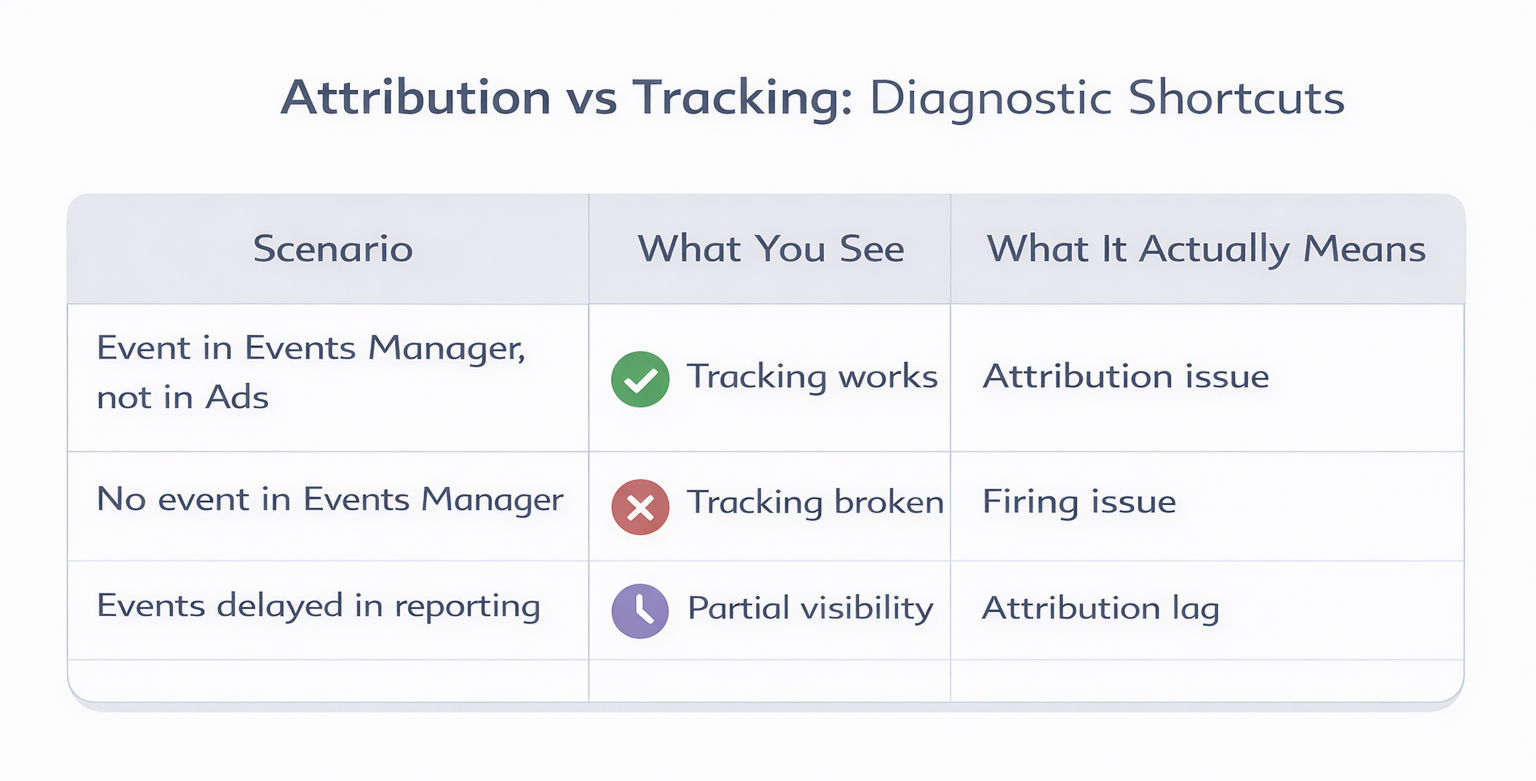
A quick way to do it:
Run a test purchase and check two places:
-
Events Manager (instant signal),
-
Ads Manager (reported results later).
If the event shows in Events Manager but not in Ads Manager, the problem is not tracking.
It’s attribution. That distinction saves a lot of wasted time. Because people often start debugging pixels when the issue is actually how Meta assigns credit.
If you’ve ever noticed that platform data doesn’t match your backend, this is part of the same problem space described in why Facebook Ads attribution rarely matches reality.
Where It Actually Breaks Most of the Time
It’s rarely “the pixel is missing.” What’s more common is this: the purchase event works — but only in a controlled path.
For example:
-
it fires on a specific URL that doesn’t always load,
-
it depends on scripts that don’t execute on slower devices,
-
or it breaks during fast checkout flows.
So you don’t lose all purchase events.
You lose enough of them to make the signal inconsistent.
That’s enough for Meta to start discounting it.
One thing worth checking specifically:
-
compare mobile vs desktop purchases.
If desktop tracks fine and mobile doesn’t, you’re not dealing with a platform issue. You’re dealing with a fragile trigger.
CAPI: The Fix That Often Creates a Second Problem
A lot of setups get worse after adding Conversion API.
Not because CAPI is bad — but because it’s implemented inconsistently.
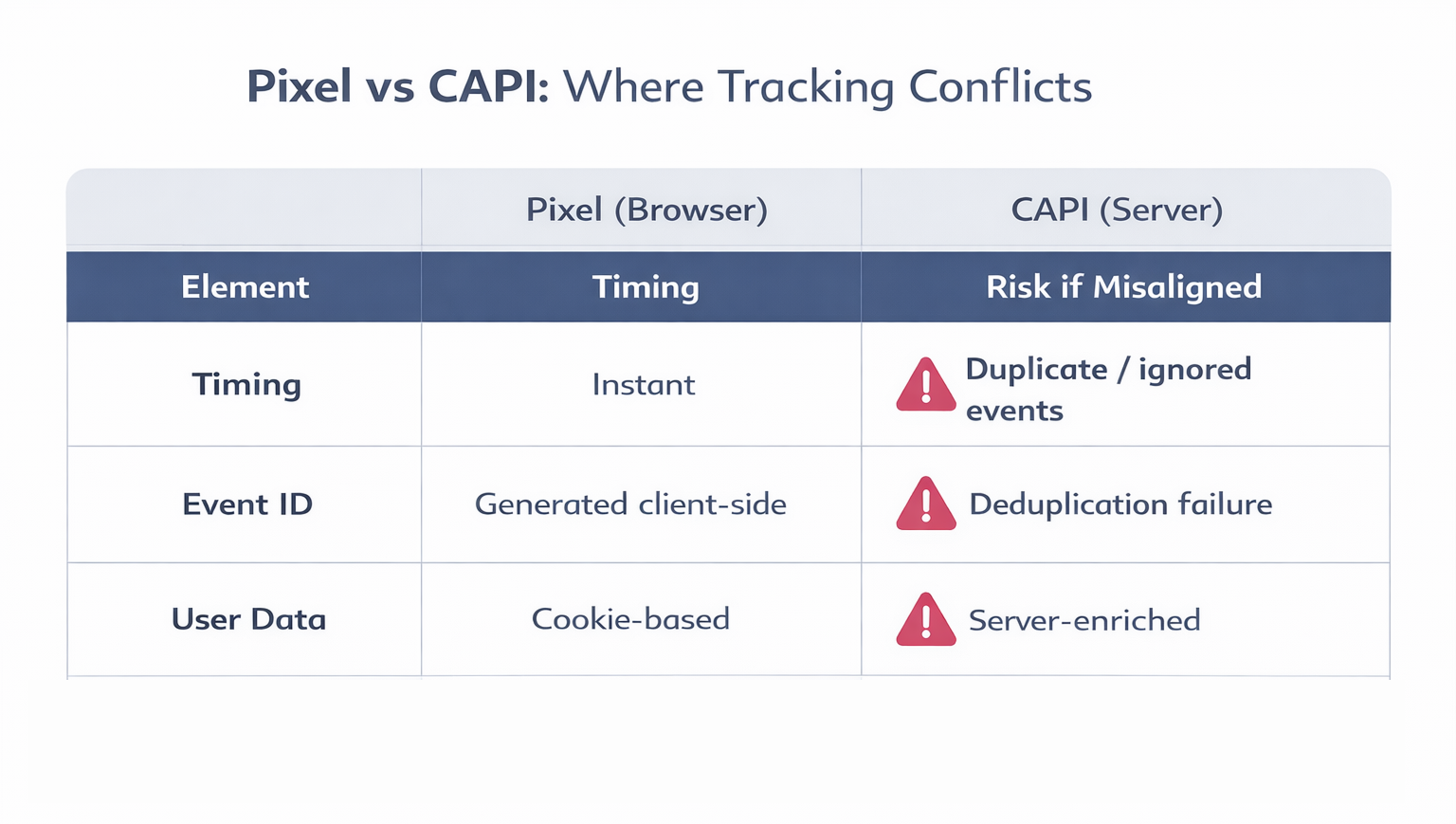
What usually happens:
-
pixel fires one version of the event,
-
CAPI sends another version,
-
Meta tries to reconcile them.
If they don’t match cleanly, you don’t get “more data.” You get a weaker signal.
In Events Manager, this shows up as:
-
events received,
-
but fewer events actually matched or used.
If you’re unsure how these systems differ, this breakdown of Pixel vs CAPI explains why alignment matters more than redundancy.
Why This Matters More Than It Looks
Meta doesn’t need every purchase event. But it needs enough consistent, trustworthy ones to form patterns.
Once that consistency breaks:
-
bidding becomes less accurate,
-
audience expansion gets noisier,
-
scaling stops working.
And the frustrating part is — nothing in the UI clearly tells you this.
It just looks like performance is “getting worse.”