Budget waste in Facebook Ads rarely looks dramatic. Campaigns keep running, leads keep coming in, and dashboards look stable. Yet profit shrinks because the wrong clicks, leads, or purchases absorb your spend.
Most advertisers focus on lowering CPL or CPM. The real question is different: which part of your budget does not turn into revenue? Once you answer that, waste becomes measurable and fixable.
What Budget Waste Really Means in Meta Ads
Budget waste is spend that does not lead to profitable outcomes. High spend is not a problem if it produces strong margin. Waste appears when the algorithm optimizes for easy actions instead of valuable customers.
Meta optimizes based on the signals you give it. If you optimize for leads, it finds people who submit forms. It does not care whether those people ever buy.
Platform Metrics vs Business Metrics
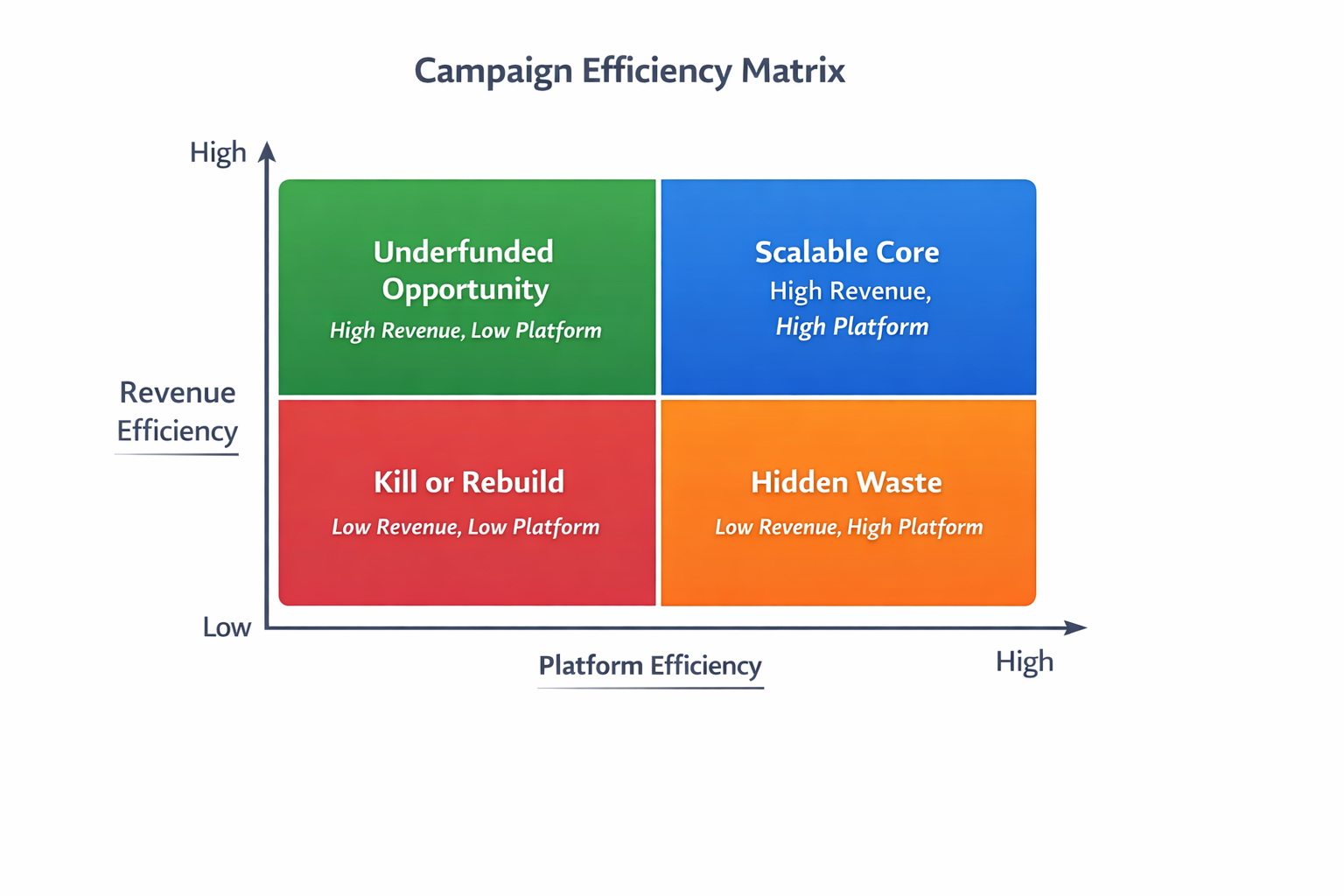
Platform metrics show delivery performance. Business metrics show financial performance. Confusing the two is one of the main reasons waste goes unnoticed.
For example, cost per lead can decrease while cost per closed deal increases. CTR can improve while meeting rates fall. These patterns mean you are attracting attention, not buyers.
To understand which numbers actually connect to revenue, review Which Facebook Ad Metrics Predict Profitability Best?
To spot the gap inside your own account, compare:
-
Cost per lead vs cost per qualified opportunity; cheap leads often fail during sales calls.
-
CTR vs lead-to-meeting rate; strong curiosity does not equal strong intent.
-
Cost per purchase vs profit margin; revenue without margin still damages growth.
-
Conversion rate vs average deal size; more sales do not always mean more profit.
If these comparisons feel uncomfortable, you are probably close to the real issue.
Start With Budget Allocation, Not Just Results
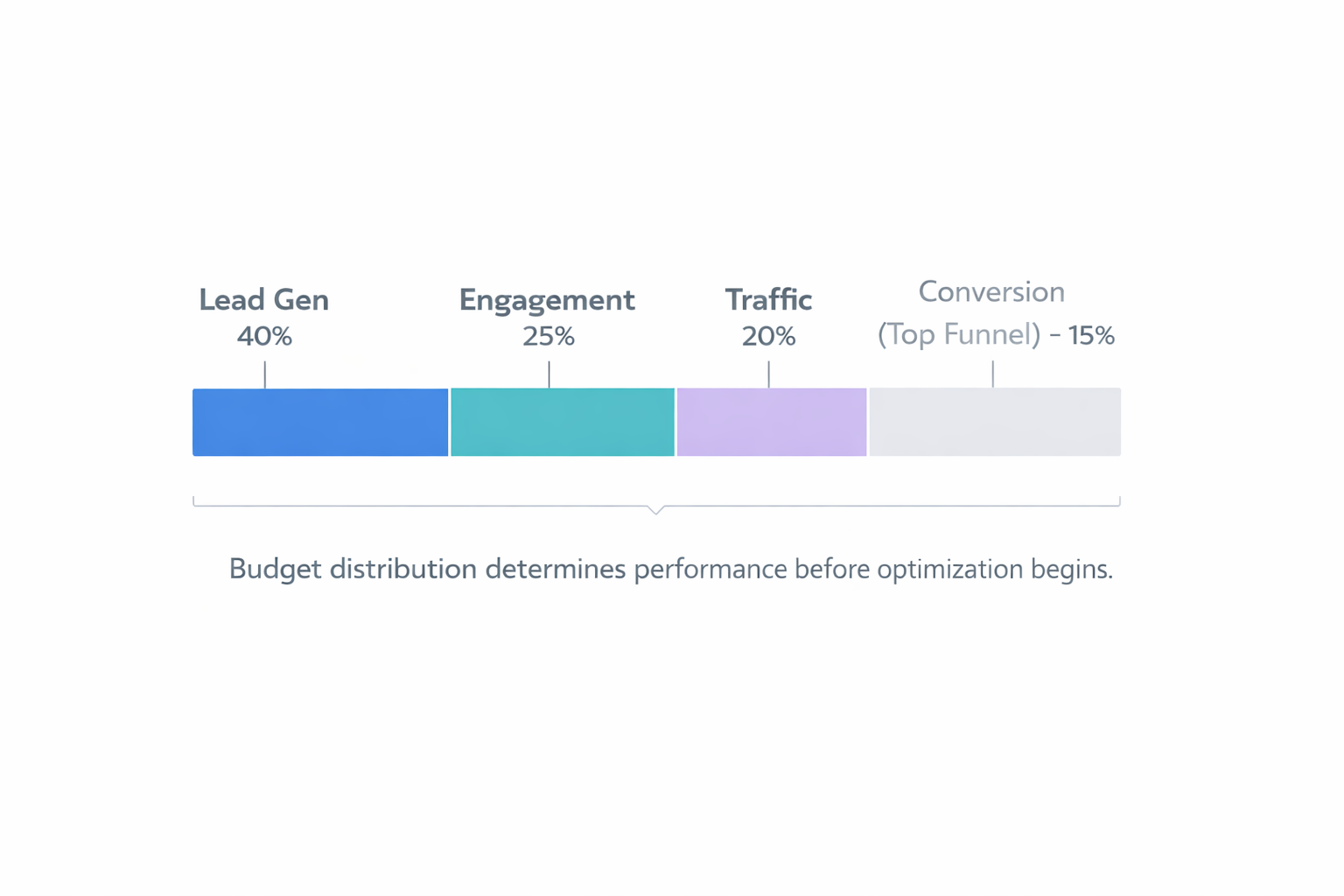
Before reviewing metrics, review where the money goes. Allocation shapes performance long before results look bad.
Old campaigns often keep spending because they once worked. Objectives drift away from current business goals, but budgets remain unchanged.
Audit Spend by Campaign Objective
Check how much budget goes to each objective. Then ask whether that objective directly supports revenue today.
If you are unsure how objectives affect lead quality and downstream performance, read How Facebook Ad Objectives Impact Lead Quality.
Common warning signs include:
-
Lead campaigns with falling meeting rates; form fills increase but sales quality drops.
-
Engagement campaigns without strong retargeting; attention grows but pipeline does not.
-
Conversion campaigns optimized for early funnel events; the system rewards easy actions.
-
Traffic campaigns still active after testing; clicks rise without clear revenue impact.
If you cannot clearly connect an objective to revenue, it likely absorbs waste.
Look for Over-Segmentation
Too many ad sets split data and weaken learning. Small budgets spread across many segments rarely perform well.
When ad sets compete in the same auctions, costs increase. When budgets are too small, results stay unstable.
If you suspect internal competition, study Why Audience Overlap Is Killing Your Facebook Ad Performance.
Then review your structure:
-
Count active ad sets per campaign; excessive segmentation often adds complexity without benefit.
-
Check audience overlap; overlapping audiences compete and inflate CPM.
-
Compare budget per ad set with expected conversions; underfunded sets struggle to stabilize.
-
Remove duplicate lookalike tiers targeting similar users; they often cannibalize results.
Simpler structures often reduce waste faster than new creatives.
Find Creative That Attracts the Wrong People
Creative waste is subtle. An ad can keep a strong CTR while sending lower-quality traffic.
The problem is not attention. The problem is intent.
Track Intent, Not Just Clicks
CTR tells you who clicked. It does not tell you why they clicked.
Look deeper into:
-
Landing page view rate; a drop suggests accidental or low-interest clicks.
-
Form completion rate; steady traffic with weaker submissions signals mismatch.
-
Cost per booked call; this reflects real buyer commitment.
-
Close rate by ad; some messages attract serious buyers, others attract browsers.
If clicks stay stable but close rates fall, the creative likely drives waste.
When you see this early, use the approach from How to Spot Early Signs of Declining Ad Performance to prevent cost spikes.
Measure Revenue Per Creative
Two ads with identical CPL can produce very different revenue. One may attract high-budget buyers. The other may bring in small deals.
Break performance down by creative and analyze:
-
Revenue per 1,000 impressions; this shows true earning power.
-
Average deal size per ad; certain angles attract stronger buyers.
-
Sales cycle length; long cycles slow cash flow and increase sales cost.
-
Churn or refund rate; some creatives attract poor-fit customers.
Shift budget toward ads that generate strong revenue, not just cheap leads.
Compare Audiences by Profit, Not CPL
Audience waste hides inside averages. Two audiences can show similar CPL but very different close rates.
Without CRM data, both look fine. With revenue data, one often stands out as inefficient.
Match Audience Data With Sales Outcomes
Export leads by audience and connect them to closed deals. Calculate revenue per lead and cost per closed deal for each segment.
If you need a structured way to tighten targeting and reduce wasted spend, review How to Reduce Ad Waste with Smarter Audience Targeting.
Focus on patterns such as:
-
Industries that submit forms but rarely close.
-
Job titles that consume sales time without buying.
-
Broad audiences that outperform complex interest stacks.
-
Small lookalikes from high-quality customers that justify higher CPL.
Audience-level analysis often reveals that a small portion of segments drives most profit.
Watch for Retargeting Saturation
Retargeting feels safe, so budgets increase gradually. Over time, frequency rises and incremental impact falls.
High frequency does not always mean stronger performance. It often means you are paying repeatedly for the same limited pool.
Monitor:
-
Frequency growth over short periods; sharp increases signal saturation.
-
Revenue trends during budget cuts; stable results during reductions suggest over-attribution.
-
Time-to-conversion patterns; long delays reduce incremental impact.
-
Audience size compared to daily spend; small pools exhaust quickly.
Retargeting waste often comes from habit, not strategy.
Review Your Optimization Events
Meta optimizes exactly for the event you choose. If the event is shallow, results will be shallow.
Optimizing for leads trains the system to find people who submit forms easily. It does not train it to find profitable customers.
Check Event Depth
List all active optimization events and map them to real revenue stages. If the event sits too high in the funnel, waste is likely built into the system.
Typical problems include:
-
Optimizing for generic form submissions instead of qualified opportunities.
-
Using purchase events without passing order value.
-
Counting repeat buyers as new acquisition success.
-
Ignoring offline conversion uploads from closed deals.
The deeper the event reflects revenue, the less structural waste you create.
Add Value Signals
The algorithm performs better when it receives economic feedback. Passing revenue or deal value back into Meta improves targeting quality.
Consider:
-
Uploading offline conversions with deal value.
-
Creating custom conversions for sales-qualified leads.
-
Building lookalikes from high-margin customers.
-
Tracking profit, not just revenue, in reporting dashboards.
When value signals are clear, the system stops chasing volume alone.
Analyze Performance Over Time
Budget waste builds slowly. Campaigns that worked six months ago may underperform today, but the decline feels gradual.
Daily reports rarely show this drift. Cohort analysis does.
Review Leads by Acquisition Month
Group leads by month and compare close rate and revenue per lead. Declines across recent cohorts signal targeting or messaging problems.
Analyze:
-
Lead-to-opportunity rate trends over time.
-
Revenue per lead by month.
-
Average days to close.
-
Changes in deal size distribution.
Time-based patterns often reveal issues that daily averages hide.
Challenge Budget Inertia
Budgets often stay where they were during past success. Market conditions change, but allocation remains fixed.
Schedule quarterly reviews and reduce or remove:
-
Campaigns with declining marginal return.
-
Old experiments still running on small daily budgets.
-
Seasonal audiences outside active demand periods.
-
Duplicate campaigns targeting similar segments.
For a structured process, see How Agencies Audit Facebook Ads to Uncover Hidden Wasted Spend.
Create a Simple Waste Audit Routine
Budget waste does not disappear on its own. It requires structured review tied to revenue.
Build a routine that includes:
-
Weekly review of revenue per campaign.
-
Monthly audience profitability breakdown linked to CRM data.
-
Quarterly structural audit of objectives and events.
-
Cohort analysis of lead quality over time.
When you connect spend to real revenue, waste becomes visible. Once visible, it becomes easier to remove and reallocate toward profitable growth.