Facebook campaign performance rarely crashes overnight. It usually slips slowly. If you watch the right signals, you can stop the decline early.
Most advertisers react when cost per lead suddenly doubles. At that point, the algorithm has already adjusted delivery. Prevention works better than recovery.
Why Facebook Campaign Performance Drops
Performance drops usually come from a few predictable causes. Competition increases. Audiences get tired. Creative loses impact. Conversion data weakens.
These forces stack on top of each other. A small CPM increase plus lower click-through rate can damage results fast. When two small issues happen together, results fall faster than expected.
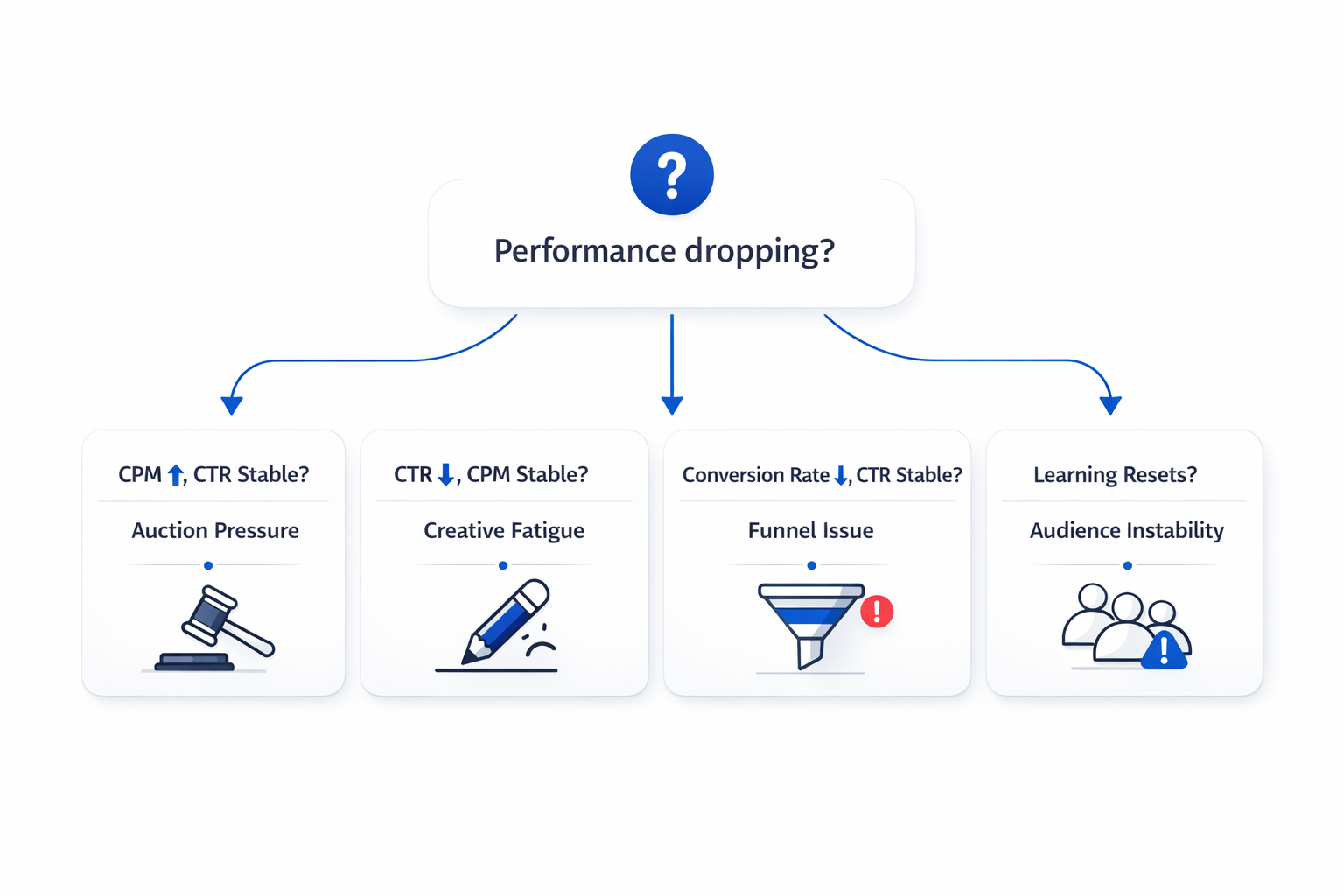
Auction Pressure And Rising Costs
Every impression goes through an auction. When more advertisers target the same audience, CPM rises immediately.
Seasonal demand makes this worse. Budget shifts across industries also affect your costs. If you want a deeper breakdown of cost drivers, read what influences CPM on Facebook Ads and how to keep it low.
Do not look at CPM in isolation. Compare it with engagement and conversion behavior to understand what is really happening.
Watch these signals every week:
-
CPM trend by audience; rising CPM with stable CTR means competition is growing, not creative fatigue.
-
Impression share; if it drops, your ads are losing auctions more often.
-
Frequency plus CPM together; high frequency and high CPM signal inefficient delivery and audience strain.
Small cost increases matter more at scale. If you are spending thousands per day, even a small CPM shift can reshape profitability.
Audience Saturation And Instability
Audiences wear out faster than most teams expect. Frequency rises quietly while performance fades.
Meta’s algorithm needs stable data to optimize properly. When audiences shrink or overlap, learning resets more often. If you suspect internal competition, review why audience overlap is killing your Facebook ad performance.
Before launching new ad sets, evaluate how your existing structure behaves.
Monitor these risks:
-
Audience overlap between ad sets; you compete against yourself and drive costs up.
-
Very small retargeting pools; delivery becomes unstable and exits learning repeatedly.
-
Too many exclusions; the system loses flexibility and struggles to find converters.
Stable audiences protect stable results. Simplicity often performs better than over-segmentation.
Build A Monitoring System That Catches Problems Early
You cannot prevent drops if you only check surface metrics. Many dashboards show impressions and clicks, but miss deeper issues.
Connect your ad data with CRM results. Platform metrics alone never tell the full story. For a structured approach, see how to spot early signs of declining ad performance.
The goal is to detect weakness before it shows up in cost per lead.
Focus On Early Warning Metrics
Cost per lead reacts late. Qualification metrics react sooner and provide cleaner signals.
Instead of watching one number, analyze transitions inside your funnel.
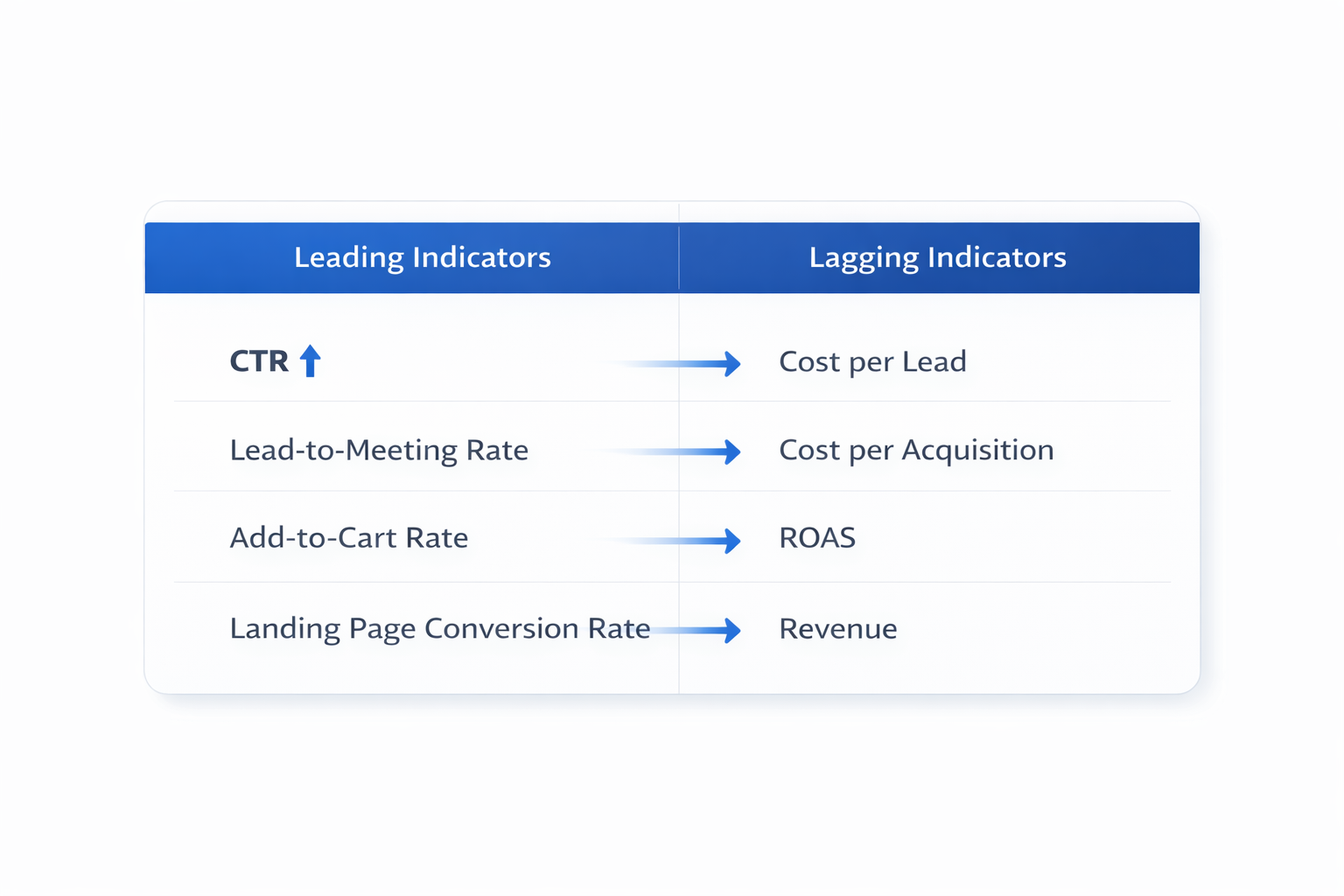
Track these transition rates:
-
Lead-to-meeting rate; shows whether targeting attracts serious prospects or just form fillers.
-
Meeting-to-close rate; reveals if messaging matches real buyer expectations.
-
Revenue per campaign; identifies profitable segments hidden behind cheap leads.
If these numbers weaken, fix targeting or messaging before scaling. Waiting for CPL to spike is already too late.
Break Down Results Into Cohorts
Averages hide decay. An ad set may look stable overall while one segment quietly declines.
Break performance down by time, audience type, and placement.
Useful cohort views include:
-
Creative age; compare week one to week four performance to detect fatigue.
-
Audience type; cold traffic behaves differently from retargeting.
-
Placement group; feeds and Stories often produce different conversion behavior.
Cohorts show where fatigue begins. Once identified, you can refresh only what needs change instead of rebuilding everything.
Control Budget Changes Carefully
Budget instability confuses the algorithm. Large changes reset learning and disrupt momentum.
Many performance drops happen after aggressive scaling. Discipline protects consistency.
Make Gradual Budget Adjustments
Increase budgets slowly, usually 10 to 20 percent at a time. Wait several days before adjusting again so data stabilizes.
Do not change multiple variables at once. If you increase budget and swap creative together, you lose clarity. For a practical framework, review why daily budget increases can hurt your performance and what to do instead.
Treat scaling as a controlled experiment, not a reaction.
Follow these rules:
-
Duplicate strong ad sets before scaling; protect proven performance and test safely.
-
Change one variable at a time; isolate the cause of movement.
-
Pause scaling if cost per purchase spikes sharply; protect efficiency before losses compound.
Controlled scaling prevents sudden drops and preserves data integrity.
Refresh Creative Before It Burns Out
Creative fatigue follows a pattern. Click-through rate drops first. Conversion rate follows later.
Most teams refresh too late because they wait for dramatic declines.
Set Clear Creative Thresholds
Do not rely on instinct. Use historical baselines and internal benchmarks.
Define internal triggers that force action.
For example:
-
Frequency above three in prospecting; prepare new variations before fatigue spreads.
-
CTR down more than 20 percent from baseline; test replacements immediately.
-
Cost per result rising for several consecutive days; review creative before adjusting targeting.
If you need a structured plan, explore creative fatigue early signals and fixes.
Refreshing early keeps momentum steady and avoids full resets.
Change Message, Not Just Visuals
Swapping images is not enough. Message fatigue is often the real issue.
If your angle stays identical, new visuals rarely fix performance. Test different positioning within the same offer.
Shift from feature-focused copy to outcome-focused proof. Replace generic claims with specific scenarios. Strong messaging drives durable performance.
Protect Conversion Data Quality
Meta optimizes around event signals. Weak data leads to weak optimization.
Tracking problems often look like performance drops, even when demand stays stable.
Audit Your Tracking Setup
Check that lead and purchase events fire correctly. Make sure attribution settings match your sales cycle length.
Even small tracking gaps distort optimization.
Common problems include:
-
Duplicate pixel events; optimization becomes distorted and overcounts conversions.
-
Delayed server-side tracking; signal strength drops and learning slows.
-
Wrong event prioritization; lower-value events override purchases in optimization logic.
Clean data supports stable results. Without it, every other fix becomes guesswork.
Stabilize Retargeting Campaigns
Retargeting pools change daily. Small volume shifts create big performance swings. Structure reduces volatility and protects cost efficiency.
Broaden Pools Without Losing Intent
When traffic declines, retargeting shrinks. Performance weakens fast if you rely on one narrow window.
Protect delivery through layered structure.
For example:
-
Layered time windows; combine seven-day and thirty-day visitors for stability.
-
Engagement audiences; include video viewers and page interactions to expand signal sources.
-
Lookalikes from recent buyers; supplement shrinking segments with high-similarity prospecting.
A wider structure keeps campaigns consistent without sacrificing relevance.
Review The Offer And Funnel
Sometimes ads perform well. The problem sits on the landing page.
Conversion rate changes often appear before ad metrics shift. If click-through rate stays stable but conversions fall, inspect the post-click experience.
Identify Funnel Friction
Compare ad performance with on-site behavior. Look at bounce rate, scroll depth, and form completion patterns.
Check these elements carefully:
-
Mobile load speed; delays kill paid traffic immediately.
-
Form length; unnecessary fields reduce submissions.
-
Message alignment; mismatch between ad and page lowers trust and intent.
Improving the funnel often restores results faster than editing ads.
Create A Weekly Stability Routine
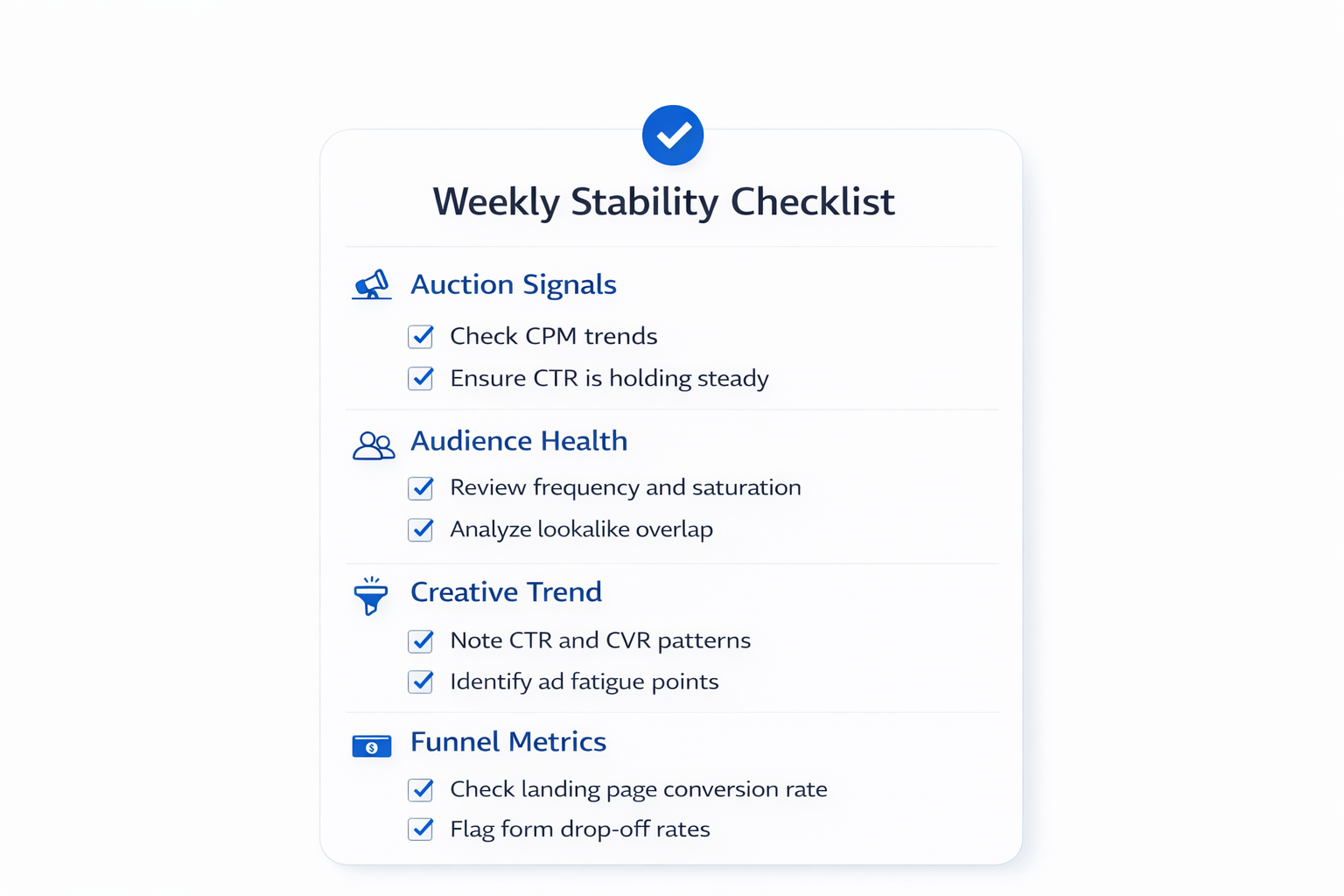
Prevention depends on rhythm. Random checks miss gradual decline.
Set a weekly review that covers auction pressure, audience health, creative trends, funnel metrics, and revenue impact together.
Focus on leading indicators, not just cost per lead. When small warning signs appear, act early.
Consistent structure keeps campaigns stable even when the market changes.