Traffic volume is easy to increase; traffic quality is not. Many campaigns fail at the scaling stage because early growth was driven by vanity metrics rather than real user value. According to industry benchmarks, campaigns that optimize for engagement and conversion signals before scaling achieve up to 60% higher long-term return on ad spend (ROAS) than those focused primarily on impressions or clicks.
High-quality traffic behaves predictably: users engage with content, explore multiple pages, and convert at consistent rates. Identifying these signals early allows marketers to invest budget where it compounds rather than leaks.
Core Metrics That Define High-Quality Traffic
1. Conversion Rate and Micro-Conversions
The most direct indicator of traffic quality is conversion behavior. Beyond final conversions (purchases, sign-ups), micro-conversions—such as newsletter subscriptions, product views, or time-on-page milestones—provide early validation.
Data from performance marketing studies shows that traffic sources with strong micro-conversion rates are 2.3× more likely to remain profitable after budget increases.
2. Engagement Depth
Quality users interact more deeply with your site. Key engagement indicators include:
-
Pages per session
-
Scroll depth
-
Session duration
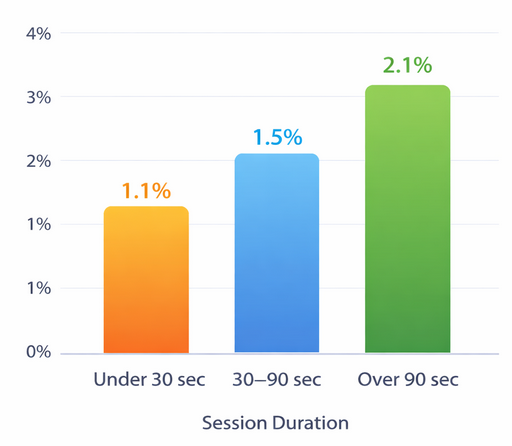
Conversion rate increases significantly as session duration grows, with sessions over 90 seconds converting nearly twice as often as those under 30 seconds
Research indicates that sessions lasting over 90 seconds convert at nearly double the rate of sessions under 30 seconds, even across different industries.
3. Cost Stability Under Small Increases
Before scaling aggressively, test modest budget increases (10–20%). High-quality traffic sources maintain relatively stable cost per conversion during these tests. If costs spike sharply, the traffic pool is likely shallow or poorly matched.
Segment Traffic Sources Before Judging Performance
Not all traffic from the same channel behaves equally. Segmenting by:
-
Audience type
-
Placement
-
Creative variant
-
Device or geography
reveals where quality truly comes from. Industry data suggests that the top 20% of segments often generate over 70% of total conversions, while the rest dilute performance metrics.
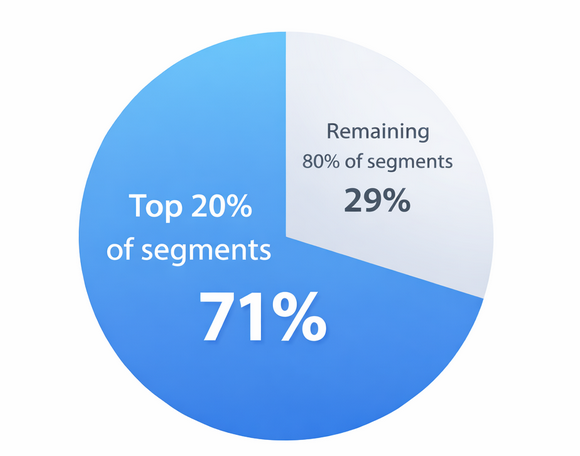
Top 20% of traffic segments are responsible for more than 70% of conversions, underscoring the importance of segment-level analysis
By isolating high-performing segments, you gain a clearer picture of which audiences are ready for scale.
Validate Traffic Quality Over Time
One-day performance spikes are misleading. High-quality traffic shows consistency across time windows:
-
Stable daily conversion rates
-
Predictable cost per acquisition
-
Repeat engagement patterns
Studies on campaign longevity show that traffic sources with stable 7–14 day performance are 45% less likely to collapse after scaling compared to sources evaluated on short-term results.
Common Signals of Low-Quality Traffic
Knowing what to avoid is as important as knowing what to scale. Red flags include:
-
High click-through rate paired with low engagement
-
Sudden volume spikes without proportional conversions
-
Rapid performance decay after minor budget increases
These signals often indicate curiosity-driven or mismatched audiences rather than genuine demand.
When Traffic Is Ready to Scale
Traffic can be considered scale-ready when it meets three criteria:
-
Consistent conversion performance over at least two weeks
-
Strong engagement metrics aligned with conversion behavior
-
Cost efficiency that remains stable during controlled budget tests
Campaigns that meet all three benchmarks statistically outperform early-scaled campaigns by 30–40% in cumulative profit over their lifetime.
Suggested Reading
To deepen your understanding of traffic evaluation and scaling strategy, explore these related articles:
-
Christmas and New Year Ad Creative Ideas That Don’t Look Like Ads
-
What to Do When Your Facebook Ads Aren't Reaching the Right Audience
Final Thoughts
Scaling is not about pushing more budget into what already exists—it is about amplifying what has proven to work. By identifying high-quality traffic through behavior, consistency, and cost stability, you reduce risk and increase the likelihood that growth remains profitable at every stage.