Getting people to buy once isn’t enough. If you want your business to grow, you need buyers to come back. That’s where customer lifetime value (CLV) comes in.
CLV is about how much revenue each customer brings in over time — not just on the first order. The higher your CLV, the more you can afford to spend on ads, and the more stable your business becomes.
Here’s how to increase CLV using better campaigns, smarter targeting, and post-purchase strategies that actually work.
What customer lifetime value really means
CLV shows how much one customer is worth over the entire time they buy from you.
It’s not the same as return on ad spend (ROAS) or conversion rate. It tells you who’s profitable long-term — and helps you avoid chasing one-time buyers who never come back.
Here’s why it matters:
-
You can spend more to get good customers. If someone spends $200 over time, you can afford to spend $50 to acquire them.
-
You’ll make smarter campaign decisions. CLV helps you see which ads bring in real buyers, not just clicks.
-
You’ll know which products bring people back. Some products naturally lead to repeat orders. Others don’t.
If you’re only looking at first sales, you’re missing the full picture. Learn why it’s smart to pair CLV with ROAS for better decision-making: Why you should pair ROAS with customer lifetime value (LTV).
Rethink how you run acquisition campaigns
Most brands try to lower their cost per purchase. But cheaper buyers aren’t always better buyers. Some churn right away.
Here’s what to do instead.
Focus on quality, not just cost
Stop chasing the lowest CAC. Instead, look for behaviors that signal high-value customers — even if they cost more to acquire.
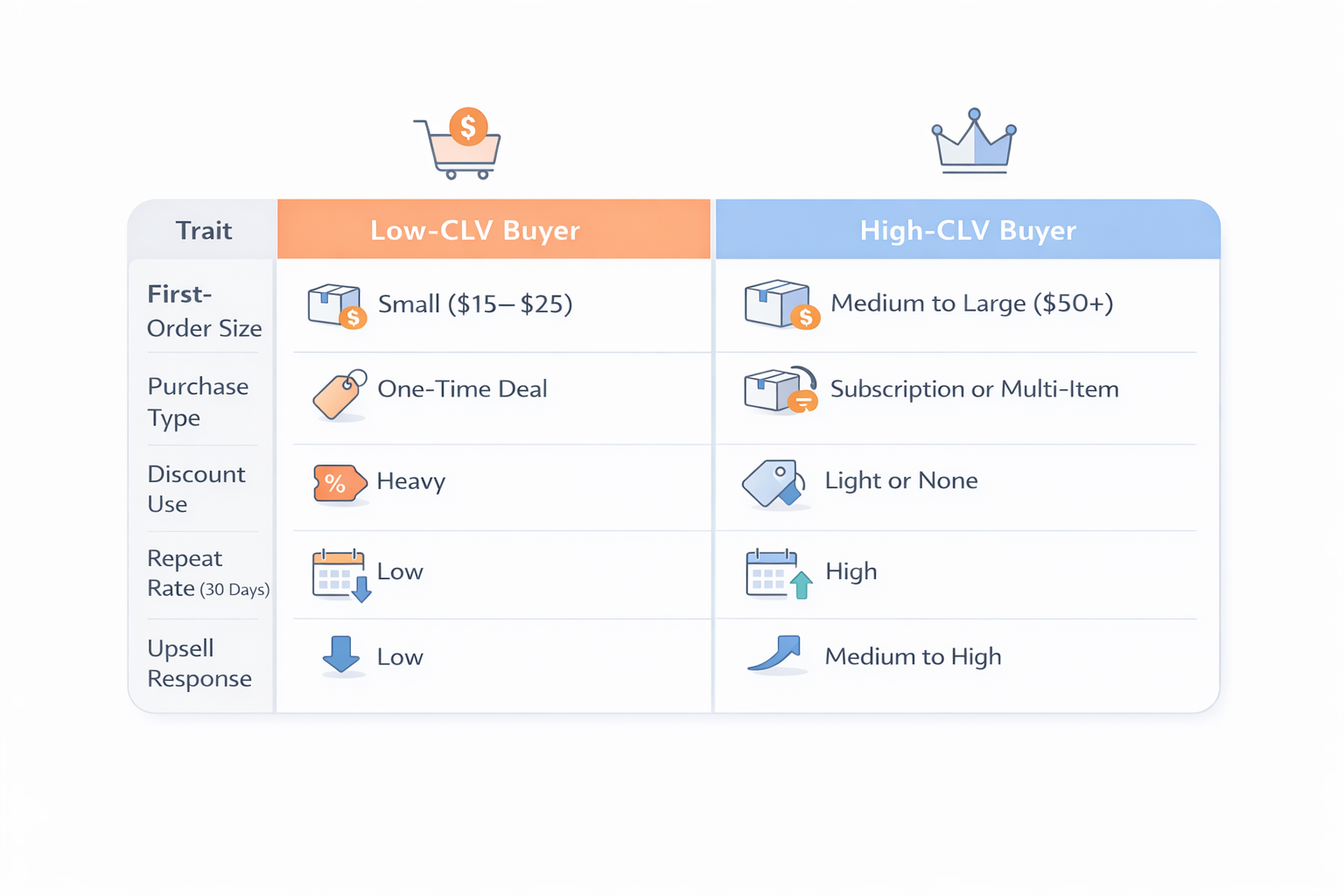
Look for people who:
-
Add more than one item to their cart;
-
Choose a subscription instead of a one-time purchase;
-
Come back within the first 30 days.
You can track these actions using Meta’s conversion API or pixel. Then, create custom events to optimize for depth, not just the first sale.
If your campaigns aren’t performing as expected, consider whether your audience quality is holding you back: Why some audiences never convert (and how to identify the right ones).
Use predicted values in your ad account
Not all customers are equal. Some are worth more from day one.
You can send Meta or Google a predicted value for each customer based on:
-
What they bought (e.g. subscriptions usually mean higher LTV);
-
How much they spent on the first order;
-
Whether they used a heavy discount.
Add these values to your conversion events. Platforms will start optimizing toward people more likely to stick with you.
To dive deeper into value-based optimization, explore: Lifetime value modeling for ad decisions.
Match your message to where users are
Everyone sees your ads at a different stage. Some are brand new. Others have already bought once or twice.
If you talk to everyone the same way, you’ll lose them. Tailor your message to where they are in the journey.
Use different messaging for cold, warm, and returning users
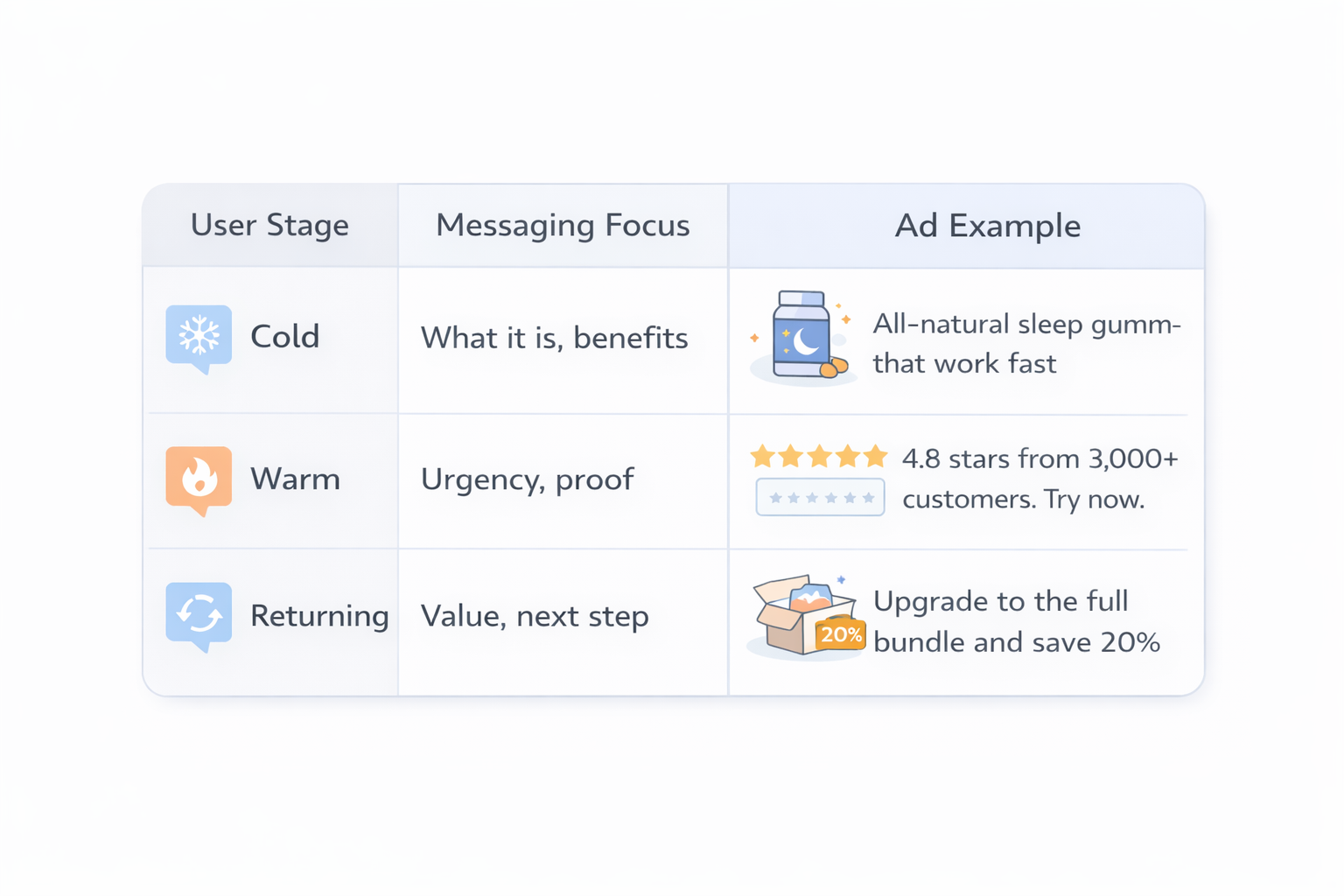
Here’s how to approach it:
-
Cold traffic: Explain the product clearly. Focus on what it is and why it’s helpful. Don’t assume they know anything yet.
-
Warm traffic: Get to the point fast. Use urgency (“Only 3 left!”) or highlight bundles and bestsellers.
-
Returning buyers: Remind them why they liked it. Suggest what to buy next. Offer loyalty perks or limited deals.
With dynamic ad tools, you can automate this shift based on behavior.
Want to learn how to retarget smarter — not harder? Retargeting strategies that double your ROAS.
Show the long-term benefit in your creative
Most ads only show the product once. But your best customers want to know how it works over time.
Here’s what to test:
-
A visual timeline (e.g. “Week 1, Week 4, Week 8” showing results);
-
Progress shots or before/after comparisons;
-
Ads showing real daily use (not just product shots).
Example: Instead of “Try our skincare set,” try “See how your skin improves in 30 days.”
It builds trust and sets expectations — which makes people more likely to stay.
Don’t forget about post-purchase campaigns
Getting a sale is only the start. What you do after the first purchase can double or triple a customer’s value.
Retarget your best buyers
People who already bought from you are more likely to do it again — if you give them a reason.
Set up campaigns that:
-
Remind them to reorder before they run out;
-
Show tips for using what they already bought (helps reduce churn);
-
Suggest upgrades or bundles they haven’t tried yet.
If you're not running post-purchase campaigns yet, here's why they matter: Why post-purchase ads drive higher LTV than discounts.
Repeat the value across every touchpoint
Use email, ads, and product pages to reinforce why your product is worth sticking with.
For example:
-
“Use this 3 times a week for best results.”
-
“Most customers subscribe after their first order — here’s why.”
-
“Loved your kit? Here’s what to try next.”
The goal is to keep reminding them that they made the right choice — and help them take the next step.
Measure what matters — over time
To really improve CLV, you need to know what’s working. Don’t just look at ad performance. Look at cohort data.
Group your buyers by:
-
Month they first purchased;
-
Campaign they came from;
-
Product they bought first.
Then track:
-
How many come back and how fast;
-
How much they spend in 30, 60, or 90 days;
-
Which channels bring the highest-value customers.
If you’re stuck measuring just clicks or cost per purchase, expand your view: How to analyze campaign performance beyond ROAS: the full funnel view.
Final thoughts
Most advertisers stop at the first sale. But the brands that grow? They keep the conversation going.
To boost your customer lifetime value:
-
Target behaviors that lead to repeat buyers, not just low-cost sales;
-
Tailor your message to where the customer is in their journey;
-
Show long-term value, not just short-term offers;
-
Keep customers engaged after the first purchase;
-
Use cohort data to guide better decisions.
The best-performing e-commerce brands don’t win on clicks. They win by making customers want to come back.