When you upload a customer list to Meta, not every record becomes a reachable user. The platform attempts to connect the identifiers in your file — such as email or phone number — with existing Facebook or Instagram accounts.
The percentage of records that successfully connect to real users is the match rate.
If the match rate is low, large portions of your customer data never enter the ad delivery system. That reduces retargeting reach and weakens the signals used to build lookalike audiences.
Understanding how matching works makes it much easier to improve results.
How Facebook Matches Customer Data
When you upload a list, Meta hashes the identifiers and compares them with hashed identifiers already associated with user accounts.
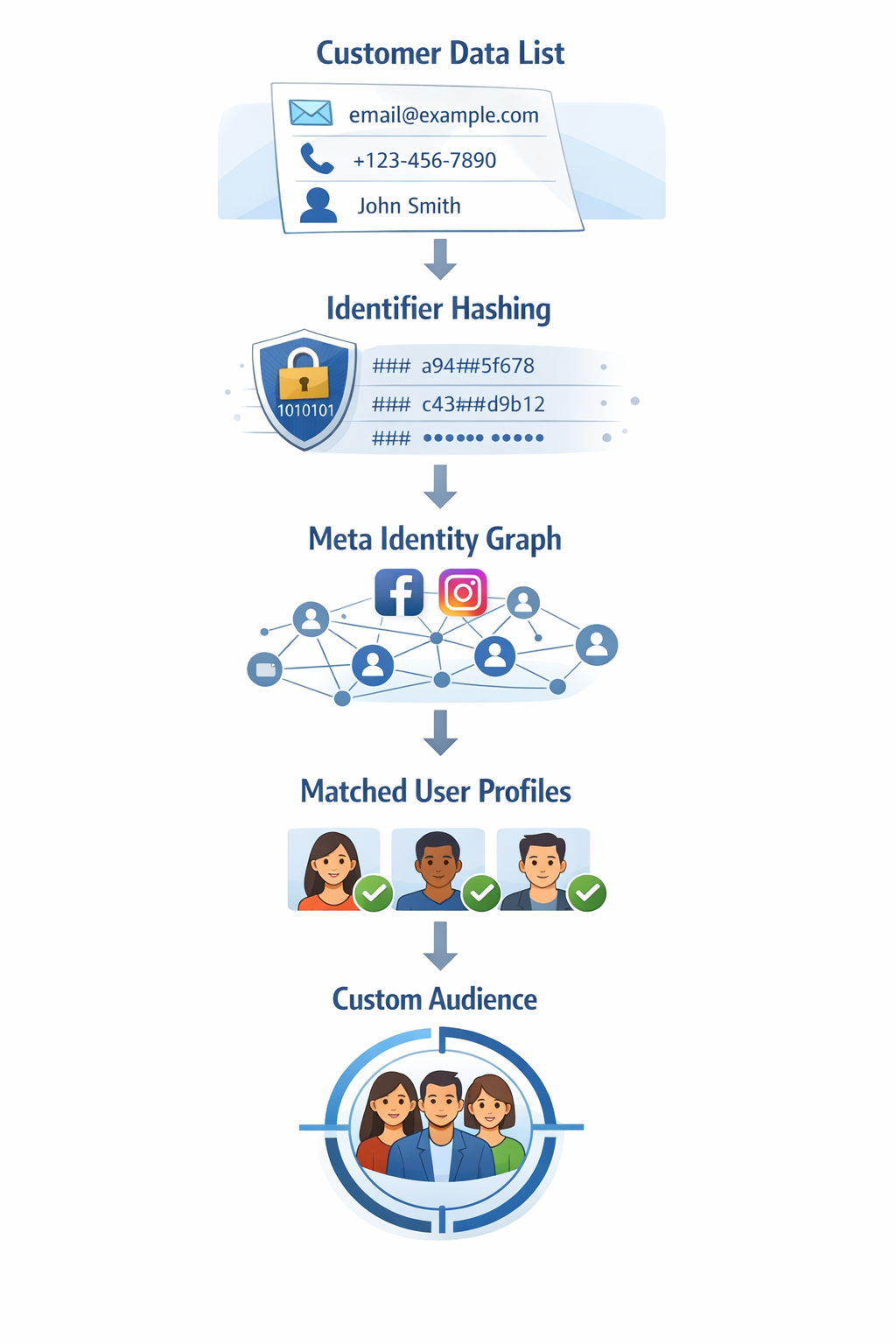
Several identity fields can be used during matching:
-
Email address.
Email usually produces the highest match rates because many users create their accounts using an email login. -
Phone number.
Phone numbers often serve as a secondary identity anchor, especially when formatted correctly with the international country code. -
First and last name.
Names rarely produce reliable matches on their own but improve accuracy when combined with stronger identifiers. -
Location data.
Fields such as city or ZIP code help confirm identity when other identifiers partially match.
Meta tests combinations of these identifiers during the matching process. A record containing multiple fields gives the system several ways to identify the user.
This is why strong datasets produce better audiences for both retargeting and lookalike modeling. If you want to understand how these audiences work in more detail, see Custom Audience – Why Should You Use It?
Why Custom Audience Match Rates Drop
Most low match rates come from issues in the underlying customer data rather than anything inside Ads Manager.
Missing identity signals
The most common problem is insufficient identifiers.
Many lead forms collect only an email address. If the user created their Facebook account with a different email or primarily uses a phone number, the system may fail to match the record.
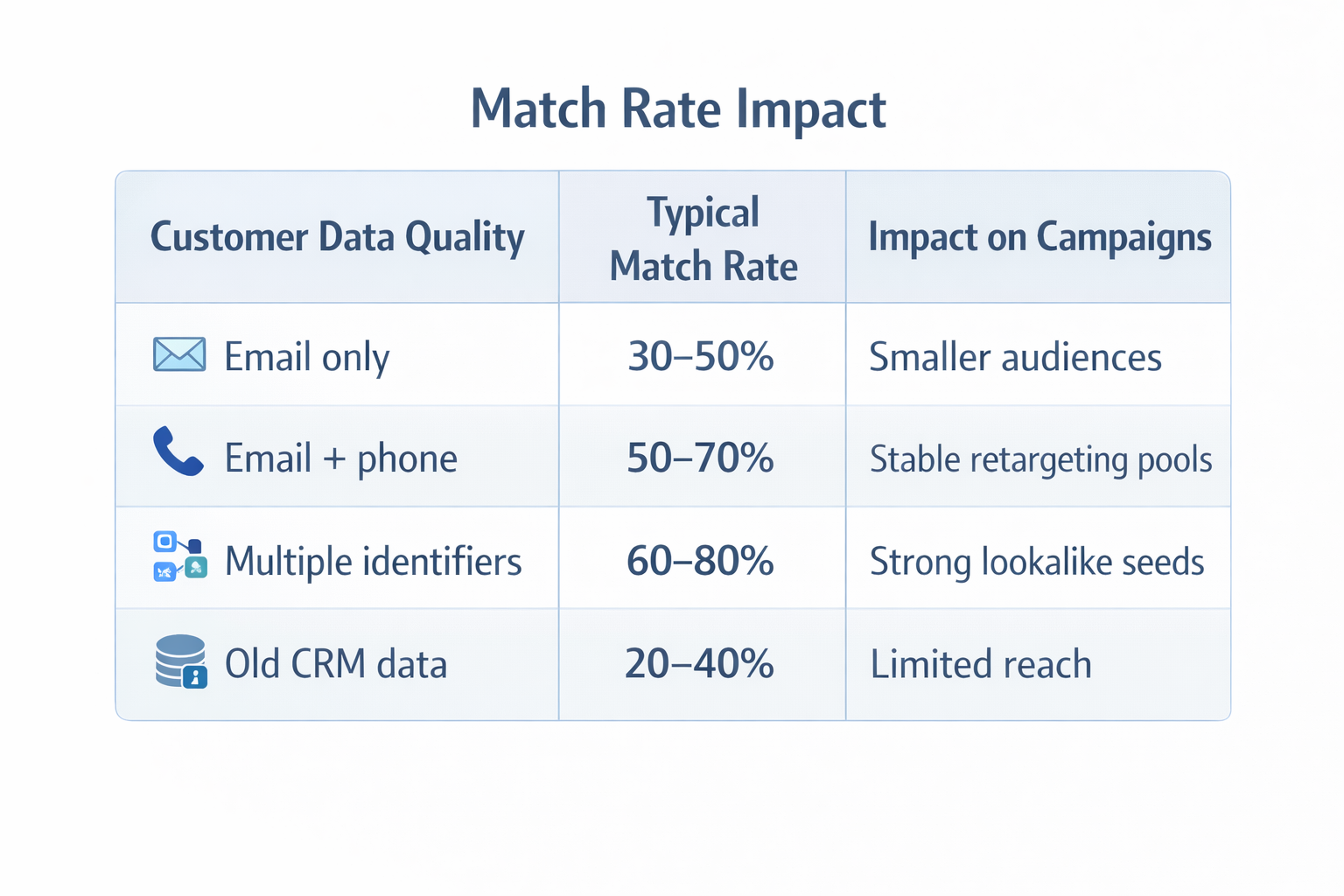
Stronger records usually contain multiple identifiers such as:
-
email address — the primary identity signal;
-
phone number — a secondary identifier linked to many accounts;
-
first and last name — confirmation data;
-
location fields — additional verification.
The more identifiers available in the same record, the higher the probability of a successful match.
Poor data formatting and hygiene
Match rates also decline when identifiers are uploaded in inconsistent formats.
Typical issues include:
-
phone numbers without country codes;
-
mixed formats such as
+1 555-123-4567and5551234567; -
trailing spaces in email fields;
-
inconsistent capitalization.
Platforms normalize identifiers before matching, but messy datasets still create avoidable failures.
Cleaning and standardizing the data — sometimes called data hygiene — can increase match rates significantly without collecting any new information.
Outdated customer data
Identity signals degrade over time.
Customers change email addresses, switch phone numbers, or create new accounts. Lists exported from older CRM databases frequently contain outdated identifiers.
Advertisers often notice this pattern when comparing segments:
| Customer Segment | Typical Match Rate |
|---|---|
| Recent buyers | 60–80% |
| Last 12 months customers | 45–60% |
| Older CRM records | 20–40% |
Recency matters because identifiers are more likely to still correspond to active accounts shortly after a user interaction.
How to Improve Facebook Custom Audience Match Rate
Improving match rate requires changes in both data collection and data preparation.
Capture multiple identifiers during user interactions
The biggest improvement usually happens during lead capture or checkout.
Instead of collecting only email, try to gather at least two identity signals whenever possible:
-
email address;
-
phone number;
-
first and last name.
When multiple identifiers align with a Meta account, the probability of a successful match increases dramatically.
For ecommerce brands, this may mean enabling phone collection at checkout. In lead generation campaigns, high-intent forms such as demo requests can include phone fields without significantly increasing friction.
Clean and standardize your dataset
Before uploading a list, normalize the identifiers.
Typical preprocessing steps include:
-
converting emails to lowercase;
-
removing extra spaces or special characters;
-
formatting phone numbers with country codes;
-
separating first and last name fields.
Even small formatting fixes can recover thousands of matches in large datasets.
Upload identifiers within the same record
Meta performs best when multiple identifiers appear in the same row.
Example structure:
| Phone | First Name | Last Name | |
|---|---|---|---|
| user@example.com | +15551234567 | Sarah | Miller |
When identifiers appear together, the matching system can test different combinations.
Uploading separate lists — one with emails and another with phone numbers — removes this advantage.
Prioritize recent customer data
Match rates decline as lists age.
When building Custom Audiences, segmenting by recency often improves both match rate and campaign performance.
Recent purchasers or leads typically produce stronger results because their identifiers are more likely to match active accounts.
These audiences also perform better in retargeting campaigns. If you want to explore how retargeting audiences are structured, see How to Set Up Facebook Retargeting.
Why Match Rate Matters for Lookalike Audiences
Match rate also affects the quality of lookalike audiences.
Lookalike models analyze the behavior of matched users and attempt to find similar profiles across the platform. When the seed audience contains fewer matched users, the model learns from a smaller dataset.
This can lead to:
-
broader targeting patterns;
-
weaker behavioral similarity;
-
slower campaign scaling.
Understanding the relationship between seed audiences and lookalike quality is essential for scaling campaigns effectively.
How Match Rate Affects Retargeting Campaigns
Low match rates also reduce the size of retargeting audiences.
Imagine uploading a list of 100,000 past customers.
If only 35% match, your usable audience shrinks to about 35,000 users. Frequency increases quickly, and campaigns start competing for the same impressions.
Inside Ads Manager, you may notice:
-
frequency climbing above normal levels;
-
CPM increasing over time;
-
conversion rates slowly declining.
This pattern often appears in campaigns where the matched audience pool is too small. In those cases, improving match rate can restore both reach and efficiency.
The Practical Takeaway
Custom Audience match rate is fundamentally an identity resolution problem.
Meta cannot target users it cannot reliably connect to an account profile. When identifiers are weak, inconsistent, or outdated, large portions of customer data never enter the ad delivery system.
Improving match rate usually comes down to three operational changes:
-
collect stronger identity signals during user interactions;
-
maintain clean and standardized customer data;
-
send multiple identifiers together in each record.
When these elements are in place, Custom Audiences become larger, lookalike seeds become more accurate, and Meta’s optimization system receives stronger signals for campaign delivery.