A stable paid campaign doesn’t mean metrics never move. It means your results stay within a manageable range week to week, so you can:
-
Forecast spend and outcomes with confidence
-
Identify real wins (not short-lived spikes)
-
Make improvements without resetting performance
Instability usually shows up as sudden CPA spikes, volatile ROAS, inconsistent daily volume, or performance that improves after a change and then collapses.
The root cause is often simple: the system is constantly re-learning because inputs keep shifting (budget, targeting, creatives, conversion signal, placements), or there isn’t enough conversion data to optimize consistently.
The biggest sources of instability
1) Not enough conversion volume to “settle”
Most delivery systems need consistent conversion feedback to find and keep efficient pockets of inventory. When volume is low, small variations in who sees the ad can swing results dramatically.
A widely cited benchmark for many conversion-optimized social ad sets is needing about 50 optimization events within a 7-day window to exit the most volatile learning period and stabilize delivery (industry analyses summarizing platform guidance: Lebesgue, LSEO, Code3).
2) Too many edits, too often
Frequent changes (even well-intended) can create a loop: performance dips → you edit → the system re-tests → performance fluctuates → you edit again.
3) Audience saturation and ad fatigue
Even with perfect setup, audiences tire of repetitive messaging. That doesn’t just lower CTR—it can reduce purchase intent.
-
In a 2024 survey summarized by MediaPost, 61% of respondents said they’re less likely to buy when they see the same ad “back to back,” and 49% said they’ve decided not to purchase because they see repetitive ads too often.
-
RTB House reported that people who saw an ad 11+ times were 4.2% less likely to buy than those who saw it 6–10 times—a clear example of diminishing returns at higher frequency.
4) Weak measurement signals
If your conversion tracking is delayed, incomplete, or inconsistent, optimization becomes noisy. That noise shows up as volatility.
5) Fragmented structure
Too many campaigns/ad sets split the same budget and data into thin pools. Thin pools learn slowly and swing more.
A stability-first operating system (step by step)
Step 1: Define your “stability window”
Pick the time horizon that will govern decisions.
-
Daily: use for pacing and anomaly detection
-
3–7 days: use for optimization decisions
-
14–28 days: use for judging structural changes and creative strategy
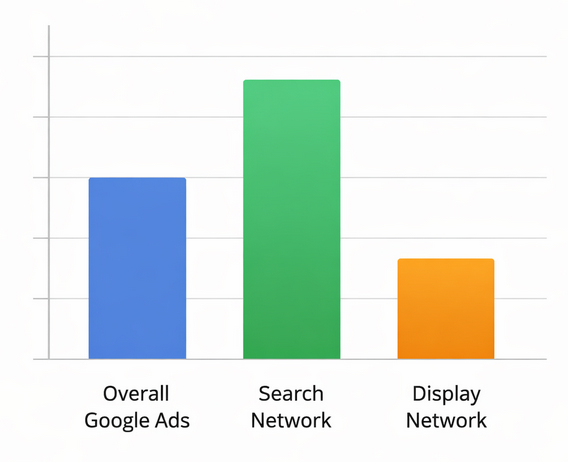
Average conversion rates differ substantially by campaign type, showing why careful structuring and optimization matter for stable paid performance
Stability improves fast when you stop reacting to single-day noise.
Action: Create a rule: “No major decisions on 1-day data unless there’s a tracking outage or spend anomaly.”
Step 2: Consolidate to concentrate learning
If you’re splitting similar audiences, creatives, and goals across multiple small ad sets, you’re paying for volatility.
Stability wins from consolidation:
-
More conversion events per delivery unit
-
Faster learning
-
Fewer “random” swings driven by low sample size
Action checklist:
-
Merge ad sets that target the same intent level and optimize for the same conversion event
-
Avoid duplicating audiences across multiple ad sets unless you have a clear testing purpose
-
Keep one primary campaign per objective when possible, then segment with creatives and messaging—not excessive structure
Step 3: Make changes like a pilot, not a mechanic
Most instability is “self-inflicted” by editing too much at once.
Stability rule: One major variable at a time.
If you change budget, audience, and creative together, you won’t know what caused the result—and you increase the chance of re-learning turbulence.
Action: Create a change log
Track every meaningful edit with:
-
Date/time
-
What changed (budget, targeting, creative, bid, optimization event, placements)
-
Expected impact
-
When you’ll evaluate (e.g., after 3 full days)
This alone can reduce instability because it prevents rapid, repeated interventions.
Step 4: Control budget volatility with pacing and guardrails
Big budget swings create big delivery swings.
Stability tactics:
-
Scale in smaller increments on a consistent schedule (e.g., every 48–72 hours)
-
Use spend caps or pacing rules so the system doesn’t over-deliver on a single day
-
Separate “testing” budgets from “scaling” budgets so experiments don’t disturb the engine that pays the bills
Practical guardrails:
-
If CPA is rising but volume is stable, don’t immediately cut budget; first diagnose frequency, placement shifts, and creative fatigue
-
If volume is collapsing, check learning status and conversion signal integrity before changing targeting
Step 5: Build a creative system that prevents fatigue
Stability requires creative freshness—not constant reinvention, but planned variation.
A stability-friendly creative rotation:
-
Maintain a “core set” of proven creatives that run continuously
-
Add new creatives on a schedule (weekly or biweekly)
-
Retire only when performance degradation is consistent across the stability window (3–7 days), not on a bad day

Engagement tends to decline after a few repeated exposures to the same creative, underlining the need for planned rotation
Because fatigue can reduce purchase likelihood and increase resistance to your messaging, it creates “mystery volatility” that looks like algorithm changes but is often simply repetition.
Action: Adopt a simple rotation rule
-
Always keep at least 3–5 distinct creatives live per major audience segment
-
Refresh at least 20–30% of creative inventory each cycle
-
Monitor frequency and performance by frequency tier (e.g., 1–2, 3–5, 6–10, 11+)
Step 6: Manage frequency before it becomes a problem
Frequency isn’t inherently bad—but uncontrolled frequency can produce unstable results because performance decays unevenly across pockets of the audience.
What to watch:
-
CTR and CVR trends as frequency increases
-
CPM rising while CTR falls (a common fatigue signature)
-
CPA rising while clicks remain stable (often post-click fatigue or misalignment)
Remember: higher repetition can reduce purchase intent—survey and performance research consistently show negative effects when exposure gets too repetitive.
Action options:
-
Expand audiences (broader targeting, larger lookalikes, additional geos)
-
Add creative variety (new hooks, formats, angles)
-
Adjust sequencing (prospecting creative differs from retargeting creative)
-
Use frequency controls where available (especially in awareness/retargeting contexts)
Step 7: Strengthen the conversion signal
You can’t stabilize what the system can’t “see.”
Signal-strength checklist:
-
Verify event firing consistency (browser + server where applicable)
-
Ensure key events aren’t delayed or missing (especially purchase and lead events)
-
Align optimization event with true business value (not just top-funnel clicks)
-
Reduce friction on landing pages to lower randomness in post-click conversion
Action: Run a weekly tracking audit:
-
Compare platform-reported conversions vs. analytics/CRM counts
-
Watch for sudden drops that coincide with site changes, tag updates, or consent changes
Step 8: Separate “exploration” from “exploitation”
Stability improves when you stop forcing your main campaigns to do two opposite jobs:
-
Exploration: testing new ideas
-
Exploitation: harvesting predictable results
Recommended structure:
-
A dedicated testing campaign (small budget, controlled experiments)
-
A scaling campaign (stable budgets, stable audiences, gradual creative updates)
Action: Put new creatives through a testing lane first. Promote winners into the scaling lane.
Step 9: Use an evaluation framework that prevents overreacting
Stability requires decision rules.
A simple framework:
-
If CPA worsens for 1–2 days, do nothing unless there’s a tracking or spend anomaly
-
If CPA worsens for 3–7 days, check: frequency, creative fatigue, placement shifts, and signal integrity
-
If CPA worsens for 14+ days, consider structural changes (consolidation, new audience strategy, offer changes)
Stability checklist you can implement this week
-
Pick a stability window (3–7 days) and stop reacting to daily noise
-
Consolidate fragmented ad sets to concentrate conversions
-
Log changes and limit to one major variable at a time
-
Scale budgets gradually and on a schedule
-
Maintain a creative rotation plan to prevent fatigue
-
Track performance by frequency tiers and intervene early
-
Audit tracking weekly to protect optimization signal quality
-
Split testing and scaling so experiments don’t destabilize production spend